An underground tunnel has been uncovered beneath an old residence once owned by the Dighapatia Zamindar family in Rajshahi.
The hidden passageway came to light on Tuesday as the structure was being torn down, according to Mahabub Siddiqui, founder of the heritage group Heritage Rajshahi.
The property was originally built by Sandeep Kumar Roy, son of Raja Hemendra Kumar Roy of Dighapatia. The grounds contain two single-storey buildings on either side, a two-storey structure at the back, and a large tree at the front.
Additional Deputy Commissioner (Revenue) Mohinul Islam confirmed that the property is classified as vested land. Since it had deteriorated significantly, the district administration auctioned it off for Tk 1,52,000. The tunnel was discovered once the new owner began demolition.
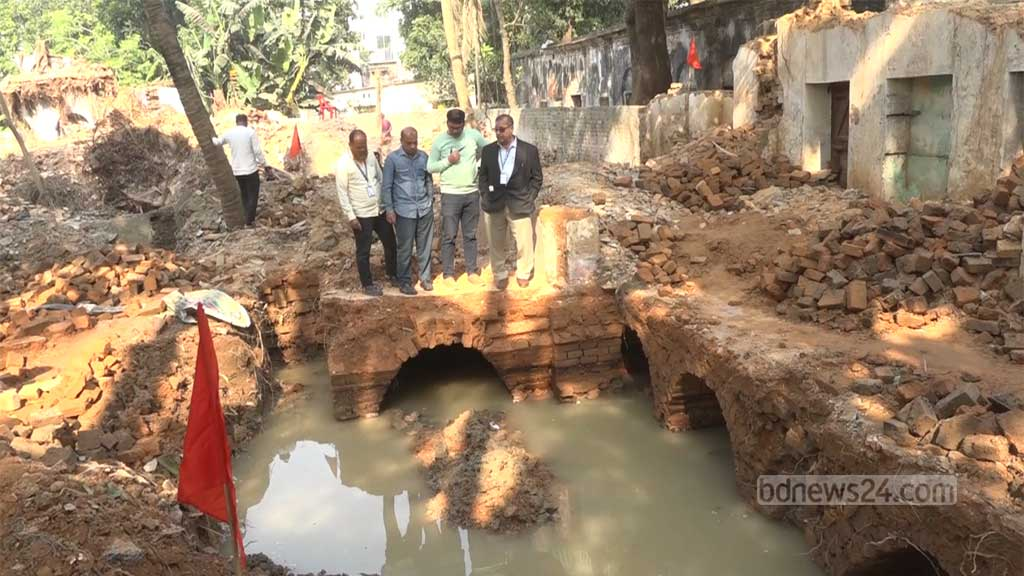
Water pooled inside the passage has since been drained, and pumps have been set up to accelerate the process. Early observations suggest the tunnel may branch off into another hidden corridor.
Poet and researcher Tasikul Islam criticised the decision to auction the site without first evaluating its archaeological importance.
He explained that after Bangladesh’s independence, the government had leased the property to language movement activist Monwara Rahman, who ran a women’s crafting centre there. Her husband, M Ataur Rahman—a key figure in the anti-British movement, the Tebhaga movement, and the Liberation War—also lived in the house, as did educator ANM Saleh.
Mahabub called the demolition “deeply regrettable,” stressing the historical value of the Dighapatia Zamindar family.
“There should have been consultation with historians before reaching such a decision,” he said.

He added that letters have already been sent to the assistant commissioner and the Department of Archaeology. If the tunnel proves to have archaeological significance, the site may be protected.
A five-member team has inspected the tunnel at the district administration’s request, said Khondaker Shamsul Arifin, deputy registrar of the Varendra Museum.
“We’ve taken several photographs and will now report to our officials. They will determine whether the site merits preservation,” he said.
Arifin believes the tunnel likely dates to the British colonial era, possibly built as a cooling system for the house. He noted that similar subterranean structures have been found elsewhere in the region.