Archaeologists in Trøndelag, Norway, have uncovered a Viking-age burial that raises intriguing questions about pre-Christian practices.
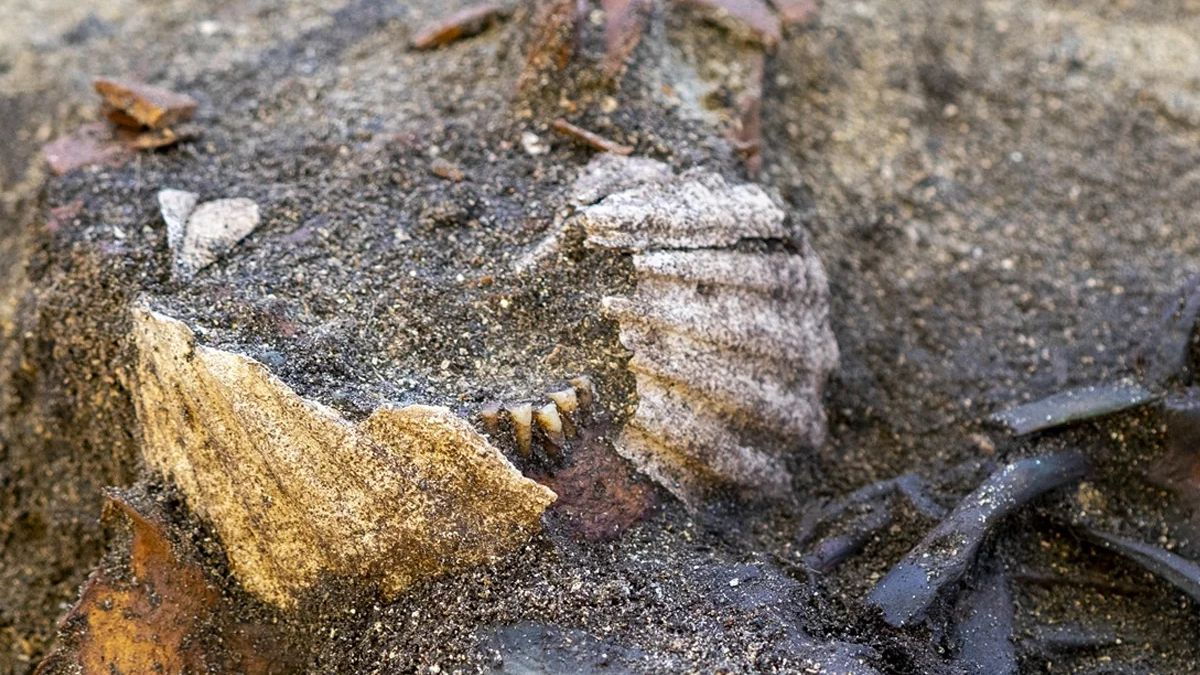
The exceptionally preserved grave contains a woman interred with two scallop shells carefully positioned near her mouth—a detail not previously recorded in Norwegian pre-Christian burials.
Raymond Sauvage, an archaeologist at the Norwegian University of Science and Technology (NTNU), highlighted the uniqueness of the find: the use of scallop shells in this context is unprecedented, and the symbolic meaning behind the placement remains unknown.
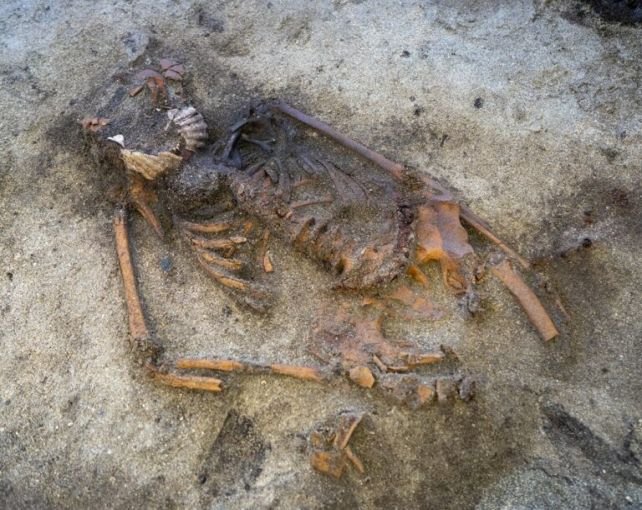
The woman's remains.
The Viking-age burial in Bjugn, Trøndelag, has yet to be fully described in a scientific publication, but an initial catalog of its contents adds to the mystery of the scallop shells.
The grave was first hinted at when metal detectorist Roy Søreng found a bronze brooch typical of the Viking period while exploring a field. He and the landowner, Arve Innstrand, informed the NTNU Museum and Trøndelag County Council, prompting experts to investigate.
Excavations revealed the remains of a Viking-age woman a rare find given that Norway’s acidic soils usually destroy human remains over time. Despite some degradation, archaeologists identified key items buried with her, including two oval brooches once fastened to her dress straps and a ring buckle used to secure her petticoat.
“The Viking-age grave seems to belong to a woman buried with a typical 9th-century costume and jewelry set,” Sauvage explains.
“This suggests she was a free and probably married woman, perhaps the mistress of the farm.”
The scallop shells are unprecedented. They were placed on either side of her jaw, outer sides facing outward, hinges toward her cheekbones, and ventral edges near her neck.
The grave also contained carefully arranged bird bones, likely from wings—a type of burial inclusion with some precedent, such as a 6,000-year-old Danish burial where a newborn was laid atop a swan’s wing.
Although scallop shells have symbolic meanings in various cultures, none are known in 9th-century Scandinavia. In Greek and Roman times, they were linked to Aphrodite/Venus, representing fertility and femininity, while by the 11th century they became Christian symbols of pilgrimage—too late to apply to this burial.
Shells have appeared in other ancient burials far from the sea, such as Neolithic and Bronze Age Poland, where bivalves like Spondylus symbolized wealth, status, and long-distance connections. The careful placement of the shells in this grave suggests they held meaning for the people who buried her.
Researchers are now studying the woman further, aiming to determine any connection to an earlier burial from the 700s found in the same field.
“We will examine the skeleton, preserve the objects, and take samples for dating and DNA analysis,” Sauvage says.
“The goal is to learn more about the person and her possible kinship to the previous find from the same location.”
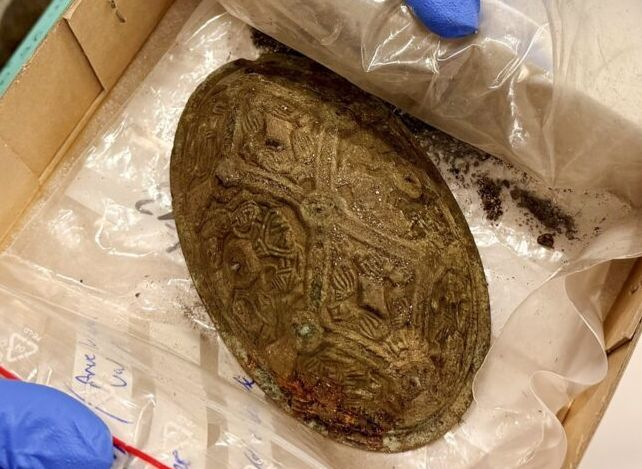
One of the two oval brooches.