Cleopatra’s story is often framed through drama, romance, and spectacle, with her reign marking the final chapter of pharaonic Egypt. Yet her status as the iconic “female pharaoh” tends to overshadow an earlier and arguably more revealing example of women wielding supreme power in ancient Egypt.
More than 1,400 years before Cleopatra, another woman ruled Egypt as pharaoh within one of the most conservative political systems of the ancient world. Her name was Hatshepsut.
Speaking on the HistoryExtra podcast, Egyptologist Campbell Price explains why Hatshepsut’s reign is crucial to understanding how authority functioned in ancient Egypt, and how her rule helped shape the path for later leaders.
An ancient civilisation with a deep past
Hatshepsut ruled from approximately 1479 to 1458 BC, nearly fifteen centuries before Cleopatra’s death in 30 BC. Her power base was Thebes in southern Egypt, then the kingdom’s political and religious centre. From there, she governed an expansive and stable state that stretched from the Nile Delta in the north to deep into Nubia in the south.
“Hatshepsut belongs to the Eighteenth Dynasty,” Price explains, “the first of several dynasties that make up what Egyptologists call the New Kingdom.”
Yet by this time, Egypt was already an ancient civilisation. It had passed through multiple phases of development, including the Old Kingdom.
“The Old Kingdom is the age of the pyramids,” Price notes. “By Hatshepsut’s reign, the pyramids were already about a thousand years old.”
Hatshepsut therefore inherited a civilisation with a long and complex history—one that had endured periods of war, fragmentation, collapse, and foreign domination during the Second Intermediate Period. In such a world, kingship existed to uphold cosmic order and prevent chaos in a society that understood how fragile stability could be.
This was not a culture inclined toward experimentation in power.
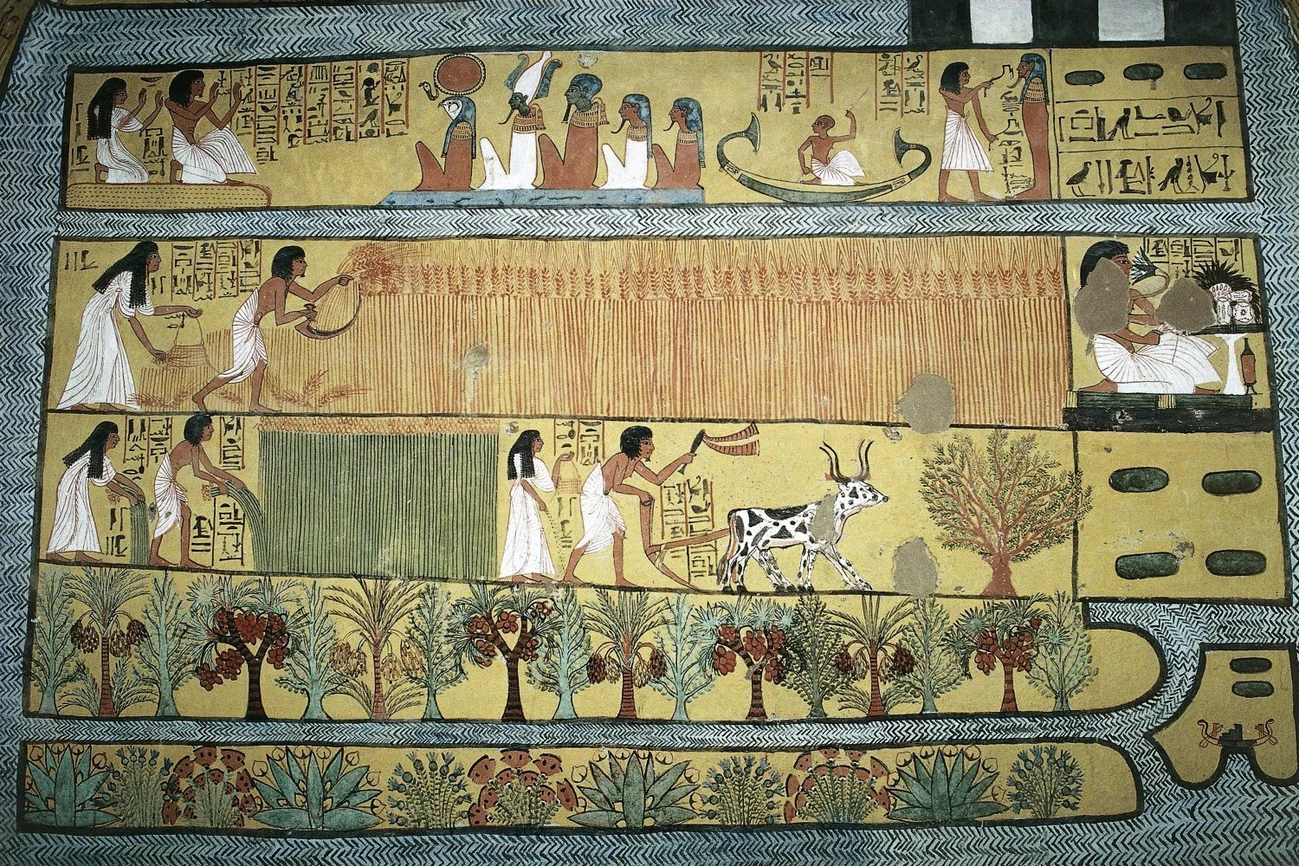
This fresco from the tomb of Sennedjem at Deir el-Medina depicts agricultural labour in the Fields of Ialu – the Egyptian paradise of the afterlife. Painted during the New Kingdom’s 19th Dynasty, the scene reflects the belief that eternal life mirrored the best aspects of earthly existence, with abundant harvests promised to the righteous.
What it meant to be an ancient Egyptian pharaoh
Ancient Egyptian pharaohs were expected to uphold maat—the principle of balance, justice, and cosmic order. The ruler acted as a mediator between the gods and humanity, commanded armies, and symbolically embodied the state of Egypt itself. The visual and ideological language of kingship was highly fixed and explicitly masculine.
While royal women in ancient Egypt could wield significant political and religious influence, formal kingship was almost exclusively male. Before Hatshepsut, no woman had ruled for an extended period as a fully recognised pharaoh in her own right. Queens often served as regents, particularly when an heir was still a child, but assuming full royal authority meant crossing a deeply entrenched cultural boundary.
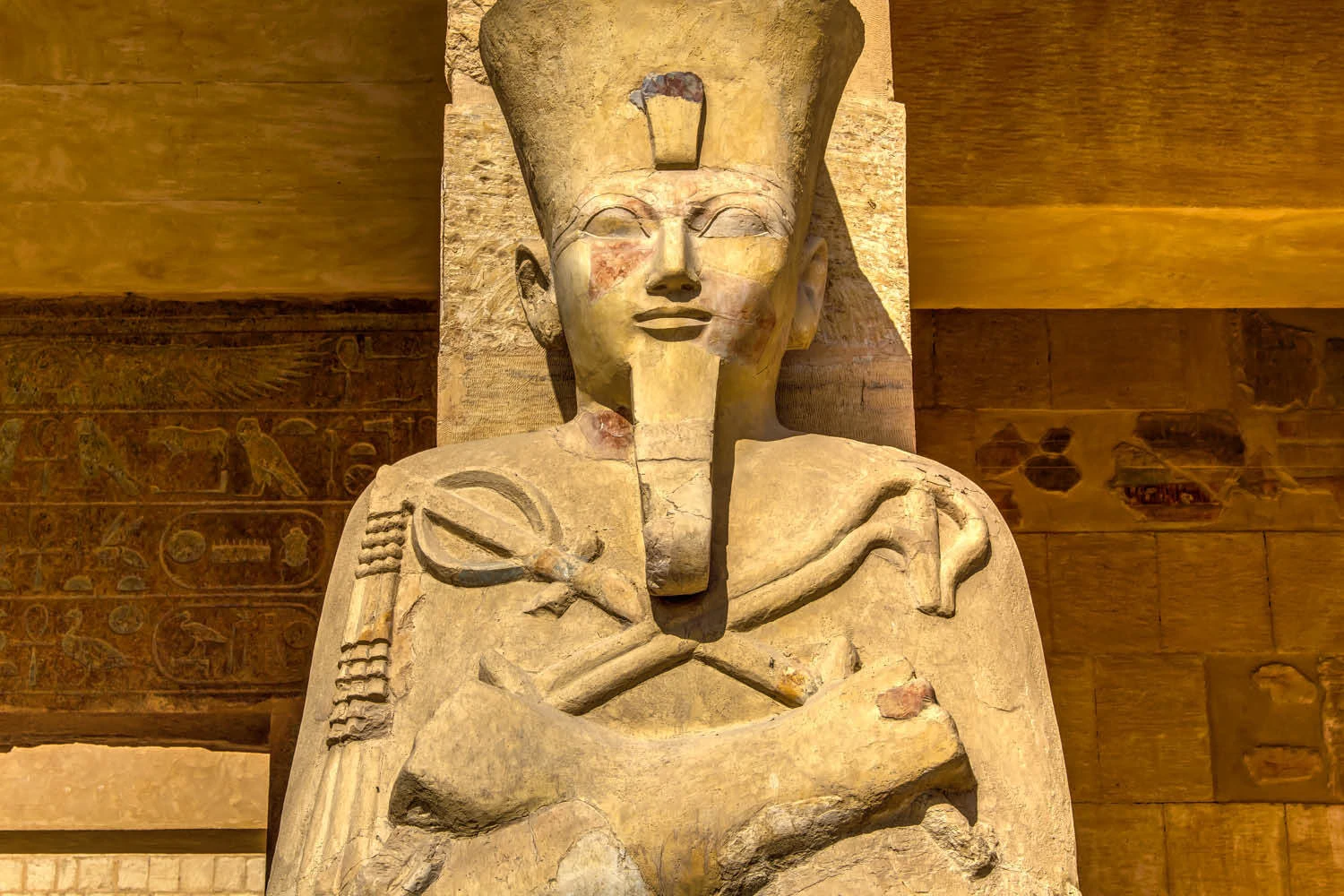
This context explains why Hatshepsut was depicted in what scholars describe as “male-coded” imagery, according to Price.
“It’s not that Hatshepsut is dressing up as a man,” he explains. “Rather, the only way to be represented as a legitimate pharaoh was through a male form. That is how kingship was visually expressed, and that is how she had to appear in statues and reliefs.”