In the following video we will be exploring a1600-year-old ancient structure hidden underwater. Watch the video to find out!
Researchers Stumbled Across A Priceless Egyptian Find – And It Solved A Globe Spanning Mystery
It seemed like just another day for researchers at Los Angeles’ Getty Research Institute. But then one individual stumbled across a set of images that would see the team collaborating with experts on the other side of the world. They rapidly became part of a shared investigation into the same strange puzzle – and it all focused on the death cults of Ancient Egypt.
The Titanic Mummy: The Truth Behind the Legend
On April 15th, 1912, four days into her maiden voyage from Southampton to New York City, the Titanic – the unsinkable ship – sank In the North Atlantic Ocean. The ship hit as iceberg at 11:40pm on Sunday, April 14th and by 2:20am the following day, she was gone.
More than 1,500 people lost their lives whilst the survivors were eventually picked up and taken to America, where their stories were published in local and national press.
But on May 12th 1912, less than a month after the Titanic sank, the Washington Post ran this peculiar headline: “Ghost of the Titanic. Vengeance of Hoodoo Mummy Followed Man Who Wrote Its History.”
The associated article starts by asking:: “Was the avenging spirit of an Egyptian priestess who died in the holy city of Thebes 1,600 years before the birth of Christ present upon the Titanic, pursuing with immortal malevolence those who had desecrated her tomb and her memory?”
It's a bizarre claim in a major newspaper less than a month after the disaster, a claim that has been exaggerated and elaborated more and more over the past century. In this video we will uncover the truth behind the legend and find out if there was cursed mummy on board the Titanic.
The Mysterious Tribes of Northern Britain
The Celts of Great Britain are an enigmatic group, whose Celtic language and Celtic culture have fascinated many people for centuries, both within England, Scotland, and Wales, and in the outside world.
The history of these Celtic tribes is often left unsaid, but this video aims to change that. Here I will show a brief overview of the Britons and their Brythonic tribes in the north of Great Britain, tying them into English history, Scottish history, and even showing their connections to the history of Wales.
The tribes being discussed in this video include, in England: the Brigantes, with their queen Cartimandua, king Venutius, and king Vellocatus, the Gaul-connected Parisii, the enigmatic Gabrantovices and Sentantii, the mysterious Carvetii of Northern England, and the barely-mentioned Lopocares, Tectoverdi, and Corionototae.
In Scotland, the Celtic tribes include the wealthy, Roman-favoured Votadini (later Gododdin of Welsh poetry), the rebellious Selgovae, and the less-mentioned Novantae and Damnonii in the south-west. While to the north, in Caledonia, they will include the Epidii, Creones, Carnonacae, Caerenii, Cornavii, Lugi, Smertae, Decantae, Vacomagi, Taezali, Venicones, and finally the puzzling Caledonii.
Göbekli Tepe - The First Temple On Earth? 10,000 BC
Göbekli Tepe, located in modern-day Turkey, is an archaeological site of significant importance due to its immense age and sophisticated structure. It dates back to the 10th millennium BC, making it one of the oldest known megalithic structures in the world. The site consists of a series of circular and oval-shaped structures set atop a hill, with large T-shaped stone pillars that are decorated with intricate carvings of animals and abstract symbols.
The question of whether Göbekli Tepe is the "first temple" on Earth depends on the definition of what constitutes a temple. If a temple is defined as a structure dedicated to religious or ritual activities, then Göbekli Tepe could indeed be considered one of the earliest, if not the earliest, known examples of such a site. The complex nature of the site, with its apparent lack of domestic use, suggests that it was used for ceremonial or religious purposes rather than as a dwelling or a defensive structure.
The discovery of Göbekli Tepe has challenged traditional ideas about the development of complex societies. Prior to its discovery, it was widely assumed that the construction of monumental religious buildings began after the advent of agriculture and settled life. However, Göbekli Tepe predates the known development of agriculture, which suggests that religious belief systems and ritualistic practices could have been a driving force in the organization of communal efforts and social stratification, possibly even contributing to the later development of settled agricultural societies.
It is important to note that Göbekli Tepe is just one of many significant archaeological sites around the world, and new discoveries could potentially alter our understanding of the history of religious structures. Nonetheless, with current knowledge, Göbekli Tepe stands out as a site of remarkable antiquity, providing valuable insights into the spiritual lives of the early hunter-gatherer societies at the end of the last Ice Age. Its unique features and early date certainly make it a prime candidate for being one of the first temple-like structures known to us, marking an important phase in the development of human societies.
Leonidas & The 300 Spartans Documentary
In today’s documentary we will be saying the story of Leonidas and the 300 Spartans. Watch the video below to find out more!
The First Sundaland People - The Negrito People of Southeast Asia
In the following video we will be talking about the first Sundaland People, the Negrito People of Southeast Asia. Watch the video to find out more!
Archaeologists are Afraid to Open The Tomb of China's First Emperor Because of Traps
Even 2,200 years after his passing, avoid tampering with Qin Shi Huang.
In an ordinary field in the Shaanxi province of China, farmers made one of the most significant archaeological discoveries of all time in 1974. They unearthed pieces of a clay human figure while digging. Simply put, this was the tip of the iceberg.
The field was discovered to be perched above a number of pits that were crammed with thousands of life-size terracotta figurines of soldiers and war horses, as well as acrobats, esteemed officials, and other creatures.
Then, according to reports, he wrapped himself around a 2,000-year-old Chinese warrior statue, took a photo, and snapped off its thumb as a memento.
We can only presume that alcohol was consumed in some form.
A week later, museum workers reported the missing digit. Rohana was identified as the perpetrator by the FBI using surveillance footage. Why? In part because Rohana's thumbprints were all over the crime scene. sitting above a series of pits filled with tens of thousands of life-size terracotta replicas of soldiers and war horses, not to mention acrobats, prestigious officials, and other creatures.
The Affidavit claims that on January 23, federal officers visited Rohana's home. He displayed the missing finger, which is worth more than $5,000 and was hidden in a drawer for almost three weeks, to the authorities.
New Archaeological Discoveries Challenge Theory of Human Evolution in Africa
At the Dawn of the Stone age, hominins commenced the production of stone tools, and they began the transition from being mere animals engaged in the pursuit of other animals to becoming human. Newly Discovered Fossils Raise Major Doubts About Out of Africa Theory. Similar to Homo naledi in South Africa, the hobbit is a hominin characterized by its diminutive physical stature and limited cranial capacity, distinguishing it from the large-brained human species. In fact, they are not considered "human" although the species is placed in our genus. The presence of fire usage by the Hobbit lacks empirical evidence, albeit this is subject to ongoing debate.
Indeed, throughout an extensive period spanning hundreds of thousands of years, early human populations sustained themselves by relying on simple stone tools. Their sustenance was likely obtained through a combination of hunting and scavenging for the remains of deceased animals. Notably, the tools employed by these ancient humans were relatively basic, consisting primarily of rudimentary blades crafted from stone that had been skillfully chipped to achieve razor-sharp edges. Lee Berger, Chris String, Stefan Milo have commented on this topic as well.
However, recent evidence indicates that mysterious early human populations traversed significant portions of the Earth, long before the previously established timeline. This predates the existence of modern humans by a significant margin, far preceding their emergence in history. The discovery implies that there were multiple instances in which ancient humans migrated out of the Cradle of Africa, although the outcomes of these migratory events were not uniformly successful.
For example, The diminutive Indonesian hominin is postulated to have originated from a lineage that departed from Africa, approximately 2 million years in the past. The current understanding of the enigmatic Homo floresiensis, commonly referred to as the hobbit, has once again undergone a significant revision. Recent research indicates that the diminutive hominin species underwent evolutionary development, originating from an unidentified precursor, which represents the earliest known instance of migration beyond the African continent.
Similar to Homo naledi in South Africa, the hobbit is a hominin characterized by its diminutive physical stature and limited cranial capacity, distinguishing it from the large-brained human species. In fact, they are not considered "human" although the species is placed in our genus. The presence of fire usage by the Hobbit lacks empirical evidence, albeit this is subject to ongoing debate.
Archaeologists Discovered A Perfectly Preserved 2,400 Year Old Weapon In China
Archaeologists discovered a perfectly preserved 2,400 year old weapon in central China, and a team of archaeologists are exploring a network of subterranean tombs. Then the experts locate something intriguing: an ancient, water-logged casket. Prizing the object open, the group find both a human skeleton and a sealed wooden box contained within. But that isn’t all. Inside that box is a sword – a beautifully crafted instrument that no one has set eyes on for around 2,400 years. And the weapon was once in the possession of one of the country’s important historical figures, as the archaeologists will ultimately find out.
What did ancient Hebrew sound like?
In the following video we will analyze what ancient Hebrew sounded like. Watch the video to find out!
The Great Pyramid’s Lost Temple of Isis
Not everybody is aware that in the immediate vicinity of the Great Pyramid is a temple dedicated to the Ancient Egyptian goddess Isis, first excavated by Auguste Mariette in 1858, and then again by George Reisner and also Selim Hassan in the early 20th century.
The temple sits next to the Great Pyramid’s satellite pyramid of Henutsen, the second or third wife of Khufu. The temple was originally a funerary chapel associated with this pyramid and its status as a Temple dedicated to Isis, wasn’t established until the 18th dynasty, or possibly as early as the Middle Kingdom.
So although there is no evidence of an Old Kingdom Isis Temple at Giza, we do know that in later times, Isis was worshipped here and that she was known as the Mistress or Lady of the Pyramid, and was revered in such a way right up to the Roman period. The full name of the temple is ‘Temple of Isis Mistress of the Pyramid” and there is evidence that the local cult of Isis also had its own priesthood.
Watch this video to learn more about the Temple of Isis, whether it could be an Old Kingdom structure, also also how it ties in with the 18th dynasty depiction of Rostau, the Ancient Egyptian underworld that was ruled by Sokar. Does this explain why Isis is the Mistress of the Pyramid?
Ancient Greece Was a Lot More Violent Than You Think. Here’s Why.
BY THE ARCHAEOLOGIST EDITOR GROUP
Beyond the Acropolis: Warriors, Games, and City-States, The Many Faces of Violence in Ancient Greece
Ancient Greece, often celebrated for its philosophical inquiries, stunning architecture, and being the birthplace of democracy, was also a society rife with violence. Violence permeated numerous aspects of Greek life, from the intimate arenas of domestic spaces to the broad theaters of war and athletic competition. This article will delve into various facets of violence in Ancient Greece, aiming to provide a holistic view of its cultural, social, and political implications.
Warfare and Militarization
Greek history is punctuated by a series of conflicts, both internal and external. The two most prominent wars were the Persian Wars (500–449 BCE) and the Peloponnesian War (431–404 BCE). In these wars, city-states like Athens, Sparta, and others clashed, and they fought for dominance, resources, or ideological reasons.
Hoplite Warfare: The mainstay of Greek armies was the hoplite, heavily armored infantry soldiers. They fought in phalanxes, tight formations that presented a wall of shields and spears. The intense, face-to-face nature of this form of warfare meant a brutal and close-quarters style of combat.
Siege Warfare: Siege warfare became increasingly common, especially during the Peloponnesian War. Cities would be surrounded, starved out, and sometimes subjected to treachery or direct assault.
Naval Combat: Especially significant for maritime powers like Athens, naval warfare in the form of trireme battles became central during various wars.
Athletic Violence
The Ancient Greeks took their sports seriously, and many of their most famous games involved intense physical violence.
Pankration: An ancient martial art combining wrestling and boxing. It was a no-holds-barred combat sport with very few rules. Strikes, joint locks, and chokes were all legal.
Boxing: Ancient Greek boxing was brutal. Contestants wrapped their hands in leather straps, sometimes with metal inserts, leading to bloody and, at times, deadly contests.
Domestic Violence
While most of our sources from Ancient Greece come from male authors writing about public affairs, there are still hints and evidence of domestic violence. Wives, children, and slaves were often at the mercy of the male head of the household. Plays, poems, and legal texts occasionally refer to physical punishments and abuses.
Social and Institutionalized violence
Slavery: Slavery was deeply entrenched in Greek society. Slaves, often captured in wars or bought, were at the whims of their masters. They faced physical punishment, sexual exploitation, and grueling labor.
Ritual Violence: Some ancient rituals involved violent aspects, such as animal (and occasionally human) sacrifices. The pharmakos ritual in some cities involved expelling or even killing a human scapegoat during times of crisis.
The Ideological Perspective
Greek literature and philosophy were not oblivious to the pervasive violence. Tragedies by playwrights like Aeschylus, Sophocles, and Euripides often revolved around violent themes, exploring the consequences of vengeance, war, and human hubris.
Philosophers like Plato and Aristotle also discussed the nature of violence, warfare, and the ideal state. They grappled with the balance between ideal and reality and the place of violence in the polis (city-state).
While Ancient Greece is remembered for its unparalleled contributions to the arts, sciences, and politics, it was a society deeply familiar with violence. This duality serves as a reminder of the multifaceted nature of civilizations and the complex interplay of culture, ideology, and societal norms. By understanding the violence of Ancient Greece, we can better appreciate the nuanced tapestry of its history and legacy.
REFERENCES
Pritchett, W. Kendrick, "The Greek State at War" (in multiple volumes)
Hanson, Victor Davis. "The Western Way of War: Infantry Battle in Classical Greece."
Kagan, Donald. "The Peloponnesian War."
Lendon, J.E., "Soldiers and Ghosts: A History of Battle in Classical Antiquity."

Necropolis of Phaliro
Cemetery vs Necropolis: What’s the Difference?
BY THE ARCHAEOLOGIST EDITOR GROUP
When exploring the intriguing world of burial practices and final resting places, two terms frequently emerge: cemetery and necropolis. Although often used interchangeably, these terms carry distinct meanings that reflect the historical, cultural, and architectural contexts in which they are employed. In this article, we'll delve into the subtle yet significant differences between a cemetery and a necropolis, shedding light on their unique characteristics.
Cemetery: A Tranquil Haven of Memories
Definition and Origins: A cemetery is a designated area, typically consecrated ground, where the deceased are interred and memorialized. The term "cemetery" traces its roots back to the Greek word "koimētērion," which translates to "sleeping place." The concept of cemeteries has evolved over centuries, with various cultures adopting their own practices and rituals for honoring the departed.
Characteristics: Cemeteries are characterized by organized rows of graves, often marked by headstones, monuments, or plaques that bear the names and dates of those buried there. These markers serve as a means of commemorating the lives of the deceased, and cemeteries are places of reflection and remembrance for the living. Cemeteries are typically associated with religious or cultural traditions and are known for their serene and peaceful ambiance.
Usage: Cemeteries are primarily used for individual or family burials. They are often located in close proximity to religious institutions or within urban areas. Cemeteries provide a final resting place for loved ones and create a space for families to visit and pay respects to their departed relatives.
Necropolis: The City of the Dead
Definition and Origins: The term "necropolis" originates from the Greek words "nekros" (dead) and "polis" (city), combining to signify "city of the dead." Unlike the concept of cemeteries, necropolises are characterized by a larger scale and often encompass entire complexes dedicated to burial and commemoration.
Characteristics: Necropolises go beyond the individual graves of cemeteries; they are expansive burial sites that may include tombs, mausoleums, and structures of varying sizes and architectural complexity. Necropolises can be found in ancient cultures across the world, from the pyramids of Egypt to the catacombs of Rome. These sites often showcase the societal and cultural values of the time, with elaborate tombs for royalty, officials, or revered individuals.
Usage: Necropolises are not merely burial grounds; they reflect a community of the departed. They were often used for multiple generations and were considered sacred spaces. In addition to being places of burial, necropolises could also hold religious ceremonies, festivals, and rituals to honor the deceased.
While both cemeteries and necropolises serve as final resting places, they differ in scope, purpose, and cultural significance. Cemeteries offer a personalized and intimate space for individual burials, fostering a connection between the living and their departed loved ones. On the other hand, necropolises encapsulate a grander vision of commemoration, reflecting the broader cultural, historical, and architectural heritage of a society. Understanding the nuanced differences between these terms allows us to appreciate the rich tapestry of human practices surrounding death and remembrance throughout history.

Ancient Beads: Unveiling the Enchanting Tale of These Small Wonders
BY THE ARCHAEOLOGIST EDITOR GROUP
In the realm of history and anthropology, few artifacts possess the captivating allure of ancient beads. These small, intricate wonders hold within them stories of ancient societies, reflecting not only extraordinary craftsmanship but also shedding light on trade routes, cultural interactions, and the deep significance of adornment in our human past. Let's embark on a journey to explore the fascinating world of ancient beads and their timeless charm.
The Evolution of Adornment: Since the earliest days of human civilization, adorning oneself has been a vital part of self-expression, cultural identity, and societal status. Ancient beads, often found in archaeological sites around the world, bear witness to this intrinsic human fascination with ornamentation.
Materials and Techniques: The artisans of antiquity showcased remarkable skills in fashioning beads from a diverse array of materials. From the simplest forms crafted from shells, seeds, and stones, to more intricate creations made from glass, metal, bone, and semi-precious gemstones, these craftsmen's ingenuity is undeniable. Techniques like carving, shaping, and intricate glasswork were used to transform these raw materials into an assortment of beads, each with its own unique character.
Symbolism and Significance: Beads held deep symbolic meaning in various ancient cultures. They were used in rituals, religious ceremonies, and as protective amulets. The choice of colors, shapes, and patterns conveyed social standing and spiritual beliefs. Beaded jewelry adorned both the living and the departed, highlighting the connection between embellishment and the afterlife.
The Global Journey of Beads: One of the most captivating aspects of ancient beads is their ability to transcend geographical boundaries, providing a remarkable insight into early trade networks and cultural exchanges.
Trade Routes and Networks: Beads were more than just ornamental; they served as valuable commodities traded across vast distances. Beads crafted from rare materials like amber, lapis lazuli, and faience were exchanged along extensive trade routes that spanned continents. These networks facilitated not only the exchange of goods but also the transmission of ideas and cultural practices.
Cultural Exchange and Interaction: The presence of beads from distant regions within a single archaeological site speaks to the interconnectedness of ancient civilizations. Beads became conduits for cultural exchange, spreading artistic styles and techniques far beyond their places of origin. This exchange enriched bead-making practices and led to the emergence of unique hybrid designs.
Preserving the Past: The delicate nature of ancient beads presents challenges in their preservation. Archaeologists and conservators employ meticulous methods to clean, restore, and document these artifacts, ensuring their survival for generations to come. Museums and cultural institutions play a crucial role in safeguarding these treasures, providing us with the privilege to appreciate the artistic achievements of our ancestors.
Conclusion: Ancient beads are more than just objects; they are windows into the past, offering glimpses into the creativity, aesthetics, and connections that defined ancient societies. Worn for protection, traded across distant lands, and cherished through generations, beads bridge the gap between our present and our shared human heritage. As we marvel at these intricate creations, we honor the artisans who crafted them and celebrate the enduring legacy of human ingenuity.

100 Ancient Egyptian Names and Their Meanings
BY THE ARCHAEOLOGIST EDITOR GROUP
The sands of time have concealed numerous stories and secrets, but none so intriguing as those held within the realm of Ancient Egypt. Names are a testament to the complex tapestry of this great culture, much like the pyramids and hieroglyphs are. Join us as we study 100 Ancient Egyptian names and the profound significance they hold as we embark on a captivating historical trip.
Amunet (Ah-moo-net): Derived from the god Amun, this name means "hidden" or "secretive." It reflects the mystique and allure that shrouded Ancient Egypt.
Bastet (Bas-tet): Named after the feline goddess of home, fertility, and protection, Bastet's name signifies "devouring lady." Cats held a special place in Egyptian households.
Khufu (Koo-foo): Khufu, known as the builder of the Great Pyramid of Giza, bears a name meaning "protected by Khnum." Khnum was a creator deity.
Nefertari (Nef-er-tah-ree): Translated as "beautiful companion," Nefertari was the beloved queen of Ramses II. Her name captures the elegance and importance of women in Egyptian society.
Seti (Say-tee): This regal name signifies "the one of Seth," referring to the god of chaos. Seti I was a renowned pharaoh and father of Ramses II.
Anubis (Ah-noo-bis): Associated with embalming and the afterlife, Anubis's name means "royal child." Anubis was often depicted as a jackal-headed deity.
Cleopatra (Klee-oh-pah-trah): A name immortalized in history, Cleopatra means "glory of the father." It embodies the allure and intelligence of one of Egypt's most famous queens.
Ptah (Tah): The name Ptah translates to "opener" or "sculptor." Ptah was the creator god, often depicted as a skilled craftsman.
Neith (Neeth): A powerful goddess, Neith's name means "water" or "weaver." She was considered the deity of war and hunting.
Senusret (Seh-noo-sret): A name for pharaohs, Senusret translates to "man of goddess Wosret." This name reflects a strong connection to divine forces.
Meritamun (Mehr-it-ah-moon): Signifying "beloved of Amun," Meritamun reflects devotion to the god of gods, Amun.
Tutankhamun (Too-tahn-kah-moon): Perhaps the most famous young pharaoh, Tutankhamun's name means "living image of Amun." His treasures continue to captivate the world.
Hatshepsut (Hat-shep-soot): As the only female pharaoh to rule in her own right, Hatshepsut's name translates to "foremost of noble women." She left an indelible mark on history.
Amenhotep (Ah-men-ho-tep): Meaning "peaceful Amun," this name reflects a desire for harmony in a society closely tied to spiritual beliefs.
Sobekhotep (So-bek-ho-tep): A name honoring the crocodile god Sobek, Sobekhotep means "Sobek is content." Crocodiles symbolized strength and fertility.
Mutnofret (Moot-no-fret): This elegant name translates to "mother is beautiful." It embodies the reverence for motherhood in Ancient Egypt.
Djoser (Joe-ser): The pharaoh associated with the Step Pyramid, Djoser's name means "sacred to the god Ptah." His reign was marked by architectural innovation.
Irynefer (Ear-ee-neh-fair): A name carrying the meaning "one who loves goodness," Irynefer reflects the values upheld by many Egyptians.
Merneith (Mehr-neeth): Regarded as one of Egypt's earliest female rulers, Merneith's name signifies "beloved by Neith." She held positions of power and authority.
Userkaf (Oo-ser-kaf): A pharaoh's name, Userkaf means "his soul is strong." It highlights the belief in the enduring power of the soul.
Mutemwia (Moot-em-wee-ah): The principal wife of Thutmose IV, Mutemwia's name translates to "Mut in the divine bark." Mut was a mother goddess.
Horemheb (Hor-em-heb): Meaning "Horus is in jubilation," Horemheb's name invokes the falcon-headed god associated with kingship and protection.
Tauret (Tow-ret): Named after the hippopotamus goddess of childbirth and fertility, Tauret's name signifies "the great one."
Montuhotep (Mon-too-ho-tep): This name means "Montu is satisfied." Montu was a warrior god associated with Thebes.
Meresankh (Mehr-es-ankh): A name often given to princesses, Meresankh means "she who loves life." It reflects the celebration of life in Egyptian culture.
Pepi (Peh-pee): Short for pharaohs named after the sun god Ra, Pepi means "of the house of Ra." It demonstrates reverence for the sun's life-giving energy.
Tuthmosis (Toot-mo-sis): With the meaning "born of Thoth," Tuthmosis carries a connection to the god of wisdom and writing.
Ankhesenamun (Ank-heh-sen-ah-moon): Famous as the wife of Tutankhamun, Ankhesenamun's name translates to "her life is of Amun." Amun's influence was pervasive.
Amenemhat (Ah-men-em-hot): This name, meaning "Amun is at the front," highlights the importance of the god Amun in royal lineages.
Renpet (Ren-pet): Named after the goddess of the new year and fertility, Renpet's name means "year" or "time."
Nakht (Nahkt): A name associated with nobility, Nakht means "strong" or "mighty." It reflects the power that individuals held in Ancient Egyptian society.
Nubia (Noo-bee-ah): While not a personal name, Nubia refers to the region south of Egypt. The name carries a sense of mystery and importance.
Sobekneferu (So-bek-nef-eru): Egypt's first female pharaoh, Sobekneferu's name means "the beauty of Sobek." Sobek was the crocodile god.
Khaemweset (Kem-weh-set): A prince and scholar, Khaemweset's name translates to "he who appears in Thebes." Thebes held cultural significance.
Tuya (Too-yah): Queen of Seti I and mother of Ramses II, Tuya's name signifies "the great one." It reflects her influential role.
Meryt (Mehr-eet): Meaning "beloved," Meryt highlights the sentiment and affection expressed through names.
Seshat (Seh-shat): The name of the goddess of writing and record-keeping, Seshat's name translates to "the one who writes."
Nebetah (Neb-eh-tah): Sister of Khufu, Nebetah's name means "mistress of the house." It reflects familial and domestic roles.
Amunhotep (Ah-mun-ho-tep): A variant of Amenhotep, Amunhotep means "Amun is content." It emphasizes the deity's satisfaction.
Meritaten (Mehr-it-ah-ten): Daughter of Akhenaten and Nefertiti, Meritaten's name translates to "she who is beloved of Aten." Aten was the sun disk god.
Neferkare (Nefer-kah-reh): A name for pharaohs, Neferkare means "beautiful is the soul of Ra." It conveys a connection to the divine.
Hapy (Ha-pee): Named after the god of the Nile's annual flooding, Hapy's name means "bull of the Nile." Nile floods were vital for agriculture.
Sneferu (Sneh-fer-oo): A name synonymous with pyramid-building, Sneferu means "to make beautiful." He was a pharaoh of the Old Kingdom.
Renenutet (Ren-en-yoo-tet): The cobra goddess of nourishment, Renenutet's name signifies "she who rears."
Nebetnehat (Neb-eh-neh-hat): A name often given to princesses, Nebetnehat means "lady of all women." It conveys a sense of prominence.
Kemet (Keh-met): The ancient name for Egypt, Kemet translates to "black land" due to its fertile soil along the Nile.
Sobekhotep (So-bek-ho-tep): This name pays homage to the crocodile god Sobek, signifying "Sobek is satisfied."
Baketmut (Bah-ket-moot): Meaning "soul of Mut," Baketmut emphasizes the deep connection between individuals and deities.
Menkaura (Men-kaw-rah): The pharaoh credited with building the third pyramid of Giza, Menkaura's name translates to "enduring life of Ra."
Mutnofret (Moot-no-fret): A queen's name, Mutnofret means "mother is beautiful." It extols the beauty of motherhood.
Mentuhotep (Men-too-ho-tep): Named after the god Montu, Mentuhotep's name means "Montu in contentment." Montu symbolized strength.
Tefnut (Tef-noote): The goddess of moisture and rain, Tefnut's name signifies "that which is spat out."
Amenemope (Ah-men-em-oh-pee): This name, meaning "Amun in the mouth," reflects the importance of divine influence in speech and thought.
Tiye (Tie-yeh): Queen of Amenhotep III, Tiye's name translates to "great." It reflects her significant role.
Nebetah (Neb-eh-tah): Sister of Khufu, Nebetah's name means "lady of all lands." It conveys her importance.
Itet (Ee-tet): A name associated with nobility, Itet means "the throne." It reflects positions of power.
Horus (Hor-us): Named after the falcon-headed god of kingship, Horus's name means "the distant one."
Meketaten (Meh-keh-tah-ten): Daughter of Akhenaten and Nefertiti, Meketaten's name signifies "protected by Aten." Aten was the sun disk god.
Djedefre (Jed-ef-ray): The son of Khufu, Djedefre's name means "enduring like Ra." Ra was the sun god.
Tia (Tee-ah): Queen of Amenhotep II, Tia's name translates to "goddess." It reflects her divine connection.
Imhotep (Eem-ho-tep): A name synonymous with architecture and medicine, Imhotep means "the one who comes in peace."
Tetisheri (Tet-ish-eh-ree): The mother of Pharaoh Ahmose I, Tetisheri's name signifies "the noble one."
Khepri (Kheh-pree): Named after the scarab beetle god, Khepri's name means "he who comes into being."
Tiy (Tie): Queen of Amenhotep III and mother of Akhenaten, Tiy's name translates to "great." It highlights her importance.
Sobek (So-bek): The god of crocodiles and fertility, Sobek's name means "crocodile."
Harsiese (Har-see-eh-seh): A name for princes, Harsiese means "Horus, son of Isis."
Qetesh (Keh-tesh): The goddess of love and beauty, Qetesh's name signifies "sacred." It emphasizes her divine nature.
Ahmose (Ah-mose): Meaning "child of the moon," Ahmose reflects a connection to lunar cycles.
Hetepheres (Heh-teh-fair-ees): The mother of Khufu, Hetepheres's name translates to "offering to the gods." It highlights her religious role.
Neferure (Neh-fair-yoor): The daughter of Hatshepsut, Neferure's name means "beautiful companion." It celebrates the bond between mother and child.
Ay (Eye): Pharaoh Ay's name translates to "he who is strong." It reflects his position of authority.
Nefertum (Nef-er-toom): The god of lotus flowers and perfume, Nefertum's name means "beautiful one who comes."
Teti (Teh-tee): A pharaoh's name, Teti means "the father." It signifies the patriarchal role of the ruler.
Seneb (Seh-neb): Named after the god of health and protection, Seneb's name means "healthy" or "well-being."
Neithhotep (Neeth-hotep): Regarded as one of Egypt's earliest queens, Neithhotep's name signifies "Neith is satisfied."
Renpetnefer (Ren-pet-neh-fer): Meaning "beautiful year," Renpetnefer reflects the celebration of time and its cycles.
Anuket (Ah-nu-ket): Named after the goddess of the Nile's inundation, Anuket's name means "embracing lady."
Ankhesenpaaten (Ank-heh-sen-pa-ah-ten): Daughter of Akhenaten and Nefertiti, Ankhesenpaaten's name translates to "her life is of Aten." Aten was the sun disk god.
Intef (In-tef): A name associated with nobility, Intef means "his father." It underscores lineage.
Nut (Noot): The goddess of the sky, Nut's name signifies "sky" or "heaven."
Nebetneferu (Neb-eh-nef-er-oo): This name, meaning "lady of perfection," highlights the pursuit of excellence.
Userkaf (Oo-ser-kaf): A pharaoh's name, Userkaf means "his soul is strong." It emphasizes inner strength.
Tadibastet (Tah-dee-bas-tet): Named after the goddess Bastet, Tadibastet's name means "daughter of Bastet."
Mutemwiya (Moot-em-wee-yah): Queen of Thutmose IV, Mutemwiya's name signifies "Mut in the divine bark."
Isetnofret (Ee-set-no-fret): A name often given to queens, Isetnofret means "the beautiful one is favored."
Akhenaten (Ah-ken-ah-ten): The pharaoh who introduced Aten worship, Akhenaten's name translates to "effective for Aten."
Weret-hekau (Wehr-et-heh-kow): Named after the goddess of magic, Weret-hekau's name means "great of magic."
Dedumose (Deh-doo-mose): Meaning "enduring is born," Dedumose reflects a hopeful sentiment.
Nebetnebhes (Neb-eh-neb-hes): A name for queens, Nebetnebhes means "lady of reverence."
Sobekemsaf (So-bek-em-saf): A pharaoh's name, Sobekemsaf means "Sobek in his glory."
Senet (Seh-net): Named after the goddess of board games, Senet's name signifies "game."
Shabaka (Sha-bah-kah): A pharaoh's name, Shabaka means "the one with strong arms."
Tausret (Tow-sret): One of Egypt's few female pharaohs, Tausret's name signifies "the powerful one."
Menkaure (Men-kaw-ray): Pharaoh credited with the third pyramid at Giza, Menkaure's name translates to "enduring like the soul of Ra."
Itet (Ee-tet): A name associated with nobility, Itet means "queen."
Amenemope (Ah-men-em-oh-pee): This name, meaning "Amun in the mouth," reflects the divine presence in speech.
Nebetneb (Neb-eh-neb): A name often given to princesses, Nebetneb means "lady of all ladies."
Sehetepibre (Seh-heh-teh-pi-breh): Meaning "pleasing to the heart of Ra," Sehetepibre reflects a desire for divine favor.
Iput (Ee-poot): Named after a royal princess, Iput's name means "pure one."
Akhetaten (Ah-khet-ah-ten): The city established by Akhenaten, Akhetaten's name translates to "horizon of Aten."
The names of Ancient Egypt resonate with meanings as diverse and profound as the civilization itself. From gods and goddesses to pharaohs and queens, each name encapsulates a unique story, a belief, or an aspiration. As we delve into these linguistic treasures, we gain a deeper appreciation for the people who once walked the banks of the Nile and the intricate web of meanings that still captivates us today.
The Middle Neolithic circular enclosure at Goseck has been characterized as both a holy site and an observatory
Approximately 150 so-called circular enclosures, which are circular or elliptical roughly concentric constructions of ditches and palisades with a diameter between 40 and up to 250 m, are known from the Central and Eastern European Middle Neolithic (first part of the 5th millennium BCE). Few have undergone thorough and organized archaeological examination. The purpose of these substantial structures is still the subject of heated debate. There have been other potential interpretations, including primary meeting locations, livestock enclosures, protective constructions, astronomical observatories, or areas for religious activity.
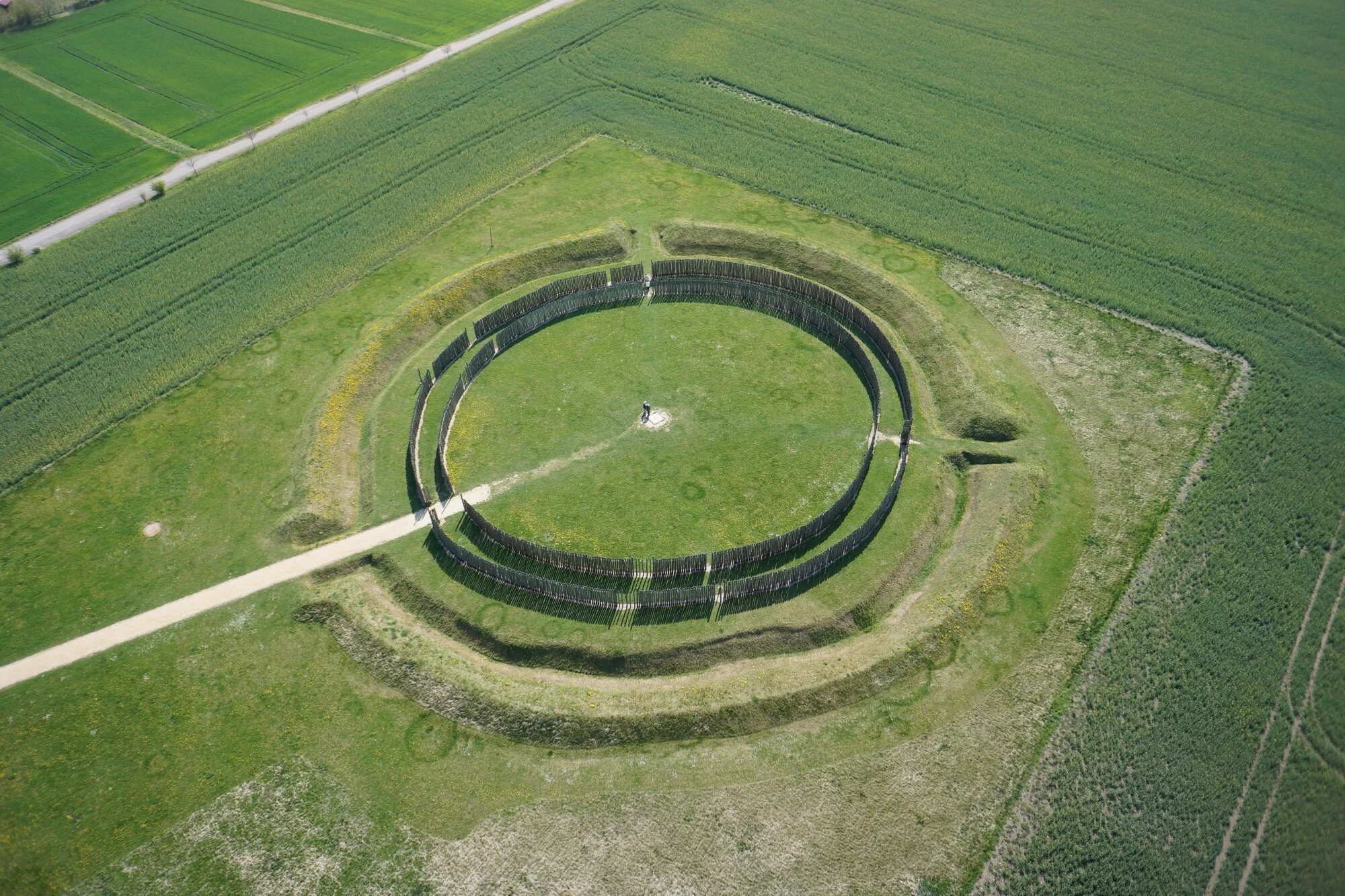
Aerial view of the Middle Neolithic circular enclosure of Goseck. Credit: State Office for Heritage Management and Archaeology Saxony-Anhalt
Dr. Norma Henkel has published the research findings from the fully excavated circular enclosure at Goseck, Burgenlandkreis, Saxony-Anhalt, which adds new information to the understanding of these still-mysterious structures. The title of the item is "The Middle Neolithic circular ditch complex of Goseck, Burgenlandkreis," and it can be found in the publications of the Saxony-Anhalt State Office for the Preservation of Monuments and Archaeology—State Museum of Prehistory (in German only).
Otto Braasch made the discovery of the Goseck Middle Neolithic circular ditch (Stichbandkeramik culture, roughly 4900 to 4600/4550 BCE) in 1991 while conducting aerial archaeological research. It was fully excavated between 2002 and 2004 as part of a collaboration effort between the Martin-Luther University Halle-Wittenberg (MLU) and the State Office for Heritage Management and Archaeology Saxony-Anhalt (LDA).
The complex was totally rebuilt on the spot and has been accessible to the public since 2005 as a result of the excavations' outstanding results. Between 2005 and 2013, a sizable project directed by Prof. Dr. François Bertemes (MLU) that examined the circular enclosure's location within the contemporary settlement environment was carried out.
A ditch, maybe a rampart in front of it, and two concentric palisade wreaths that define the complex's interior make up the Goseck circular perimeter. The north, southeast, and southwest were its three entrances. Both within and outside the building, several pits were discovered, the majority of which were filled with pottery and animal bones. Numerous data suggest that the structure serves a religious purpose.
About 30 cow horn cores were also discovered in the vicinity of the circular ditch, together with a startlingly high frequency of cattle skull fragments. Additionally, cattle are by far the most prevalent species in the circular enclosure's animal bone spectrum. It is clear that cattle have a specific significance and symbolic meaning for many Neolithic communities.
The outer palisade creates a pit that is roughly 1.6 m by 1.3 m in size in the southeast. There are various strange things about the pit. Its walls have suffered significant burns. In Goseck, the system of circular ditches contains numerous pits with signs of fire. In addition to flame markings, this hole held an adult person's bones. Only fragments of the extremities, as well as no skull or torso bones, were discovered. It can be presumed that the bones were placed in a largely skeletonized form because they were no longer in an anatomical composition. Five phalanges and metacarpal bones from a human right hand were found in another hole. The bones belonged to a male youngster or adult and were laid in anatomical order.
In addition to these discoveries, astrological evidence suggests that the circular enclosure served a religious purpose. The dawn and sunset of significant astronomical events may be accurately anticipated and witnessed from a spot roughly in the center of the building to within a few days. The two culverts in the south-east and south-west are where the most crucial lines of sight cross. The circular ditch only reflects the gaps in the fence here. They line up with the sun's rising and setting positions on December 21, the winter solstice. Other passages in the palisade make reference to Beltaine (April 30) and the summer solstice (June 21).
In a 2,000-year-old Han era tomb, Chinese archaeologists discover the first full panda burial
Chinese researchers have discovered what they claim to be the first full skeleton of a gigantic panda in an emperor's tomb from the more than 2,000-year-old Han era.

The discovery is the first complete panda skeleton found in an imperial tomb. Photo: Shutterstock
According to legend, the huge panda was sacrificed so that Emperor Wen, who ruled from 180 to 157 BCE, may travel to the afterlife with it.
The animal's head was pointing in the direction of the tomb as its body lay in a satellite hole.
The tomb is located in Shaanxi province's contemporary city of Xian, which was once the capital of China.
An whole panda skeleton was discovered in an emperor's tomb for the first time, according to Hu Songmei, an archaeologist at the Shaanxi Academy of Archaeology.
She claimed that although a huge panda's corpse had been missing since 1975, archaeologists had discovered its skull in the tomb of Emperor Wen's mother Consort Bo.

The animal was found in the tomb of the Han Emperor Wen. Photo: Wikipedia
In the royal tombs of Shaanxi, archaeologists have discovered a wide range of wild animals, which they think were a prestige symbol for the Han emperors.
The Asian tapir, which went extinct in China around 1,000 years ago and is currently recognized as an endangered species by the International Union for Conservation of Nature, was also discovered in the tomb, according to Hu.
The emperor was also interred with tigers and yaks, and the tomb of his mother included the remains of a red-crowned crane, a peacock, a snub-nosed monkey, and a tortoise.
Hu claimed that only the emperor, empress, and the emperor's mother's graves had the uncommon, wild animals, and that some of them might have been gifts from southern China.

The skeleton was found in a satellite burial chamber. Photo: Shaanxi TV
She said that it was possible that there were more pandas in Shaanxi during the Han era, implying that the province's environment was warmer and wetter than it is now and that bamboo may have grown there.
Hu added that to determine what the animals ate and their origins, archaeologists will analyze the creatures' DNA.
A new, extinct species of gibbon was previously discovered in Lady Xia's tomb, the grandmother of China's first emperor Qin Shihuang.
The "solved" mystery of how Egyptians moved the stones for the pyramids does not include extraterrestrials
The origins of the Egyptian pyramids may now be understood, according to scientists.
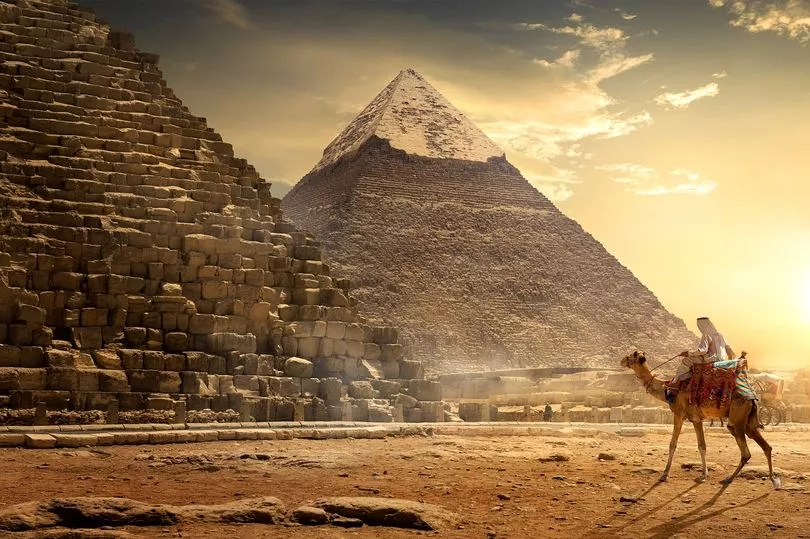
The pyramids have left scientists scratching their heads for centuries
A whopping 2.3 million slabs of limestone and granite, each weighing about two tonnes, make construct the Great Pyramid alone, a puzzle that has confounded historians for centuries.
Without modern tools like cranes, scholars were left perplexed as to how the prehistoric civilization was able to move and stack the gigantic slabs; some conspiracy theorists even proposed that aliens might be responsible.
Archaeologists from around the world now think they may have found the solution and that the Egyptians may have exploited a River Nile tributary to move enormous rocks to Giza.

Some people think the pyramids were placed in Giza by aliens
The scientists searched for evidence of pollen and plants typically seen surrounding Africa's longest river in a lab in France using five fossilized soil samples sent from the Giza floodplain.
Scientists had to dig up to nine meters into the ground to retrieve the samples, which was a laborious operation.
The Khufu Branch, a channel off the river that allowed the ancient builders to move the slabs, was eventually confirmed to exist, proving that their efforts were worthwhile.
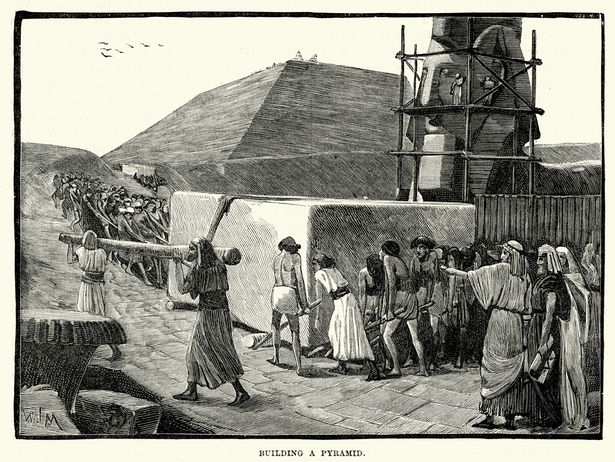
An engraving of ancient Egyptians building one of the pyramids
“I was quite fascinated because this proves that the building components for the pyramid were transported through water”, environmental geographer Hader Sheisha told the New York Times.
She continued that without the tributary, it would have been "impossible" to construct the spectacular ancient structures.
Approximately 2,000 years after the construction of the pyramids, the Khufu Branch dried up approximately 600 BC.
Sheisha believes that despite being long gone, this discovery may inspire researchers to learn more about the ancient Egyptians.
The construction of the pyramids can be partially explained by learning more about the surroundings, she continued.
Even a fragment of papyrus discovered in the adjacent Red Sea served as inspiration for the discovery.

An engraving of ancient Egyptians building one of the pyramids
The antiquated text described how one official, known as "Merer," sent limestone up the Nile to Giza.
The three pyramids of Giza were built as grandiose tombs for the Egyptian pharaohs between around 2550 and 2490 BC.
Pharaoh Khufu, who ruled during the Fourth Dynasty of the Old Kingdom, is buried in the Great Pyramid, the tallest pyramid in Egypt, while his son Khafre and his grandson Menkaure are interred in the other two significant pyramids.
For the monarchs' mothers and wives, smaller buildings were built.
The finding of the underworld calls into question our notion of human evolution
Did a'small-brained ape-man' species that went extinct create a complex society thousands of years before we did?
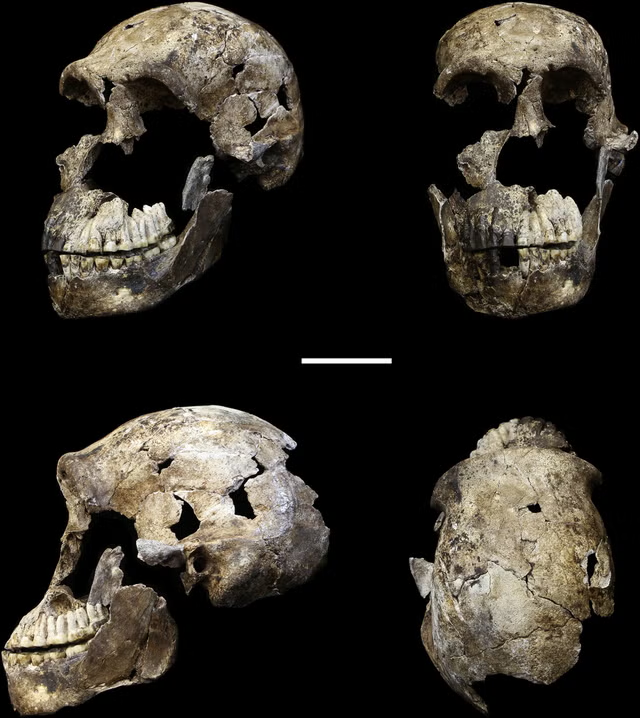
The species has been named Homo naledi by the scientists
One of the greatest archaeological riddles in the world will be resolved by scientists.
Experts are examining if a group of 'ape-men' were able to develop a complex human-like civilisation, possibly thousands of years before our own species, Homo sapiens, was able to do so. They are doing this using an unmatched range of tests.
According to the scientists' evidence, a sophisticated "ape-man" civilisation with some beliefs and behaviours that are typically only linked with modern humanity first appeared in southern Africa some 300,000 years ago.
The fact that the now long-extinct species functioned in a number of crucial ways similar to current humans while also appearing to have been able to do so with brains barely a third the size of ours adds to the enigma.

The discovery has been met with excitement by some scientists but with scepticism from others
Key concepts of how the scientific community perceives human evolution are in danger of being overturned by the discovery and current research.
These "ape-men" with little brains may have been able to achieve seven amazing feats, according to the evidence so far:
-Consider the possibility of an afterlife, or the idea that life exists in some way after death.
-An afterlife is said to take place in some form of "underworld" that is situated below (rather than on or above) the world of the living. That suggests that they may have created an extremely primitive understanding of cosmology.
-Imagine the possibility of them really burying their dead in the "underworld."
-Give burial goods to deceased community members, an apparent conduct that suggests they may have thought the dead would be able to use them in some way in the afterlife.
-Conduct possible rites, including funeral feasts, within their "underworld."
-Create primitive artwork (abstract designs) to surround at least one of the burial chambers' entrances in the "underworld."
-Construct a rather sophisticated lighting system (either a series of little fires or torches) to allow them to access their "underworld" and transport their deceased there.

Despite its small brain size, the creature had very well-developed human-like frontal lobes
In what is now the north-east of South Africa, their "underworld" was situated deep underground in the elaborate subterranean structure known as Rising Star Cave. It took 130 meters of underground travel to get to the main room, which contained what appeared to be tombs.
Some scientists have responded to the revelation with delight, while others have expressed skepticism.
"We are aware that the information we are uncovering is contentious since it is completely fresh. The leader of the Rising Star Cave investigation, Professor Lee Berger of the University of Witwatersrand and palaeoanthropologist for National Geographic, recently released a detailed National Geographic book on the discoveries, entitled Cave of Bones. "We are deploying every type of investigative technology available to ensure that the maximum amount of additional evidence can be found," Professor Berger said.
Although preliminary scientific studies have already been conducted, numerous additional tests are currently being planned to either confirm or modify original findings.
The creature's brain size, which is only slightly larger than that of a chimpanzee, is the most contentious feature of the species, which scientists have given the moniker Homo naledi.
In order to better comprehend the anatomy and organization of the species' brains, a major component of the current inquiry will be a more in-depth examination of the species' skull fragments discovered in the cave complex. At least 30 people's remains have so far been discovered there, and it's possible that many more will be recovered over the following months and years.

The team lays out fossils of H. naledi at the University of the Witwatersrand’s Evolutionary Studies Institute
The creature had highly well-developed frontal lobes that resembled those of a human, which is the specific region of the brain known to be involved with planning and language, despite having a modest brain size.
The researchers will need to present further proof that brain size is not necessarily important in terms of cognitive capacity in order to make the discovery less contentious. That would mean destroying literally centuries' worth of scientific knowledge.
The evidence at this point in the inquiry is compelling enough to conclude that Homo naledi bodies were intentionally carried into the cave system and buried there. The data thus far indicates that living individuals of that species are accountable for achieving it.
One Homo naledi person, a child, appears to have been purposefully interred with a burial good—possibly a tool—in his or her right hand.
There are currently further excavations planned that could uncover more grave goods in other Homo naledi graves.
Any such findings would support the hypothesis that Homo naledi had an understanding of life beyond death.
The investigation's main focus will be dating the hearths that were used to prepare food, including antelope, in the underground complex's total darkness. To conclusively prove that the hearths were created during the Homo naledi epoch, dating them is essential. The enamel on the teeth of those antelopes and other animals may be dated using a technique called electron spin resonance. In addition, the archaeologists will attempt to utilize a different method of dating to establish the age of a layer of solidified lime that covers some of the hearths.

A reconstruction of Homo naledi’s head by paleoartist John Gurche, who spent some 700 hours recreating the head from bone scans
The people who cooked the antelope and other meats also appeared to have purposefully shattered the lengthy bones of those animals, maybe to obtain the very nutritious marrow from within. The breaks in the bones will be subjected to microscopic examination in an effort to establish that they were intentionally shattered with a stone tool rather than occurring accidently.
In-depth geomorphological and other examinations of the cave rock walls where engravings have most likely been found will play a significant role in the inquiry as well. First, the archaeologists must establish beyond a shadow of a doubt that the patterns that appeared to be engraved on those walls were not produced by erosion or other natural processes.
They will next need to provide evidence that they were created using tools.
Additionally, and perhaps most importantly, the researchers hope to determine the age of the calcite patches that formed inside the apparent carvings after they were carved using uranium series dating.
Additionally, researchers will be searching for any Homo naledi DNA remnants connected to the carvings or any other objects stuck to the cave walls. This is due to the fact that it is known that occasionally pigment and spit that may have contained DNA was used to produce other, albeit much less ancient, Stone Age artwork.
"We are currently preparing to conduct the most extensive and ambitious scientific examination on alleged prehistoric engravings. According to rock art expert Genevieve von Petzinger, co-leader of the Spanish-based archaeology team, the First Art Team, which is examining the engravings in Rising Star Cave, "if we can confirm that the patterns on the rock face were most likely made by Homo naledi, they will overturn scientific thinking on the evolution of symbolic thought."

The find was announced by the University of the Witwatersrand, the National Geographic Society and the South African National Research Foundation and published in the journal eLife
The Homo naledi 'underworld's' challenging accessibility is one of its most outstanding features. Today, getting there requires traveling 130 meters below in 30 minutes, crawling through spaces that are only 15 to 20 centimeters high for about 12 meters, and then descending an almost vertical 12-meter-long "chimney" with an average width of 20 centimeters.
The cave complex's geomorphological investigations indicate that Homo naledi's time would have found it to be almost as difficult. Therefore, it would have required great resolve and perhaps even ideological vision for them to embark on such a difficult underground expedition with corpses, firewood, firebrands, and possibly antelope and other meat.
There is no obvious alternative above ground entry to the main burial chamber, which has a 10 meter high ceiling and is located about 35 meters below the surface of the earth.
Many scientists will find it very difficult to accept the discovery's probable implications—that "ape-men" may have held religious and even cosmological beliefs on life after death—because they are so revolutionary.
The line separating our species, Homo sapiens, from our 'ape-man' antecedents and forebears is very significantly blurred.
However, if the forthcoming studies support those revolutionary implications, they might also offer interesting new light on the fundamental causes of the thoughts and beliefs that modern humans still hold today.
The majority of people on earth still hold the belief in an afterlife, and historical and ethnographic data clearly demonstrate that many ancient human cultures held the cosmological belief that the afterlife was situated beneath the world of the living (rather than on it or, in the manner of heaven, above it). The fact that it is a worldwide notion may be telling.
Ancient Sumerians from southern Iraq believed in an underworld named Kur, which means "earth/ground" or "mountain," from at least the fourth millennium BC. The Duat was the name of the underworld in ancient Egypt, and the Diyu and Difu, which are Chinese terms that literally translate to "Earth Prison" and "Earth Mansion," respectively, had a similar connotation. While the ancient Maya, Aztecs, and Incas in the Americas, as well as the ancient Celts, Greeks, and Romans in Europe, the Polynesians of the Pacific, the Inuit of the Arctic, and the peoples of Japan and Korea, all had an understanding of the underworld, there is the ancient Hindu concept of the Patala (literally, "that which is below the feet"). Hell is still a notion in Christianity.
The apparently complex funerary culture of Homo naledi is remarkable because it is the first instance in which archaeologists have found proof of such behavior being used by a species other than ourselves, Homo sapiens.
It's interesting to note that many modern human (Homo sapiens) tribes, from the Stone Age to the present, buried or left their dead in caves, as did several Neanderthal and Homo heidelbergensis communities. If there were no natural caves nearby, people even built artificial ones in numerous ancient civilizations all across the planet.
Rising Star Cave's secrets are still being investigated, and this will probably reveal some exciting new information about the distant beginnings of human cognition and belief.

National Geographic Explorer-in-Residence Lee Berger and leader of the excavation expedition, inside the Rising Star cave in South Africa where fossil elements belonging to H. naledi, a new species of human relative, were discovered
Since Homo naledi was probably certainly not a direct predecessor of ours, the final consequence may change how we perceive prehistory dating back several million years.
The parallels in belief could be accidental or inherited from even earlier prehistory because Homo sapiens and Homo naledi were likely descended from a common parent species long before either species existed.
Recent zoological research has started to show that a number of high intelligence animal species (elephants, chimpanzees, monkeys, magpies, dolphins, and others) appear to have death-related 'rituals', such as standing guard over the dead and, in some cases, covering the dead with leaves and other material. Future studies on this type of animal behavior may reveal further information about the extremely remote origins of contemporary human and pre-modern human funeral behavior.
The Rising Star Cave investigation is multidisciplinary and international, involving archaeologists, physical anthropologists, geomorphologists, and other scientists from South Africa, the United States, Canada, China, Nigeria, Germany, the United Kingdom, Italy, Spain, and Portugal. It is currently the focus of a one and a half hour Netflix documentary called Unknown: Cave of Bones.
In a series of trips over the past ten years, many hundreds of Homo naledi bones have been discovered in the cave network. The engravings and the evidence for the intentional interment of Homo naledi people in the cave have just recently been made public. Today, Tuesday, September 9, 2023, the in-depth book Cave of Bones, which is available on the website, was released.