10 Ancient Civilizations That Existed Before Recorded History
Close your eyes.
You’re standing in a vast library lined with the milestones of human achievement.
Ancient Egypt — 3100 BCE — first hieroglyphs.
Sumer — 3500 BCE — first cities.
Ancient China — 2000 BCE — first dynasties.
These are the “official” beginnings of civilization. The dawn of recorded history.
Now open your eyes.
Because history didn’t begin when writing began.
It began long before that.
Before ink touched clay tablets… before priests etched royal names into stone… before empires declared themselves eternal — there were others.
Civilizations that built in stone when the world supposedly still lived in mud huts.
People who mapped the sky without telescopes.
Engineers who moved stones weighing hundreds of tons.
Surgeons who drilled into skulls — and their patients survived.
And then… they vanished.
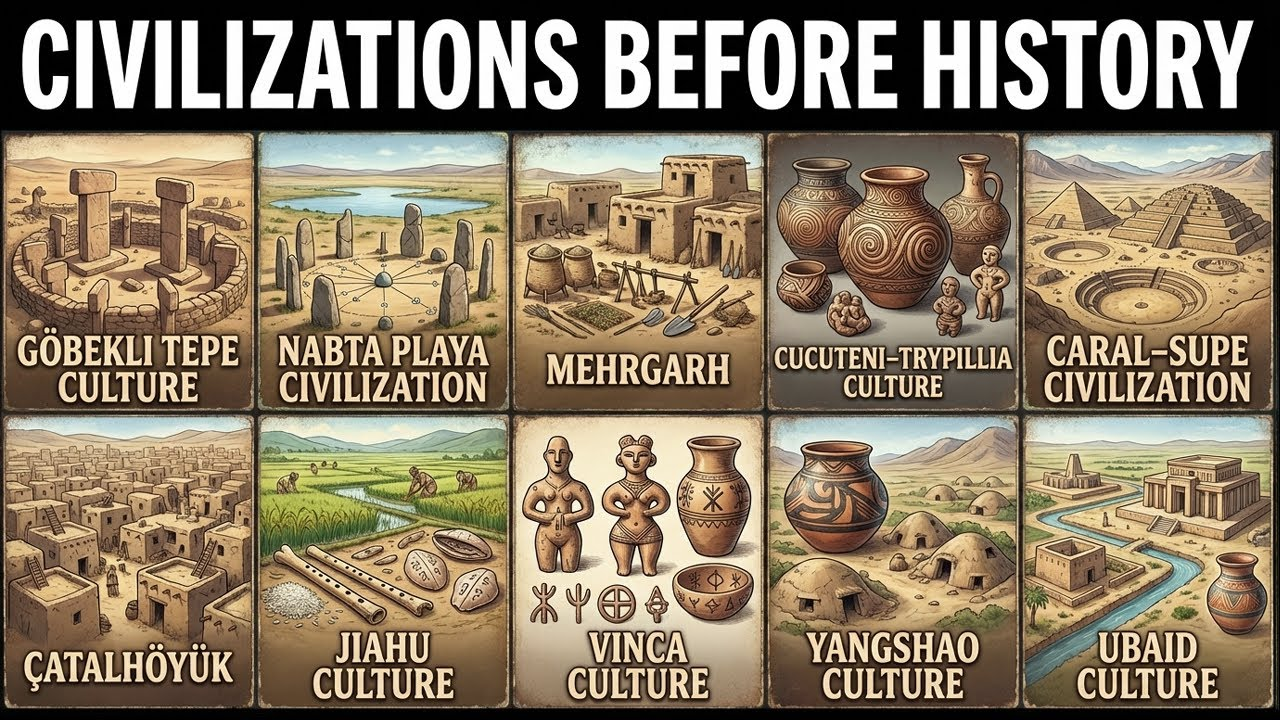
Here are ten ancient civilizations that existed before recorded history — and are still rewriting everything we thought we knew.
1. Göbekli Tepe (c. 9600 BCE)
Long before Stonehenge. Before the pyramids. Before agriculture was supposed to exist.
In southeastern Turkey stands Göbekli Tepe, a ceremonial complex built over 11,000 years ago.
Massive T-shaped stone pillars arranged in circles. Intricate carvings of animals. Precision alignment.
It was constructed by hunter-gatherers.
Let that sink in.
This site forces archaeologists to reconsider a core belief: that farming led to civilization. Göbekli Tepe suggests ritual and organized construction may have come first.
2. Çatalhöyük (c. 7500 BCE)
In what is now Turkey, Çatalhöyük reveals a densely packed city of mud-brick homes — built wall-to-wall with no streets.
People entered through rooftops.
Inside were murals, shrines, and symbolic art. It wasn’t primitive. It was complex, planned, and socially organized thousands of years before writing.
3. Mehrgarh (c. 7000 BCE)
Before the Indus Valley script.
In modern Pakistan, Mehrgarh shows early farming communities practicing dentistry. Yes — dentistry.
Human remains reveal drilled molars dating back 9,000 years.
Surgery. Agriculture. Craft specialization.
All before recorded history.
4. Nabta Playa (c. 6000 BCE)
In the Nubian Desert lies Nabta Playa — a stone circle aligned with the summer solstice.
It predates Stonehenge by millennia.
These weren’t wandering nomads. They were sky-watchers. Astronomers.
5. The Cucuteni–Trypillia Culture (c. 5500 BCE)
Stretching across modern Ukraine and Romania, the Cucuteni–Trypillia culture built enormous settlements — some housing tens of thousands of people.
They regularly burned their cities — intentionally.
No clear reason. Ritual renewal? Social reset? We still don’t know.
6. Caral (c. 3000 BCE)
In Peru stands Caral, one of the oldest cities in the Americas.
Massive pyramid complexes. Sophisticated urban planning.
And almost no evidence of warfare.
A civilization without visible violence — thousands of years ago.
7. The Ubaid Culture (c. 6500 BCE)
Before Sumer rose, southern Mesopotamia was shaped by the Ubaid period.
They developed irrigation systems, long-distance trade, and large communal temples.
They laid the groundwork for the civilizations we call “the first.”
8. Jiahu (c. 7000 BCE)
In China, Jiahu reveals early flutes made from crane bones — playable instruments nearly 9,000 years old.
Music. Fermented beverages. Proto-writing symbols.
Human culture thriving long before dynasties.
9. Skara Brae (c. 3100 BCE)
In Scotland’s Orkney Islands sits Skara Brae — a stone-built village older than the Great Pyramid.
Indoor plumbing. Stone furniture. Insulated dwellings.
Prehistoric — yet astonishingly advanced.
10. The Olmec (c. 1500 BCE roots in earlier traditions)
Though later than others on this list, the foundations of Olmec civilization likely stretch further back than their recorded emergence.
Colossal stone heads carved from volcanic rock — transported miles without wheels or beasts of burden.
Their origins remain partly shrouded in mystery.
So What Does This Mean?
Writing didn’t create civilization.
It recorded what had already existed for thousands of years.
The deeper we dig, the older complexity becomes.
History isn’t a straight line beginning in 3000 BCE.
It’s a fog.
And occasionally — when the earth shifts or a farmer plows too deep — something ancient emerges from that fog and reminds us:
We are not as first as we thought.
🎥 Watch the full episode below to uncover the forgotten cities, astronomical monuments, surgical breakthroughs, and vanished cultures that challenge everything we think we know about the dawn of civilization.