Did Japan Reach the Americas Before Columbus? The Hokkaido Connection & The Zuni Enigma
Could ancient Japanese sailors have crossed the Pacific long before Columbus ever sailed west?
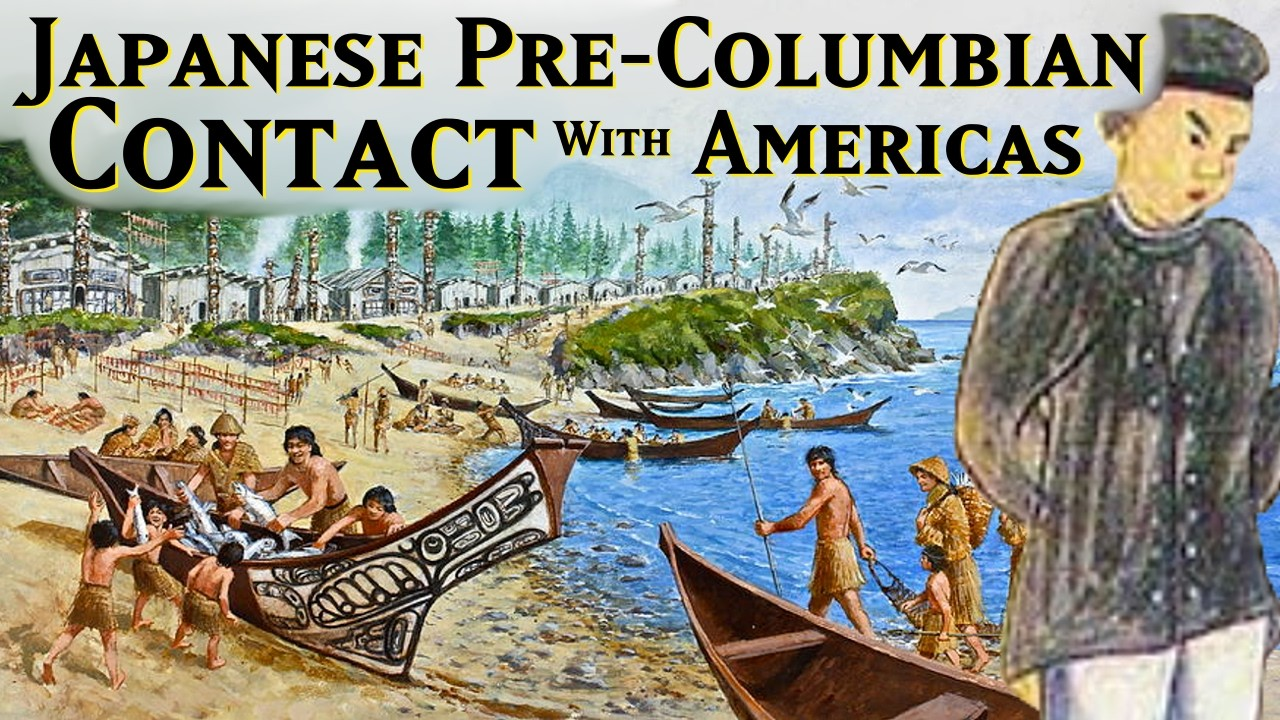
It’s a bold idea — one that sits at the intersection of archaeology, ocean currents, oral tradition, and controversial theory. In this episode, we explore the major hypotheses surrounding possible pre-Columbian contact between the peoples of Japan — including Hokkaido — and Indigenous societies of North, Central, and South America.
But we also separate fascination from fact.
The Hokkaido Connection
One of the most discussed clues comes from stone tools.
Researchers have observed similarities between projectile points from the Western Stemmed Tradition in western North America and points discovered in Hokkaido. Both date to roughly the same late Ice Age time frame.
This parallel has been called the “Hokkaido Connection.”
Does that mean contact occurred?
Most archaeologists urge caution. Similar environmental conditions can lead to similar technological solutions. Independent innovation — known as convergent development — is common in human history. Resemblance alone is not proof of interaction.
Jōmon Pottery & Ecuador
Another intriguing comparison involves pottery.
The Jōmon culture produced some of the world’s earliest ceramics, known for their cord-marked decoration. Meanwhile, early pottery from the Valdivia culture in Ecuador has been argued by some researchers to resemble Jōmon forms.
Could this indicate trans-Pacific contact?
The prevailing scholarly view is that the similarities are best explained as parallel invention. Pottery was developed independently in multiple regions worldwide. Without genetic, linguistic, or additional material evidence, resemblance alone cannot confirm cultural diffusion.
The Power of the Kuroshio Current
Then there’s the ocean itself.
The Kuroshio Current, sometimes called the Pacific’s Gulf Stream, flows northward along Japan’s coast before turning east across the open Pacific.
It is powerful — and historically capable of carrying debris, wreckage, and even disabled vessels thousands of miles.
This makes accidental drift voyages physically plausible.
But plausible does not mean proven.
Oral Traditions of the Pacific Northwest
Indigenous oral histories from groups like the Coast Salish, the Makah, and the Tlingit describe encounters with strange people arriving from the sea, sometimes bearing unfamiliar metals such as iron.
Anthropologists emphasize that oral traditions are invaluable historical knowledge systems — but they cannot automatically be read as literal documentation of specific medieval trans-Pacific voyages.
They may preserve memories of encounters.
They are not direct archaeological proof.
Japanese Shipbuilding & Drift Voyages
Historically, Japanese vessels were primarily coastal craft. They were well suited for fishing and regional trade but lacked deep keels, relied on square sails, and were vulnerable to major storms.
When storms struck, control could be lost.
Japan recorded numerous vessels lost at sea in the post-Columbian era — some of which drifted astonishing distances across the Pacific.
The 1834 Castaways
One documented case occurred in 1834 when three Japanese sailors — Iwakichi (29), Kyukichi (16), and Otokichi (15) — lost control of their vessel during a storm.
They drifted across the Pacific for months before wrecking on the coast of Washington State, in territory controlled by the Makah people.
This case proves something important:
Drift voyages from Japan to North America are physically possible.
But this occurred in the 19th century — not the medieval or prehistoric periods.
The Zuni Enigma
Anthropologist Nancy Yaw Davis proposed that the Zuni Pueblo may have been influenced by Japanese Buddhist monks who crossed the Pacific in the 13th century.
This idea, sometimes called the “Zuni Enigma,” draws on perceived similarities in ritual, language, and symbolism.
However, the hypothesis remains speculative and controversial.
Mainstream archaeology and genetics have not confirmed such contact.
So… Did It Happen?
The current scholarly consensus is clear:
There is no definitive evidence of sustained pre-Columbian contact between Japan and the Americas.
The Jōmon–Valdivia similarities are most likely parallel invention.
The Zuni–Japanese theory remains unproven.
Pacific Northwest oral traditions are culturally significant but not direct proof of Japanese arrival.
The Pacific is vast.
Ocean currents make drift voyages possible.
But history requires evidence — not just possibility.
The line between “could have happened” and “did happen” matters.
🎥 Watch the full episode below to explore the evidence, the ocean currents, the castaways, and the controversial theories surrounding possible pre-Columbian contact between Japan and the Americas — and decide for yourself where possibility ends and proof begins.