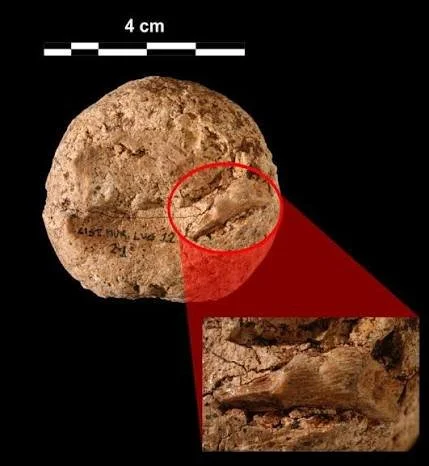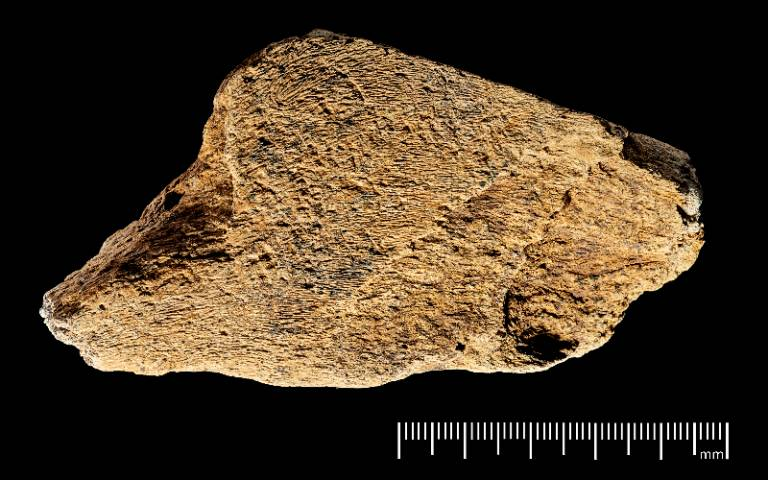
LONDON, ENGLAND — Researchers from University College London and London’s Natural History Museum have re-examined artifacts recovered in 1990 from the Boxgrove Paleolithic site in southern England. According to a statement from UCL, the team, led by Simon Parfitt, identified a bone tool dating to around 500,000 years ago, made from elephant or mammoth bone.
The outer layer of elephant bone is softer than stone but more durable than most other animal bones, making it particularly well suited for tool use. Parfitt noted that elephant bone would have been a rare and valuable material, suggesting the tool held significant importance for its makers.
Based on its age, the hammer was likely produced and used by either Neanderthals or Homo heidelbergensis. Detailed analysis using 3D scanning and electron microscopy revealed multiple notches and impact marks on the bone, with fragments of flint embedded in some of them.
These features indicate that the bone implement functioned as a “retoucher,” used to resharpen stone tools and restore their edges after wear.