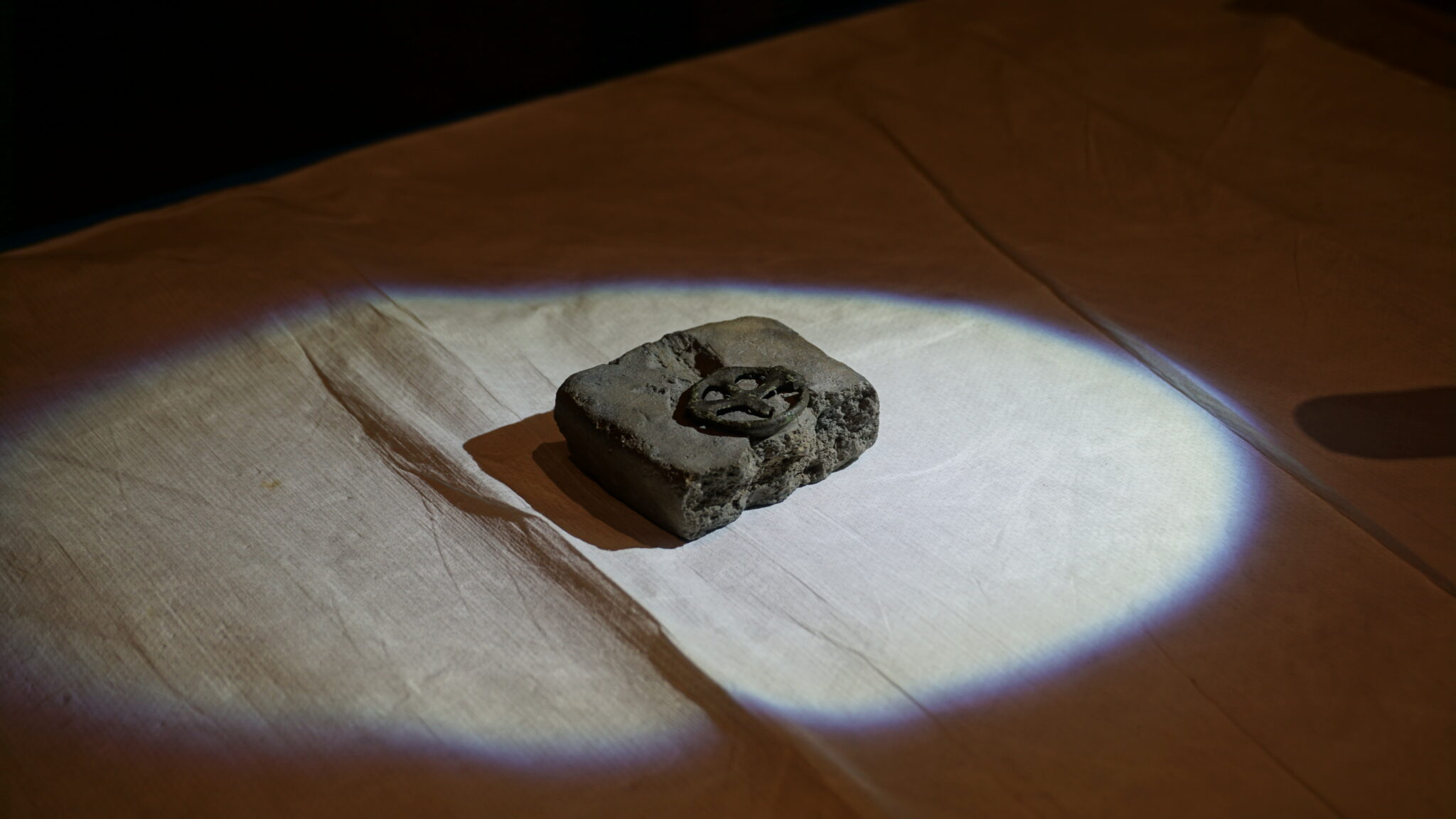
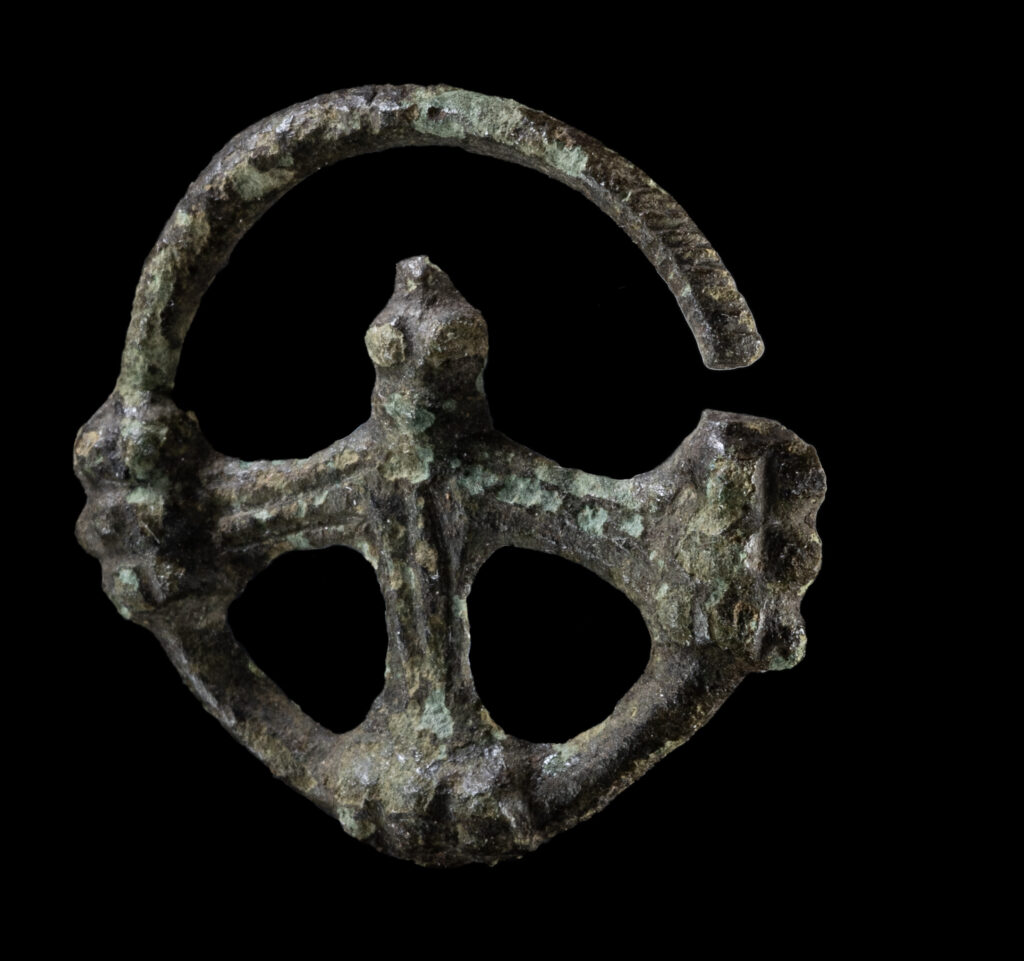
A small bronze cross recently discovered in western Brandenburg is transforming archaeologists’ understanding of how Christianity spread through northeastern Germany in the early Middle Ages. Dating to the 10th or early 11th century, the object is notable not for its size, but for an extraordinary archaeological link that ties it directly to a casting mold unearthed more than 40 years ago.
The wheel-shaped cross was found in the Havelland region by Juliane Rangnow, a certified volunteer heritage guardian working under official authorization. When experts at the Brandenburg State Office for Heritage Management and Archaeological Museum examined the artifact, they made a remarkable discovery: the cross fits perfectly into a bronze mold excavated in 1983 from a Slavic hillfort in Berlin-Spandau.
Until now, no finished object had ever been associated with that mold.
A Rare Reunion Across the Centuries
The Spandau mold—commonly known among scholars as the “Spandau Cross”—has long been considered one of the earliest pieces of material evidence for Christian symbolism in the region between the Elbe and Oder rivers. Found near the remains of an early wooden church, it suggested that Christian objects may have been produced locally during a time when historical knowledge largely relies on written sources.
The newly recovered cross fundamentally changes that understanding. Careful measurements and conservation work confirmed that the Havelland cross was cast using the Spandau mold. Archaeologists describe this as an exceptionally rare case: a medieval casting mold and its finished product reunited after more than a millennium.
“This kind of match is virtually unheard of,” said Franz Schopper, highlighting the value of long-term archaeological documentation and cooperation between professional researchers and trained volunteer finders.
The wheel-shaped cross was found in the Havelland region by Juliane Rangnow, a certified volunteer heritage guardian working under official authorization.
Christianity Before the Uprising of 983
Beyond its technical uniqueness, the cross carries deep historical implications. The object dates to a volatile era, when the Slavic-inhabited regions of today’s Berlin and Brandenburg were under growing influence from the East Frankish Kingdom, the precursor to the Holy Roman Empire.
Christian symbols from this early phase are rare in the archaeological record. Most evidence for the first wave of Christianization comes from written sources, which describe resistance among Slavic communities. That resistance would culminate in the Lutician uprising of 983, when local groups rejected Frankish authority and suppressed Christian institutions for more than a century.
The cross suggests that Christianity had already spread more widely—and more locally—than previously assumed. Matthias Wemhoff notes that the mold’s existence implies serial production, likely serving a mobile population and a broader regional market well before the uprising.
Found by a Volunteer, Preserved by a Network
Rangnow discovered the cross during a permitted metal-detector survey at a known archaeological site. The same location also yielded coins, gilded jewelry fragments, and iron weapons from the 10th and 11th centuries, indicating sustained activity rather than an isolated loss.
Holding the object, Rangnow described the experience as “a bridge to the past”—a sentiment echoed by Brandenburg’s Minister of Culture Manja Schüle, who highlighted the find as a testament to the role of trained volunteers in protecting cultural heritage.
Brandenburg currently works with around 350 certified volunteer archaeological conservators, all of whom undergo formal training and operate under strict legal frameworks.