Long before numbers were inscribed on clay tablets or calculations written in cuneiform, early farming communities in the Near East were already engaging with mathematical ideas, expressing them through floral imagery, symmetry, and painted pottery.
A recent study published in the Journal of World Prehistory suggests that some of the earliest known botanical artworks, dating back more than 8,000 years, contain sophisticated numerical and spatial concepts. Rather than serving as simple decoration, these plant designs reflect an early awareness of order, balance, and proportion that developed well before formal mathematical systems.
Painted Plants in the Earliest Settlements
The study centers on painted ceramic vessels created by the Halafian culture, which occupied northern Mesopotamia—modern southeastern Turkey, northern Syria, and northern Iraq—between about 6200 and 5500 BCE. These societies lived in small agricultural villages and depended on shared labor, communal resources, and organized land use.
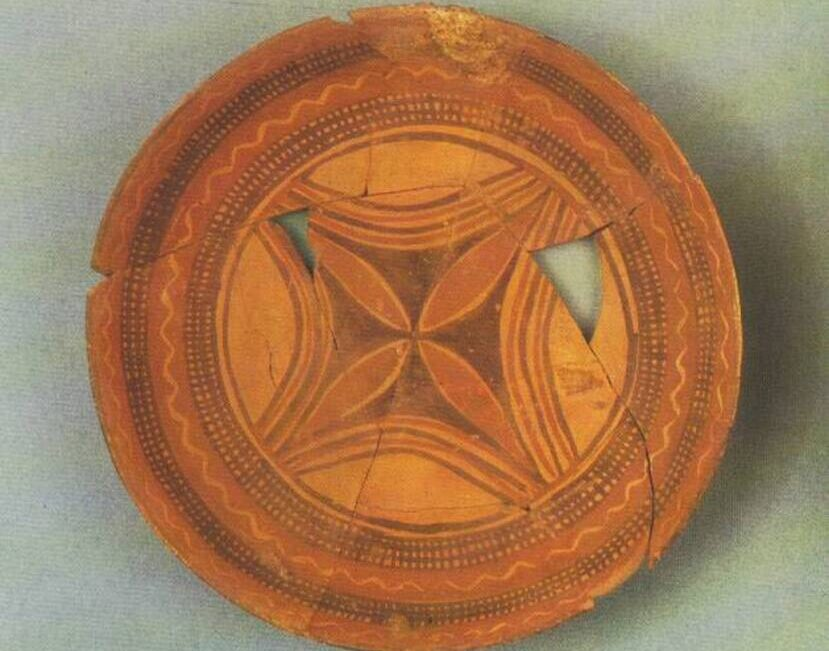
In contrast to earlier prehistoric art that focused mainly on animals and human figures, Halafian pottery prominently features plant imagery. Flowers, branches, shrubs, and trees frequently decorate bowls, jars, and plates, often arranged with careful symmetry and visual balance.
Drawing on material from 29 archaeological sites and thousands of pottery fragments, the researchers documented hundreds of plant-based motifs. Some resemble real vegetation, while others are more abstract. What connects them is not realism, but intentional structure, pointing to a common visual system rather than random embellishment.
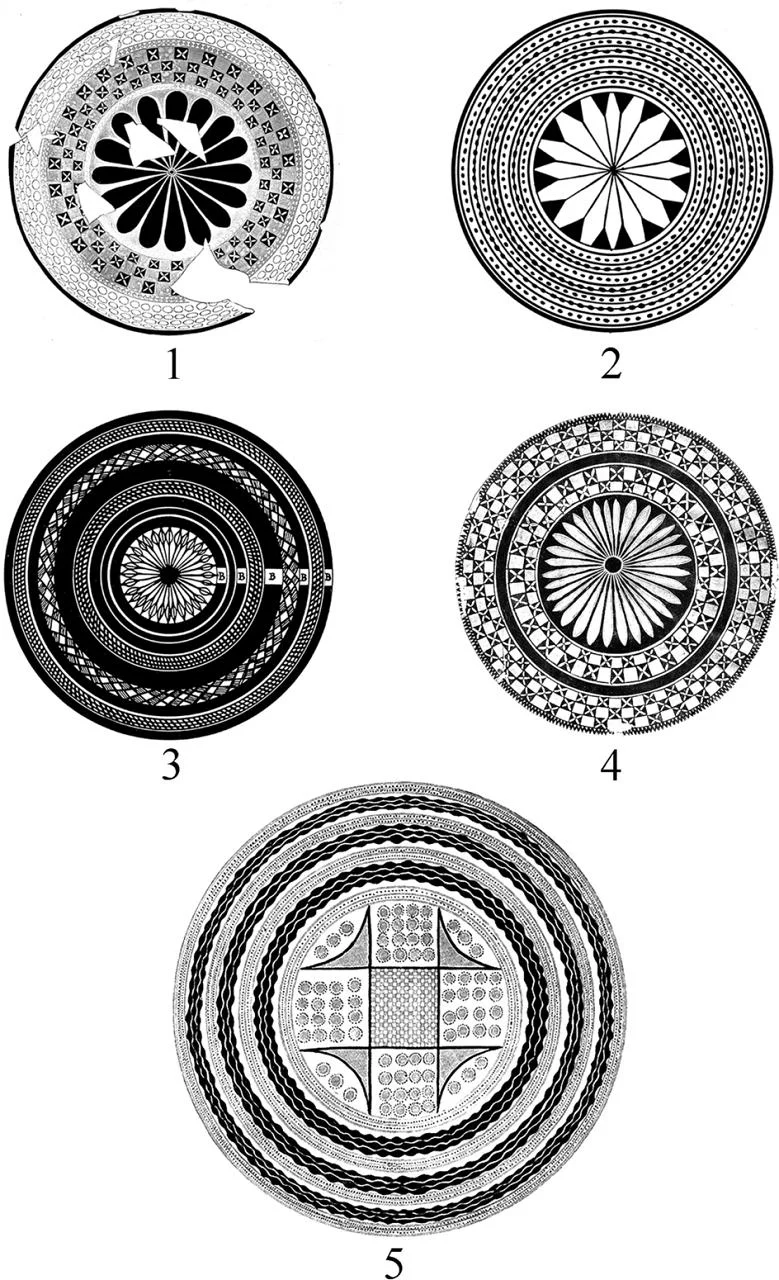
A precisely executed Halafian depiction of a large flower arranged with 16 or 32 petals, alongside a bowl decorated with 64 (+12) floral motifs.
Flowers That Count
The most significant findings emerge from the way these plant images were structured.
Many Halafian pottery pieces display large, centrally positioned flowers with petals arranged in exact numerical patterns. The researchers repeatedly observed flowers composed of 4, 8, 16, 32, and even 64 petals—figures that follow a clear doubling sequence. In one striking case, the base of a bowl was organized into a grid containing 64 separate flowers, each placed deliberately within the overall design.
These arrangements are unlikely to be random. Dividing a circular surface into equal sections requires forethought, spatial awareness, and uniformity, all of which are fundamental elements of mathematical reasoning. The study argues that these floral patterns represent some of the earliest known examples of arithmetic logic, created thousands of years before the invention of writing.
Mathematics Before Writing
These findings challenge traditional views about how and when mathematics developed. For a long time, mathematical knowledge in Mesopotamia has been associated with later urban societies, where systems of writing were used for accounting, taxation, and administration.
The Halafian material presents an alternative perspective. It suggests that mathematical thinking arose naturally within early agricultural communities. Everyday activities such as dividing land, distributing crops, organizing shared labor, and ensuring fairness among community members would have required careful measurement, equal division, and proportional reasoning.