Archaeologists in Mexico have uncovered an extraordinary cube-shaped skull that is challenging current understandings of ancient societies.
The skull belonged to a man over 40 years old who lived during Mexico’s Classic period, between roughly 400 and 900 AD, according to experts from the National Institute of Anthropology and History (INAH).
It was found at the Balcón de Montezuma site in the northern Huasteca region of Tamaulipas, a mountainous area in Mexico.
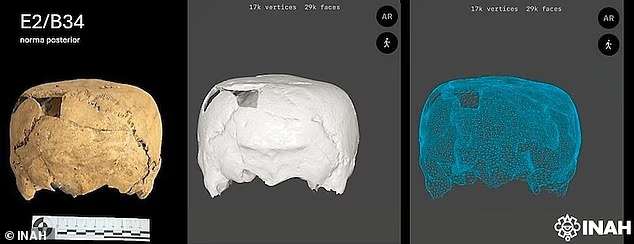
Researchers in Mexico have discovered a man's skull which was deformed to take the shape of a cube roughly 1,400 years ago
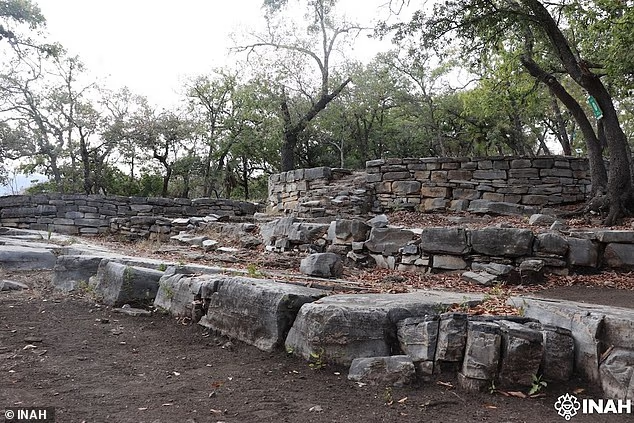
The skull was found at the Balcón de Montezuma archaeological site in the northern Huasteca region of Mexico's Tamaulipas state
In ancient Mexico, archaeologists have long found intentionally modified skulls, especially elongated, cone-shaped ones among the Olmec and Maya.
These shapes were created by gently binding infants’ soft skulls with cloth or bandages during the early months or years of life. Different civilizations assigned various meanings to the practice. For example, the Maya often did it for social status or aesthetic reasons.
The newly discovered cube-shaped skull in Tamaulipas, however, is puzzling. It is the only known example from that region, as cube-shaped skulls—with flattened tops forming a boxy appearance—are usually found at distant sites like El Zapotal in Veracruz and scattered Maya settlements in southeastern Mexico.
To determine if the 40-year-old man was truly local to northern Huasteca, researchers analyzed his bones and teeth for “stable oxygen isotopes,” variations of oxygen atoms that remain unchanged over time. The mix of these isotopes reflects the water a person consumed during their life, offering clues about their geographic origins.
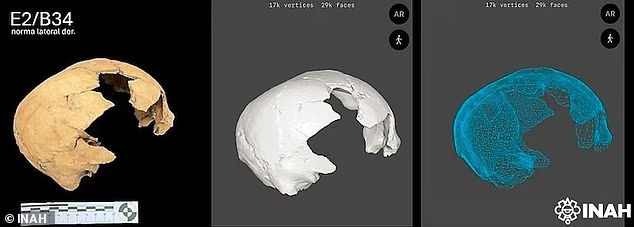
The research team was able to confirm that this man spent his entire life in the region, making his cube-shaped skull more of a mystery since this ritual was unusual for the area
Water in different regions such as rainy mountains or dry coastal areas has a distinct oxygen “fingerprint” shaped by local climate and geography.
By analyzing these oxygen signatures in the man’s tooth enamel, which forms in childhood, and bone collagen, which renews throughout adulthood, researchers found patterns matching the mountain water of northern Mexico.
Physical anthropologist Jesús Ernesto Velasco González explained that stable oxygen isotope analysis of bone and teeth confirms the man was born, lived, and died in this mountain region. This rules out a direct connection with groups from El Zapotal or other southern areas.
Although the reason for his cube-shaped skull remains unclear, the team suggests it may have symbolized membership in a broader cultural network that spanned hundreds of miles along the Mexican coastline, rather than being purely aesthetic.