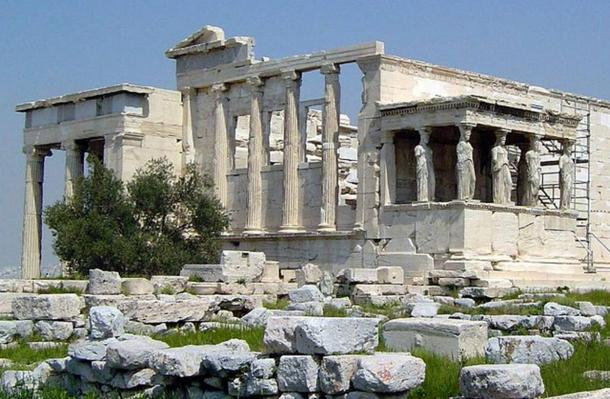
The longevity of Ancient Greek temples like the Parthenon or the Temple of Hephaestus is not merely a result of using heavy stone. These structures were built in one of the most seismically active regions in the world. To survive, Greek architects developed a sophisticated system of "flexible" engineering that allowed their buildings to move with the earth rather than resist it until they snapped.
1. The "Dry" Masonry System
One of the most critical innovations was the absence of mortar. While modern buildings use cement to bond bricks together, Greek temples were built using "dry" masonry.
Frictional Dissipation: By stacking precision-cut blocks without mortar, the architects created a structure that could "chatter." During an earthquake, the blocks would slide slightly against each other, absorbing and dissipating the kinetic energy of the seismic waves through friction.
Self-Centering: Because the stones were so massive and perfectly leveled, the weight of the structure would often settle the blocks back into their original positions once the shaking stopped.
2. Iron Clamps and Lead Poured "Shock Absorbers"
To keep the stones from sliding too far, the Greeks used an ingenious internal skeleton of metal connectors.
I-Shaped and Pi-Shaped Clamps: These iron clamps held horizontal blocks together, while vertical "dowels" connected the drum sections of columns.
The Lead Jacket: Crucially, the iron was not placed directly against the stone. Architects carved channels, placed the iron, and then poured molten lead around it.
Seismic Protection: The lead served two purposes: it prevented the iron from rusting, and because lead is a soft, ductile metal, it acted as a tiny "shock absorber." When the earth shook, the lead would deform slightly, preventing the brittle iron from snapping or the stone from cracking under tension.
3. The Geometry of the Column: Entasis and Drums
Greek columns were rarely single monolithic pieces of stone; they were composed of stacked "drums."
Segmented Resilience: A single long stone is brittle and snaps easily under lateral (sideways) pressure. A stack of drums, however, behaves like a heavy-duty spring. The individual segments can shift and "tilt" independently, preventing the entire column from toppling.
Entasis (The Curve): The slight swelling in the middle of a column, known as entasis, wasn't just for optical beauty. It increased the structural integrity of the column, providing a broader center of gravity to handle the swaying motion of a tremor.
4. Strategic Foundations: The Stereobate
The Greeks understood that the interaction between the building and the soil was paramount.
Layered Platforms: Temples were built on a multi-layered stone platform called the stereobate. This acted as a rigid "raft" that distributed the weight of the temple evenly.
The "Floating" Foundation: In areas with softer soil, architects often laid down layers of sand or charcoal beneath the stone foundations. This created a primitive version of base isolation, where the building could "slide" on a layer of debris, decoupling it from the violent movements of the bedrock.
5. The Parthenon: An Engineering Paradox
The Parthenon is famous for having no straight lines—every horizontal surface is slightly curved, and every column leans slightly inward.
The Pyramid Effect: By leaning the columns inward, the architects created a subtle pyramidal shape. This "inward tension" made the building more stable against lateral forces. If the lines of the Parthenon were projected upward, they would meet at a point roughly 2.4 kilometers in the sky, creating a literal "cone of stability."
6. The Durability of the Material
Finally, the choice of Pentelic marble or high-quality limestone was essential. These materials have a high compressive strength, allowing them to bear the immense weight of the roof while the internal metal "connectors" handled the tension—a precursor to modern reinforced concrete.
The fact that these temples have survived over 2,000 years of earthquakes—while many modern concrete structures in the same region have collapsed—proves that the Greeks had mastered the art of "controlled movement."