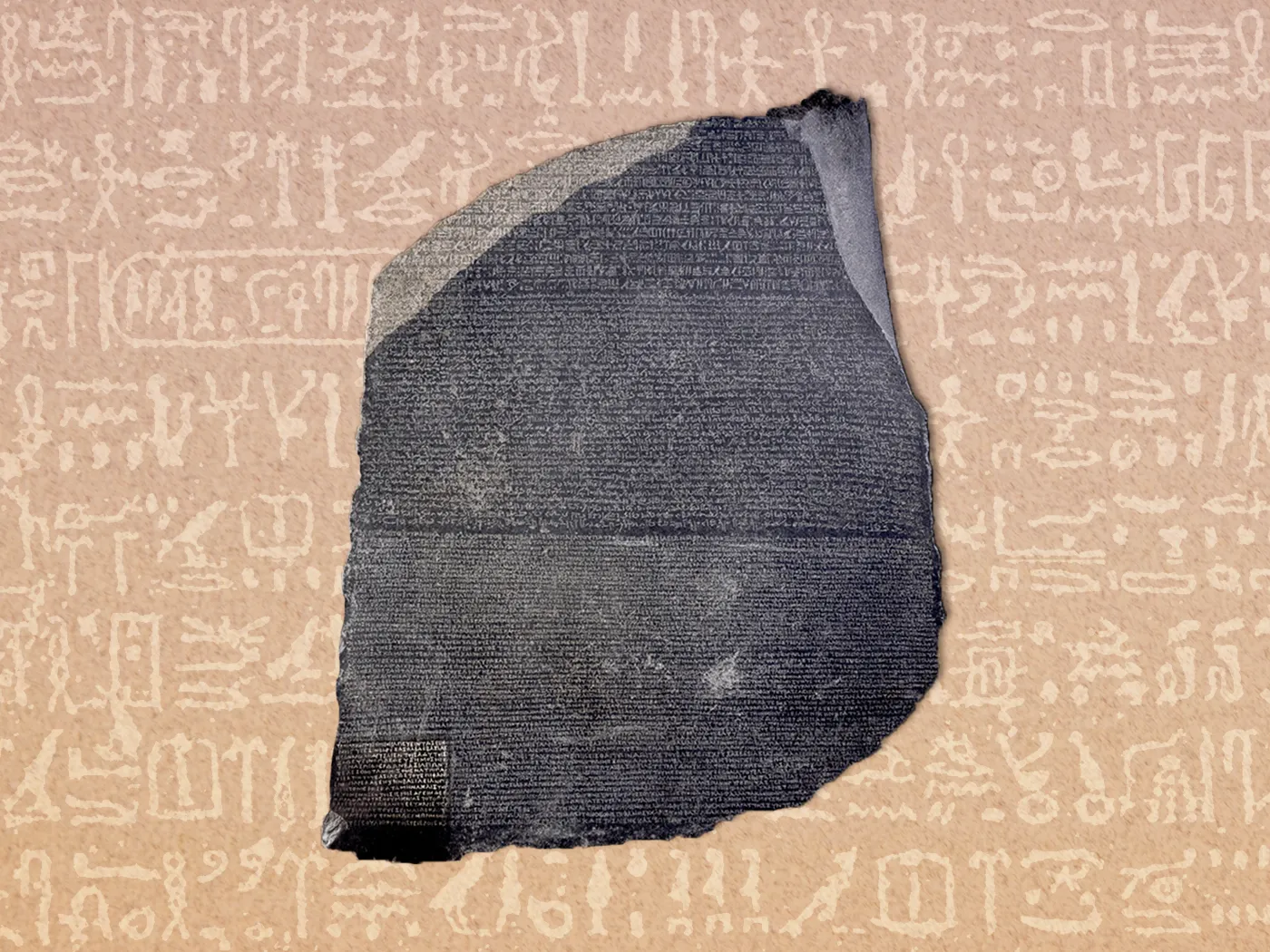
The Rosetta Stone is perhaps the most famous piece of rock in history. Discovered in 1799 by French soldiers during Napoleon’s Egyptian campaign, it became the "codebook" that unlocked three millennia of Egyptian history.
Before its discovery, the world looked at hieroglyphs as mere mystical symbols—pretty pictures with no phonetic value. The stone proved they were a sophisticated, living language.
1. The Stone Itself: A Triple Decree
The stone is a granodiorite stele from 196 BCE, issued by Ptolemy V Epiphanes. Because the Ptolemies were Greeks ruling over Egyptians, they needed their propaganda to be readable by everyone who mattered.
Hieroglyphic (Top): The sacred script of the gods, used for formal decrees and temple walls.
Demotic (Middle): The "native" or "popular" script used for everyday administration and legal documents.
Ancient Greek (Bottom): The language of the ruling government and the Mediterranean elite.
2. The Great Race: Young vs. Champollion
The "battle" to crack the code was a decades-long intellectual war between two brilliant polymaths: Thomas Young (an English physicist) and Jean-François Champollion (a French linguist).
Young’s Breakthrough: Young realized that the "cartouches" (the oval loops surrounding certain symbols) contained royal names like Ptolemy. He correctly identified that these names were spelled phonetically, but he incorrectly believed the rest of the hieroglyphs were purely symbolic.
Champollion’s "Eureka!": Champollion, who spoke fluent Coptic (the late-stage descendant of Ancient Egyptian), realized that the entire system was a mix of phonetic (sounds), logographic (words), and ideographic (ideas) signs. In 1822, he famously rushed into his brother’s office, shouted "Je tiens l'affaire!" ("I’ve got it!"), and fainted from exhaustion.
3. How the Decipherment Worked
The key was the "Bilingual Bridge." Since Champollion could read the Greek portion, he knew the text mentioned "Ptolemy."
He matched the Greek name Ptolemaios to the symbols inside the cartouche.
By comparing it to another inscription (the Philae Obelisk) that contained the name Cleopatra, he identified overlapping letters like P, L, and T.
This confirmed that hieroglyphs could represent sounds, allowing him to begin "reading" the signs as a phonetic alphabet.
4. The 200-Year Legacy: From Silence to History
The decipherment of the stone in 1822 birthed the field of Egyptology. Before this, we knew nothing of the Pharaohs except what was in the Bible or through Greek myths.
Pharaonic Records: We can now read the King Lists, which restored the names of rulers like Ramses II and Akhenaten to history.
The Book of the Dead: We gained insight into the complex Egyptian afterlife, funerary rites, and medical knowledge.
Social History: Demotic texts on the stone and other papyri revealed the lives of ordinary Egyptians—their lawsuits, marriage contracts, and even schoolboy exercises.
5. The Modern Controversy: Where Does it Belong?
The stone’s legacy is also tied to the history of colonialism. It was surrendered by the French to the British in 1801 and has been the centerpiece of the British Museum since 1802.
In recent years, there has been a significant push from Egyptian archaeologists and the Egyptian government for its repatriation. They argue that as a foundational piece of their national identity, the stone belongs in the Grand Egyptian Museum in Cairo.
The Rosetta Stone didn't just translate words; it translated a dead civilization back into the collective memory of humanity.