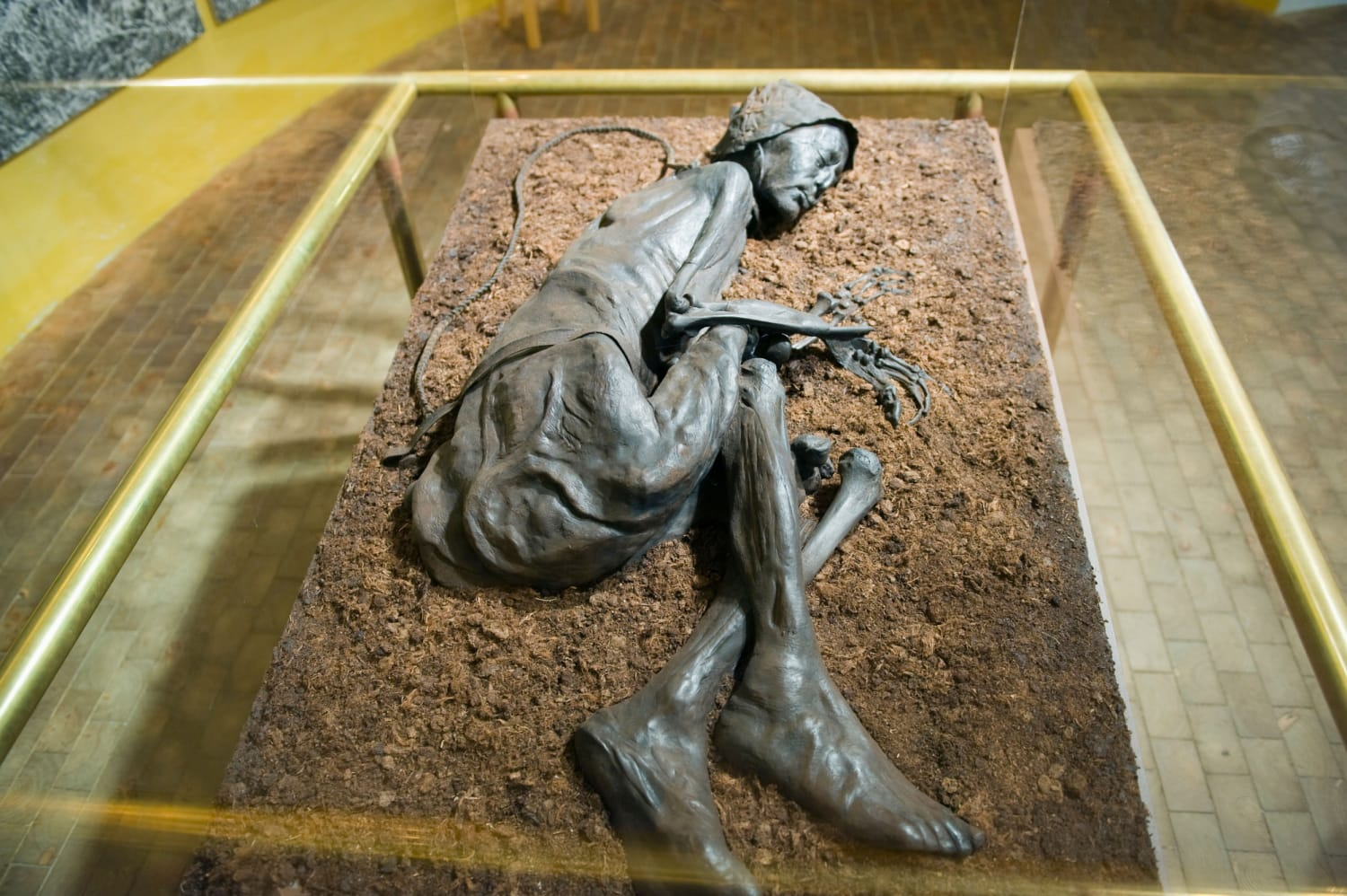
The discovery of Tollund Man in 1950 is one of the most haunting and scientifically significant finds in European archaeology. Found in a peat bog on the Jutland Peninsula in Denmark, the body was so perfectly preserved that the peat cutters who found him initially called the police, believing they had discovered a recent murder victim.
In reality, the man had been dead for approximately 2,400 years, dating back to the Pre-Roman Iron Age (c. 400 BCE).
1. The Chemistry of Preservation: The "Bog Effect"
The reason Tollund Man looks like he is merely sleeping—with visible stubble on his chin and wrinkles on his forehead—is due to the unique environment of a raised bog.
Sphagnum Moss: As this moss dies, it forms peat, which releases a tanning agent called sphagnan.
The "Pickling" Process: The sphagnan reacts with the body's proteins, tanning the skin and turning it into a dark, durable leather. The highly acidic, oxygen-free (anaerobic) environment prevents the bacteria responsible for decay from surviving.
Calcium Dissolution: While the skin and organs are preserved, the acid dissolves the calcium in the bones. This is why Tollund Man appears somewhat flattened or "rubbery"—his skeletal structure has largely disappeared.
2. The Cause of Death: Ritual Sacrifice
While the preservation is a miracle of nature, the circumstances of his death are a window into Iron Age spirituality. Tollund Man did not die of natural causes.
The Noose: He was found with a braided leather noose still tightened around his neck. Forensic analysis of his neck vertebrae and skin confirmed he was hanged, not strangled.
The Peaceful Pose: Unlike many victims of violence, Tollund Man was carefully arranged in a fetal position. His eyes and mouth were closed. This suggests that his death was a ritual sacrifice to a deity—likely a fertility goddess of the bog—rather than a criminal execution.
3. The Last Meal: Forensic Archaeobotany
One of the most famous "mysteries solved" regarding Tollund Man involves his digestive tract. Because the bog preserved his internal organs, scientists could analyze his stomach contents.
The Menu: In 2021, a new high-tech analysis revealed his final meal was a porridge of barley, flax, and gold-of-pleasure seeds, along with some fish.
The "Secret" Ingredient: Scientists found a high concentration of pale persicaria seeds. These were usually considered weed waste. The fact that they were intentionally included suggests the meal was a special "ritual gruel" prepared specifically for the sacrifice.
Timing: The state of digestion indicates he ate this meal between 12 and 24 hours before he was killed.
4. Personal Details: Who Was He?
Through modern forensic technology, we have built a surprisingly intimate profile of this Iron Age man.
Age and Health: He was approximately 30 to 40 years old at the time of death and stood about 161 cm (5'3") tall. Despite his violent end, he appeared to be in relatively good health, though he suffered from intestinal worms.
Clothing: He was buried almost naked, wearing only a pointed sheepskin cap fastened under his chin and a smooth leather belt around his waist. This "nakedness" is a common trait among bog bodies and may have held ritual significance.
5. The Modern Reconstruction
If you visit the Silkeborg Museum today, you will see his original head, which remains the best-preserved part of the body. The body currently on display is a wax replica attached to the original head, as the drying techniques used in the 1950s failed to preserve the rest of the torso properly.
The Tollund Man remains a powerful "ambassador" from the Iron Age. He was a man who lived through a time of massive transition in Europe and was ultimately given to the earth in a way that ensured he would never be forgotten.