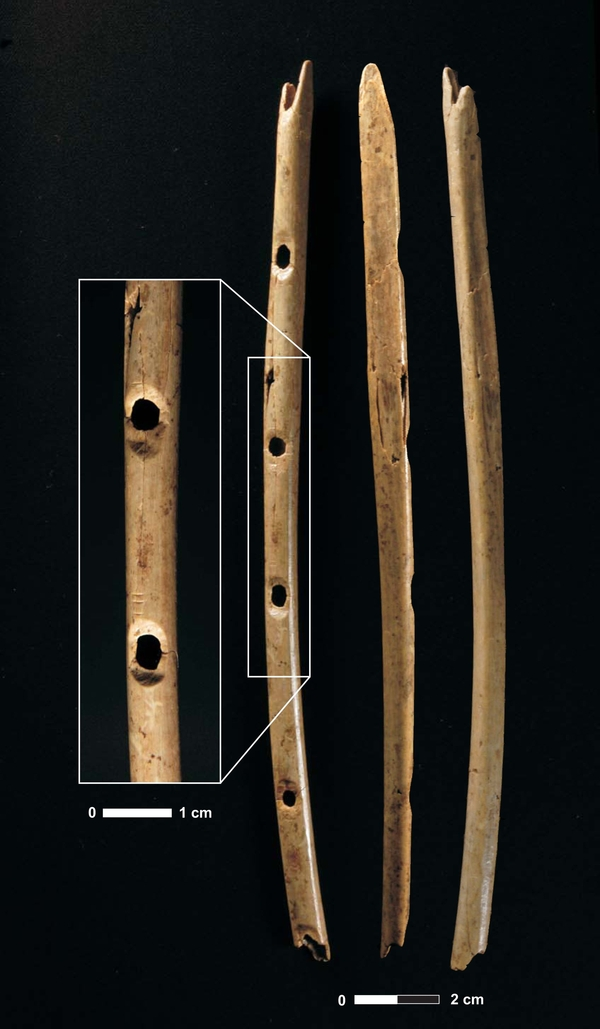
The discovery of bone flutes in the Danube Valley—specifically in caves like Hohle Fels and Geissenklösterle in southwestern Germany—has pushed back the timeline of human musicality by tens of thousands of years.
Dating to approximately 35,000 to 40,000 years ago, these instruments were crafted by some of the first Homo sapiens to enter Europe. They prove that music was not a late development in human history but a fundamental tool used for social bonding, communication, and ritual during the Ice Age.
1. The Hohle Fels Flute: A Masterpiece of Scavenging
The most complete instrument found to date is the Hohle Fels Flute, discovered in 2008. It is crafted from the radius bone of a griffon vulture.
Strategic Material Choice: Bird bones are naturally hollow and thin-walled, making them the perfect "raw pipes" for wind instruments.
Precision Engineering: The flute features five finger holes and two "V-shaped" notches at the mouthpiece. The placement of the holes suggests that Paleolithic humans had a sophisticated understanding of acoustics and pitch.
The Scale: Replicas of the flute have shown that it is capable of producing a variety of notes, which some musicologists suggest are comparable to the modern pentatonic scale.
2. The Mammoth Ivory Flutes: Extreme Craftsmanship
While bird bones were easier to use, the Aurignacian people also crafted flutes from mammoth ivory. This process was significantly more difficult and required immense technical skill.
Split and Glue Technique: Because ivory is solid, the artisan had to carefully saw a tusk into two halves, hollow out the center of each half with stone tools, and then "glue" the halves back together with a resin or pitch to create an airtight seal.
Durability: These flutes were likely high-prestige items. Mammoth ivory is incredibly difficult to work, and the labor involved suggests that music played a central role in the spiritual or social life of the tribe.
3. Why Make Music in the Ice Age?
Archaeologists believe that music provided an evolutionary advantage for Homo sapiens over the Neanderthals (who lived in the same regions but have left behind no definitive musical instruments).
Social Cohesion: Music may have helped early humans maintain larger social networks. Singing and playing together releases oxytocin and endorphins, fostering trust and cooperation within a group.
Ritual and Religion: The flutes were found in the same archaeological layers as the "Venus" figurines and the "Lion Man," suggesting that music was part of a broader symbolic revolution that included art and religion.
Communication: In the echoing environments of deep caves, the sound of a bone flute could travel vast distances, potentially acting as a signaling device or a way to mark territory.
4. The Acoustic Architecture of Caves
The location of these flutes is no coincidence. The Danube Valley caves possess unique acoustic properties that would have amplified the sound of the flutes.
Reverberation: Many Paleolithic caves act as natural resonance chambers. Playing a flute in these spaces would create a rich, immersive sound that might have been perceived as "magical" or "otherworldly."
Sonic Mapping: Some researchers have noted that the areas of caves with the most paintings often have the best acoustic resonance, suggesting that Ice Age rituals were multimodal—combining visual art, firelight, and flute music.
5. The "Neanderthal Flute" Controversy
Before the Danube Valley discoveries, a bone fragment found at Divje Babe in Slovenia (dating to 43,000 years ago) was hailed as a Neanderthal flute. It is a bear femur with two circular holes.
The Debate: While some claim it is a musical instrument, many archaeologists argue the holes are simply bite marks from a cave hyena.
The Distinction: The Danube flutes are indisputably man-made, featuring clear tool marks, beveled edges, and deliberate hole placement, marking a clear "technological leap" in the Homo sapiens record.
The bone flutes of the Danube Valley remind us that the "cavemen" of popular imagination were actually sophisticated artists. They faced the brutal conditions of the Ice Age not just with spears and fire, but with melody and rhythm.