Introduction: The Vanguard of the New Kingdom
When the Hyksos, a coalition of West Asian peoples, conquered Lower Egypt during the Second Intermediate Period, they introduced a revolutionary technology that shattered Egypt’s traditional reliance on massed infantry: the horse-drawn war chariot. Rather than merely adopting this foreign weapon, the pharaohs of the 18th Dynasty (c. 1550–1295 BC)—including Ahmose I, Thutmose III, and Tutankhamun—brilliantly re-engineered, perfected, and institutionalized it.
Under the 18th Dynasty, the chariot was transformed from a heavy, unstable transport platform into an ultra-lightweight, high-velocity weapon system. Combined with the introduction of the composite bow, the Egyptian chariot corps (netjeret) became the elite vanguard of a new, imperial army. This military innovation allowed Egypt to push its borders to their greatest territorial heights, dominating the battlefields of the Levant and establishing a highly mobile micro-empire that redefined Late Bronze Age warfare.
1. The Engineering Triumph: The Lightened Chassis
While contemporary empires like the Hittites built heavy, three-man chariots designed to smash into enemy lines via shock tactics, the Egyptians engineered their vehicles for maximum speed, agility, and stability.
The Weight Reduction: An 18th Dynasty chariot was incredibly light, weighing roughly 65 to 70 pounds. A single warrior could easily lift the entire vehicle over his head to cross rough terrain.
The Flexible Wood Matrix: Instead of using solid wood blocks, Egyptian wheelwrights used heat-bent pliant woods (such as ash, elm, and plum, often imported via trade networks). The frame of the cab was made of bent wood covered in stretched, woven leather mesh rather than heavy wooden paneling, which acted as a natural shock absorber when racing across rocky desert floors.
The Translocated Axle: In early chariot designs, the axle was positioned directly under the center of the riding platform. Egyptian engineers shifted the axle to the absolute rear of the chassis. This wide wheel-track layout dramatically increased stability, allowing drivers to execute high-speed, sharp tactical turns without flipping the vehicle.
2. Wheel Anatomy: The Six-Spoke Revolution
The evolution of the chariot wheel during the 18th Dynasty represents a pinnacle of Bronze Age carpentry, directly dictating the vehicle's combat effectiveness.
From Four to Six Spokes: Early New Kingdom chariots retained the older, four-spoke wheel design. However, by the reign of Thutmose III, engineers standardized the six-spoke wheel. This added structural reinforcement allowed the wheel rim to be thinned out, reducing weight while uniformly distributing the immense downward pressure generated during high-speed maneuvers.
The Segmented Felloe: The outer rim was constructed from curved wooden segments (felloes) lashed together with wet rawhide. As the leather dried, it shrank, binding the wooden joints with iron-like tension.
The Leather Tires: The wheels were wrapped in replaceable leather tires. This padding protected the core wooden rim from fracturing against desert flint and provided crucial traction on shifting sands.
3. The Weapon System: The Mobile Missile Platform
The 18th Dynasty chariot was not a shock-and-awe ramming device; it was an advanced, high-speed missile platform designed to maintain distance while decimating infantry.
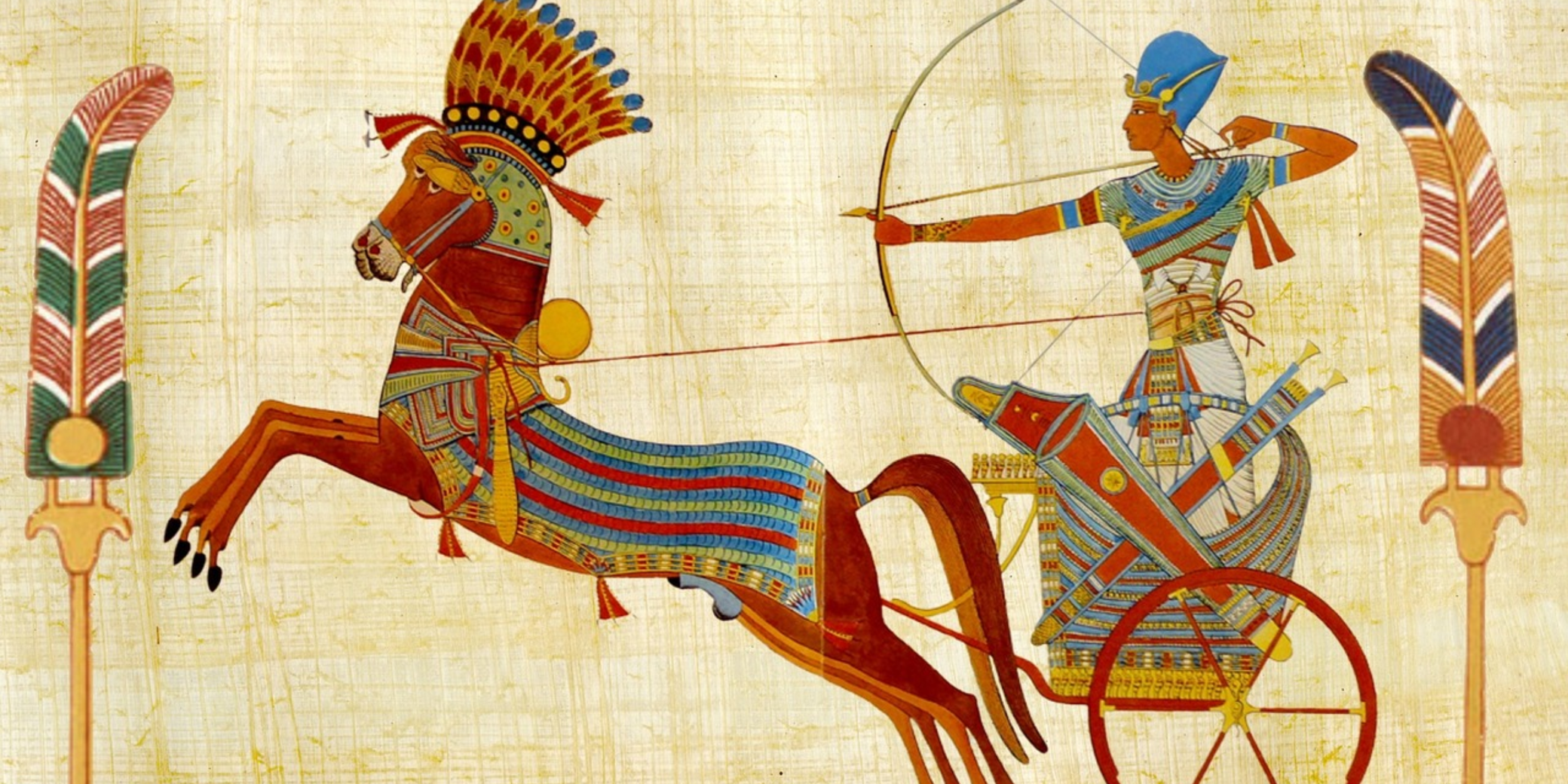
The Composite Bow: The primary armament of the chariot warrior was the composite bow, made of laminated layers of wood, horn, and animal sinew. This weapon possessed double the draw weight and range of a traditional Egyptian longbow, allowing a chariot archer to pierce Bronze Age scale armor from over 200 meters away while moving at speeds of up to 25 miles per hour.
The Quiver Array: Chariot cabs were equipped with dual, crossed leather quivers mounted on the exterior panels. This layout allowed the archer to rapidly draw arrows and swap out bows without breaking his stance or looking away from the enemy line.
4. Tactical Execution: The Battle Assembly
The tactical deployment of the chariot corps was managed with calculated, surgical precision, prioritizing continuous movement over static engagements.
[ LONG-RANGE BARRAGE ] ──► [ SKIRMISHING FLANK ] ──► [ INFANTRY BREAKTHROUGH ] ──► [ PURSUIT & ROUT ]
The Swarm Attack: Chariots were deployed in disciplined tactical units of 10 to 25 vehicles. They advanced in wide, sweeping lines, charging toward the enemy infantry at a dead gallop.
The Wheel-Away Barrage: Just before entering the range of enemy hand-weapons, the entire line would pivot sharply, driving parallel to the enemy front. The archers loosed an uninterrupted barrage of high-velocity arrows into the dense infantry ranks, sowing chaos and fracturing their formations.
The Harassment Loop: The chariots would circle back, reload, and repeat the loop, utilizing their superior speed to remain permanently out of reach of foot soldiers.
The Rout: Once the enemy infantry line broke out of panic, the chariots transitioned into their final tactical role: pursuing fleeing troops, preventing them from reforming, and decimating the retreating army.
5. The Two-Man Crew: Shared Synapse
Each Egyptian chariot operated as a symbiotic unit, requiring absolute trust and division of labor between its two aristocratic occupants.
The Kedjen (The Driver): The driver was responsible for navigation, speed, and defense. He held the reins of two heavily armored stallions. To free up the archer’s hands completely, the driver would frequently tie the long leather reins securely around his own waist, controlling the horses’ direction through shifts in his body weight and leaning stances. He also carried a large shield to protect the archer during close passes.
The Menyt (The Archer): The elite shock trooper of the Egyptian empire. Drawn exclusively from the aristocratic upper classes, these men underwent years of grueling physical conditioning. They had to master the art of balancing on a bouncing, un-sprung platform while simultaneously drawing a 100-pound composite bow and maintaining pinpoint accuracy.
6. The Visual Record: The Reliefs of Thutmose III and Tutankhamun
The definitive archaeological validation of these 18th Dynasty military innovations is preserved across monumental temple walls and tomb treasures.
The Karnak Reliefs: The pylon walls of the Amun Temple at Karnak depict the military campaigns of Thutmose III, the "Napoleon of Egypt." The reliefs capture the Battle of Megiddo (1457 BC), showcasing hundreds of meticulously detailed six-spoke chariots executing a massive pincer movement, confirming the scale and organization of the state-run chariot divisions.
The Treasures of Tutankhamun: When Howard Carter excavated tomb KV62, he recovered six complete, intact chariots. Among them were ultra-lightweight, gold-plated state chariots and simpler, un-adorned hunting and training vehicles.
The physical analysis of these surviving artifacts confirmed every detail found on temple reliefs: the sophisticated use of layered woods, the precise placement of the rear axle, the woven leather floors, and the complex leather horse harnesses, proving that the 18th Dynasty had achieved an unprecedented mastery of automotive engineering in the ancient world.