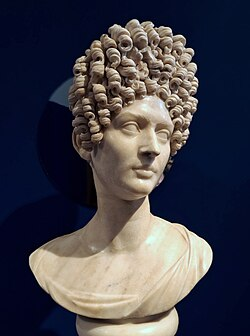
Introduction: The Sculpted Crowns of Imperial Rome
In the high society of ancient Rome, a woman’s hair was far more than a matter of personal grooming; it was a potent visual currency of status, wealth, and political alignment. To appear in public with loose, unstyled hair was a mark of low status, mourning, or cultural backwardness. Elite Roman women, known as matronas, vied for social dominance through increasingly complex, gravity-defying coiffures.
This obsession reached its artistic and logistical zenith during the Flavian Era (69–96 AD). Under the reign of the Flavian emperors—Vespasian, Titus, and Domitian—court fashion shifted away from the simpler, classic styles of the earlier Julio-Claudian dynasty toward dramatic, towering architectural creations. These styles required the complete transformation of the natural head using hairpieces, heavy framing, and elaborate wigs. The resulting coiffures were so monumental that the satirist Juvenal famously remarked that a woman seen from the front looked like a towering building, only to look entirely different from behind.
1. The Flavian Aesthetic: The Orbis Comarum
The signature look of the Flavian aristocratic woman was the orbis comarum (circle of hair). This style transformed the hair framing the face into a massive, semicircular honeycomb of dense curls that rose several inches above the forehead.
The Front Diadem: The hair at the front of the scalp was sectioned off, tightly curled using a thermal iron, and arranged in concentric, vertical rows of hollow, pipe-like curls. This created a dramatic wall of hair that framed the face like a crescent moon or a royal diadem.
The Structural Frame: Because natural hair could not support this vertical weight on its own, hair stylists used internal supports made of wire mesh, bone frames, or tightly woven pads of wool to pad out the structure from within, anchoring the curls to a solid base.
The Chignon: In stark contrast to the voluminous front, the hair at the back of the head was combed smooth, divided into numerous thin braids, and coiled into a tight, flat bun (chignon) pinned low on the nape of the neck.
2. The Logistics of Wigs and Extensions
As Flavian hairstyles grew larger than life, the natural hair of even the wealthiest Roman women proved insufficient. Wigs (galeri) and false hairpieces (crines) became indispensable luxury commodities.
The Source of the Hair: Wigs were valued based on their color and origin. The most expensive and sought-after hair was blonde or red, forcibly shaved or traded from conquered Germanic tribes along the Rhine frontier. Deep, glossy black hair was imported via trade routes from India.
The Construction: Roman wig-makers (capillamentarii) stitched individual strands of natural hair onto custom-fitted caps made of fine leather or open fabric mesh. These wigs could cover the entire head or be split into modular pieces—such as a pre-curled front diadem that could be pinned directly into a woman's natural hair.
The Dye and Powder Economy: To enhance the color of their hairpieces, Roman women used gold dust, saffron dyes, and oils scented with Myrrh. To achieve a uniform, lustrous sheen, they applied a paste made of goat fat and beechwood ash, which acted as an early pomade to lock the elaborate curls into place.
3. The Enslaved Stylists: The Ornatrices
Executing a flawless Flavian hairstyle was a physical impossibility for the woman wearing it. It required an army of specialized, domestic slaves known as ornatrices (singular: ornatrix).
[ Natural Hair Sectioned ] ──► [ Thermal Iron Curling ] ──► [ Wire Frame Anchoring ] ──► [ False Wig Stitching ]
The Hair Dressing Guilds: The ornatrix was a highly trained, valuable asset within an elite Roman household. These women formed their own professional sub-class within the enslaved hierarchy, often training under elder masters to learn the complex geometry of Flavian braiding and curling.
The Calamistrum: The primary tool used by the ornatrix was the calamistrum—a hollow bronze rod. A solid iron rod was heated inside an open braizer of hot coals and then inserted into the bronze sleeve. The hair was wrapped around the heated sleeve to create tight, long-lasting ringlets, a process requiring immense care to avoid burning the mistress's scalp.
The Cruelty of Fashion: Roman literature reveals that the dressing room (ornatorium) was a high-stress, often violent environment. If a curl was asymmetrical or a hairpin slipped, the elite mistress would routinely lash out, striking the ornatrix with a mirror or stabbing her arms with long, sharp hairpins.
4. Materials and Tools of the Craft
The ancient Roman dressing table (mundus muliebris) was stocked with specialized tools designed to construct and maintain these complex hair monuments.
Acus Discriminalis (The Hairpin): These were long, slender pins crafted from carved bone, ivory, silver, or tortoiseshell. They were used to part the hair with geometric precision and to pierce through the heavy coils at the back of the head to lock the chignon in place. Many were topped with intricate sculptures of imperial women or the goddess Venus.
Hair Sewing Needles: Rather than relying entirely on pins, which could slip out during a banquet, ornatrices used bone needles and heavy flax thread to literally sew the braids and false hairpieces together, creating an immovable, structural weave.
Phonetic Pomades: To prevent the hair from frizzing or unraveling in the humid Mediterranean climate, slaves coated the finished structure in a thick layer of boiled lard mixed with herbal extracts, creating a hard, glossy shell.
5. Architectural Parallels in Imperial Art
The dramatic shift in Flavian hairstyling perfectly mirrors the broader architectural developments occurring in the city of Rome during the exact same decades.
The Portrait Sculptures: The definitive evidence for these hairstyles comes from the stunning marble portrait busts of the Flavian era, such as the famous Fonseca Bust in the Capitoline Museums. Roman sculptors had to invent new technical methods to capture the deep texture of the orbis comarum, using deep drilling techniques to hollow out the marble, creating complex patterns of light and shadow that mimicked real hair.
The Colosseum Era: Under the Flavians, Rome witnessed the construction of the Flavian Amphitheater (the Colosseum), an architecture defined by deep, repeating shadowed arches and monumental tiering. The hair of the court women evolved along the exact same aesthetic track: it became heavily tiered, deeply shadowed, and grandly theatrical, turning the female body into a living monument to Flavian engineering and material dominance over the known world.