Introduction: The Center of the Norse Universe
In the harsh, wind-swept landscapes of early medieval Scandinavia, the Viking longhouse (langhús) was far more than a simple shelter from the elements. It was the absolute economic, social, and spiritual anchor of Norse civilization. From the fjords of Norway to the colonies of Iceland and Newfoundland, these monumental timber and turf structures mirrored the hierarchical fabric of the Viking world.
A single longhouse served as a multi-generational home, a bustling factory, a livestock barn, and a political court all under one smoky roof. Whether housing a modest family of farmers or a powerful chieftain surrounded by loyal warriors, the longhouse was where alliances were forged over mead, laws were debated, and the grand oral traditions of the sagas were kept alive during the dark, claustrophobic months of subarctic winter.
1. Structural Engineering: The Anatomy of the Langhús
The architecture of the longhouse was an exercise in master carpentry and environmental adaptation, utilizing local resources to create an incredibly durable, load-bearing framework.
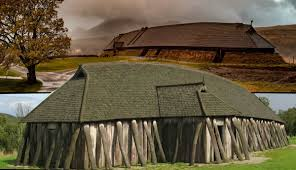
The Long, Curved Profile: Longhouses were typically long and narrow, ranging from 50 to over 100 feet in length. Many displayed a distinct boat-like, bowed profile—the walls curved outward in the center and tapered at the ends—which aerodynamic design helped deflect the fierce Atlantic and Scandinavian winds.
The Load-Bearing Post Rows: Unlike modern buildings where exterior walls hold up the roof, the weight of a longhouse roof was supported internally. Two parallel rows of massive, vertical wooden posts (súlur) ran down the length of the interior, dividing the space into three distinct aisles. This layout relieved the pressure on the exterior walls, preventing them from buckling under thick winter snow.
The Roof and Insulation Matrix: The steep, thatched or shingled roof was designed to shed heavy rain and snow rapidly. In heavily forested areas like southern Scandinavia, walls were constructed of double-layered wooden planks packed with moss. In treeless environments like Iceland and Greenland, builders adapted by constructing massive exterior walls out of cut turf blocks up to six feet thick, providing superb thermal insulation against the arctic cold.
2. Spatial Mapping: The Interior Layout
The interior of a longhouse was a communal, open-plan space, though strictly organized by function and social hierarchy.
The Hearth (Langeldur): Running down the center of the main aisle were one or more long, stone-lined fire pits. The hearth was the literal heart of the home, providing the sole sources of heat, light, and cooking fire. Because there were no chimneys—only simple smoke holes (ljóri) cut into the roof ridge—the upper rafters were perpetually choked with a thick layer of preservative soot and smoke.
The Raised Benches (Pallur): Lining the two outer side aisles were wide, earthen or wooden platforms raised slightly off the floor. Covered in hides, furs, and textiles, these benches served as multi-functional spaces: they were the workspaces where women spun wool during the day, the dining seats during feasts, and the communal sleeping quarters for the entire household at night.
The Chieftain's High Seat (Öndvegi): In a chieftain’s hall, the center of the platform featured the high-seat pillars. These heavily carved wooden posts faced the hearth and marked the absolute seat of authority, reserved exclusively for the master of the house and distinguished guests.
3. Social Life: Hierarchy Under One Roof
The longhouse was a dense, intimate, and intensely social ecosystem where privacy was non-existent. A single large longhouse could home anywhere from 20 to 50 individuals, encompassing a strict social hierarchy.
The Extended Kinship Network: Living together were the chieftain or patriarch, his wife (who managed the household keys and finances), their children, elderly relatives, and foster children.
The Thralls (Enslaved Labor): At the absolute bottom of the social ladder were the thralls. They performed the most grueling domestic and agricultural chores, sleeping on the cold dirt floors near the entryway or in the smoke-filled corners of the house, completely exposed to the whims of the family.
The Retinue (Lið): In elite longhouses, the benches also housed the chieftain's hird—his personal bodyguard of sworn warriors. Their presence turned the longhouse into a continuous military barracks, ensuring the chieftain's local political dominance.
4. Domestic Economy and the Winter Barn
The survival of a Viking homestead depended entirely on the longhouse functioning as a self-sustaining economic engine.
The Integrated Byre (Barn): The most distinct feature of many longhouses, particularly in the North Atlantic colonies, was the integration of the livestock barn directly into one end of the structure. A sturdy wooden partition separated the human living quarters from the animal stalls.
The Symbiotic Heat System: During the brutal subarctic winters, cattle, sheep, and horses were brought inside and locked into these tight stalls. The collective body heat generated by the livestock radiated through the wooden partitions, significantly warming the human side of the house and conserving precious firewood.
The Textile Loom: Near the warmest part of the main hall stood the heavy, upright warp-weighted loom. Here, the women of the household spent countless hours spinning and weaving the heavy wool cloth (vaðmál) required for everyday clothing, winter cloaks, and the massive, wind-resistant sails that powered the Viking longship expansion.
5. Archaeological Footprints: How We Reconstruct the Langhús
Because timber, thatch, and turf rot away over centuries, archaeology relies on meticulous forensic excavation techniques to reconstruct these ancient structures.
Posthole Staining: When a massive structural wooden post rots in situ, it leaves behind a distinct, dark circular stain in the lighter subsoil, known as a posthole ghost. By mapping the geometric patterns of these stains, archaeologists can determine the exact size, shape, alignment, and load-bearing capacity of a longhouse that vanished a thousand years ago.
Phosphate Mapping: Human and animal waste leaves behind heavy concentrations of microscopic chemical compounds, particularly phosphates, in the dirt floors. By conducting chemical sampling across an excavation site, archaeologists can map out exactly where the livestock stalls ended, where human food preparation occurred, and where the cleanest sleeping quarters were located.
Key Excavated Sites:
Borg in the Lofoten Islands (Norway): The largest known Viking longhouse ever discovered, measuring a staggering 272 feet (83 meters) in length. It belonged to a powerful chieftain and has been fully reconstructed as a living history museum.
L’Anse aux Meadows (Newfoundland, Canada): The definitive archaeological proof of the Norse exploration of North America. Excavations here revealed three distinct timber-and-turf longhouses built using the exact same structural engineering principles as those found in Viking Age Iceland, confirming the accuracy of the Vinland Sagas.