Introduction: The Sacred Truce and the Arenas of Honor
Every four years in ancient Greece, a sacred truce (ekecheiria) was proclaimed across the Mediterranean. Heralds traveled to every city-state, commanding a temporary halt to all wars so that athletes, spectators, and diplomats could travel safely to the Peloponnese. Their destination was Olympia, the religious sanctuary of Zeus and the birthplace of the Panhellenic Games.
While modern culture views the Olympics as a secular celebration of global sport, the ancient Panhellenic Games—comprising competitions at Olympia, Delphi, Nemea, and Isthmia—were fundamentally religious festivals wrapped in intense military elitism. To the ancient Greeks, athletic victory was the ultimate manifestation of arete (virtue and excellence), a divine sign that the gods favored an individual’s physical and moral lineage. Through the lens of archaeology, the excavated stadiums, training grounds, and bronze prize artifacts reveal a gritty, highly competitive world where athletes ran, wrestled, and raced chariots to achieve literal immortality in the collective memory of Hellas.
1. The Panhellenic Circuit: The Crown Games
The Panhellenic games were organized into a four-year cycle known as an Olympiad, which served as the foundational calendar system for the entire Greek world. Unlike modern games that award gold, silver, and bronze, the ancient circuit awarded only a crown of foliage, making them the Stephanitic (Crown) Games.
The Olympic Games (Olympia): Held every four years in honor of Zeus. The ultimate prize was a crown of sacred olive leaves. This was the oldest and most prestigious festival, dating traditionally to 776 BC.
The Pythian Games (Delphi): Held every four years at the sanctuary of Apollo to celebrate the god's victory over the monstrous serpent Python. Because Apollo was the patron of the arts, these games uniquely featured competitions in music, poetry, and drama alongside athletics. Winners received a crown of laurel leaves.
The Nemean Games (Nemea): Held every two years in honor of Zeus. The sanctuary was located in a secluded valley where Hercules famously slew the Nemean Lion. Winners were crowned with wild celery.
The Isthmian Games (Isthmia): Held every two years at the narrow Isthmus of Corinth in honor of Poseidon, the god of the sea and horses. Its proximity to a major maritime trade hub made it the most heavily attended and commercialized festival on the circuit. Winners received a crown of pine or dry celery.
2. The Architectural Anatomy of the Games
Excavations across the Panhellenic sanctuaries have revealed a standardized set of monumental structures designed to facilitate athletic training, preparation, and public spectacle.
The Palaestra and Gymnasium: Long before entering the stadium, athletes spent a mandatory month training at the host sanctuary. The Gymnasium was a vast, open-air colonnaded courtyard used for javelin, discus, and running practice. Adjacent to it was the Palaestra, a smaller, square structure centered around a sand-filled courtyard, equipped with undressing rooms, baths, and oiling rooms specifically designed for wrestlers and boxers.
The Krypte (The Secret Vault): At Olympia, athletes entered the track through a long, narrow, stone-vaulted tunnel known as the Krypte. This subterranean passageway acted as a psychological threshold, funneling the naked competitors out of the quiet, sacred grove of temples directly into the roaring, sun-drenched chaos of the stadium.
The Stadium (Stadion): The ancient Greek stadium was not a circular bowl, but a long, rectangular field flanked by natural or artificial earthen banks where up to 45,000 spectators sat directly on the ground. The length of the track was universally fixed at 600 Greek feet, though the actual measurement varied slightly between sites because it was based on the local footprint of a mythical hero (Olympia’s track was roughly 192 meters, while Delphi’s was 177 meters).
3. The Mechanics of the Starting Line: The Hysplex
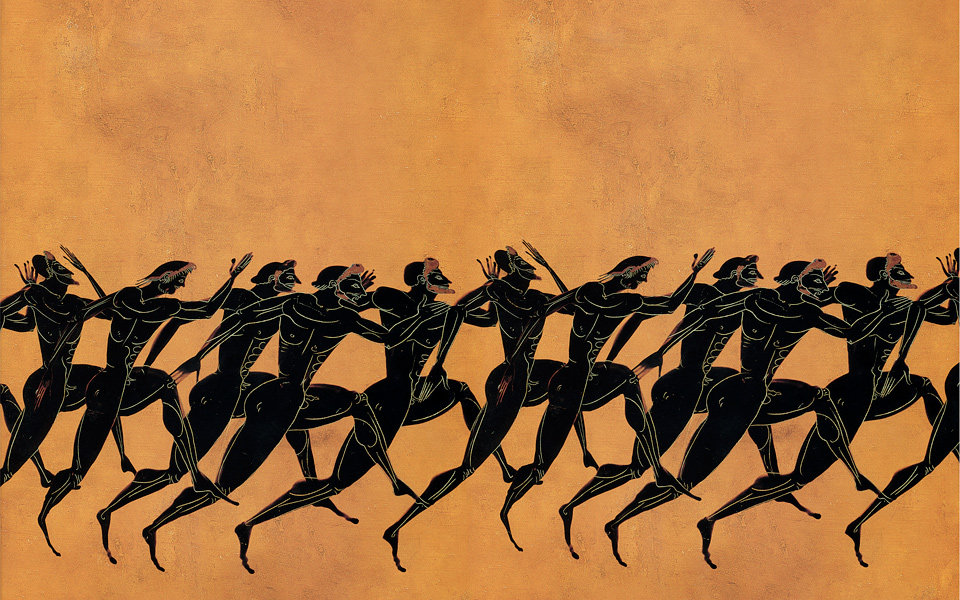
In short-distance running events like the stade (one length of the track) or the diaulos (two lengths), preventing false starts was a critical engineering challenge. To ensure absolute fairness, the Greeks invented a brilliant mechanical starting gate known as the Hysplex.
The Balbis: Running across the width of the track were stone sills called balbides. These stones featured two parallel, shallow grooves carved into the surface where runners locked their bare toes into position, adopting an upright, leaning stance rather than the modern crouch.
The Wooden Barrier: In front of each runner stood a horizontal wooden gate or rope held upright by vertical wooden posts mounted on metal springs or torsion coils at either end of the starting line.
The Catapult Drop: A starter judge stood behind the runners holding strings connected to a central master lever. When the signal was given, the judge released the lever, causing all the vertical posts to instantly snap forward and drop the ropes to the ground simultaneously. If an athlete tried to jump the gun, they would trip over the rising or falling rope, facing immediate public humiliation and a brutal beating by the rabdouchoi (whip-bearing track officials).
4. The Agon: Heavy Events and Kinetic Realism
The heart of the Panhellenic games lay in the agon—the brutal, high-intensity combat and throwing events that closely mirrored the physical realities of Bronze and Iron Age warfare.
The Pentathlon: The ultimate test of the all-around warrior, combining five events held on a single day: the discus, the javelin (thrown using a leather launch strap called an ankyle), the running long jump, the stade sprint, and wrestling.
The Halteres (Jumping Weights): Archaeological excavations have recovered numerous halteres—stone or bronze weights carved with custom finger grips. In the long jump, athletes swung these weights forward during takeoff to generate forward momentum, and then violently thrust them backward mid-air just before landing to extend their trajectory into the sandpit.
The Pankration: Literally meaning "all-powerful," this was an extreme, no-holds-barred combat sport combining elements of boxing, wrestling, and submission grappling. Only two rules existed: no eye-gouging and no biting. Matches took place on wet, muddy sand and carried no time limits or weight classes; a bout ended only when an athlete raised a single index finger to signal submission, or died in the arena.
5. Material Culture: The Accoutrements of the Naked Athlete
Greek athletes competed entirely in the nude (gymnos), a cultural practice that distinguished civilised Greeks from "barbarians" who viewed public nudity with shame. This practice birthed a highly specific material culture centered around body maintenance and civic pride.
The Aryballos and the Strigil: Before competing, athletes coated their entire bodies in olive oil to protect their skin from the sun, lock in moisture, and make it harder for wrestling opponents to secure a grip. After the events, they used a strigil—a curved, crescent-shaped bronze or iron scraping tool—to systematically scrape off the gloios, a thick paste of sweat, oil, and arena dust. This scrapings paste was highly prized; it was collected in jars and sold to wealthy citizens as a medicinal ointment for muscle aches.
The Halma and Discus Archaeology: Surviving artifacts show a clear evolution in sports technology. Early discuses were crafted from carved stone, later giving way to standardized bronze discuses weighing anywhere from 4 to 12 pounds. Many of these bronze plates survive because they were inscribed with dedications to the gods and buried as permanent votive offerings inside temples after a victory.
6. The Votive Landscape: Monuments of Victory and Shame
The archaeological layout of a Panhellenic sanctuary was a dynamic political map where rival city-states used art, architecture, and monuments to launch proxy propaganda wars against one another.
The Treasuries: Along the sacred ways leading to the main temples at Delphi and Olympia sat rows of Treasuries—small, highly ornate, temple-like buildings constructed by individual city-states (like Athens, Sparta, or Thebes). These structures served as secure vaults to display the spoils of war and the rich athletic trophies won by their citizens, projecting civic wealth and military dominance to all who walked past.
The Epinikian Statues: If an athlete won an event, they or their wealthy patrons gained the right to erect a life-sized bronze or marble statue within the sacred grove. Sculpted by the master artists of the age, such as Polyclitus or Myron, these statues did not capture realistic facial portraits; instead, they captured the mathematical perfection of the idealized human form, freezing the athlete's fleeting earthly victory into an eternal, divine monument.
The Zanes (The Statues of Shame): Directly outside the entrance to the stadium at Olympia stood a row of bronze statues of Zeus known as the Zanes. These statues were funded entirely by the heavy fines levied against athletes caught cheating, bribing judges, or throwing matches. As competitors walked through the tunnel into the stadium, they were forced to pass these monuments of disgrace, which were inscribed with the cheating athlete's name and family lineage—a stark visual reminder that athletic glory could not be bought, and that the eyes of the gods saw through the illusions of the arena.