Introduction: The Canvas of Ceramic Canvas
In the archaic and classical eras of ancient Greece, Athenian pottery was not merely utilitarian tableware; it was a dominant medium for storytelling, propaganda, and artistic competition. Potters and painters working in the Kerameikos (the potters' quarter of Athens) continuously innovated to capture the dynamism of the human form, mythology, and daily life.
The evolution of this art form is defined by two revolutionary, opposing techniques that dominated the 6th and 5th centuries BC: Black-Figure and Red-Figure. By fundamentally reversing the relationship between foreground and background, Greek artisans transformed a rigid, silhouette-based craft into a fluid, three-dimensional masterclass in draftsmanship, changing the trajectory of Western art.
1. The Chemistry of the Three-Phase Firing
Before comparing styles, it is essential to understand that both techniques relied on the exact same chemical wizardry. Greek painters did not use paint; they used a liquid clay slip (refined clay suspended in water) on unfired pots. The dramatic colors were achieved entirely through a highly sophisticated, three-phase firing process inside wood-burning kilns.
Phase 1: Oxidizing (The Fire): Air was allowed into the kiln at around 800°C. The entire vase turned a bright, rusty red as the iron in the clay absorbed oxygen.
Phase 2: Reducing (The Smoke): The air vents were closed, and green wood or water was added to create a smoky, oxygen-starved environment while the temperature was raised to 950°C. The intense heat fused the silica in the painted slip areas, turning them into a vitrified, glassy black layer. The unpainted clay turned a dark, smoky gray.
Phase 3: Re-oxidizing (The Cool Down): The vents were reopened as the kiln cooled. Oxygen rushed back in. The porous, unpainted clay re-absorbed the oxygen and turned bright orange-red again. However, the vitrified slip areas were sealed tight; they could not absorb oxygen and remained a glossy, midnight black.
2. The Black-Figure Technique (c. 620 – 530 BC)
Originating in Corinth and perfected in Athens, the Black-Figure style treated the vase like a shadow puppet theater.
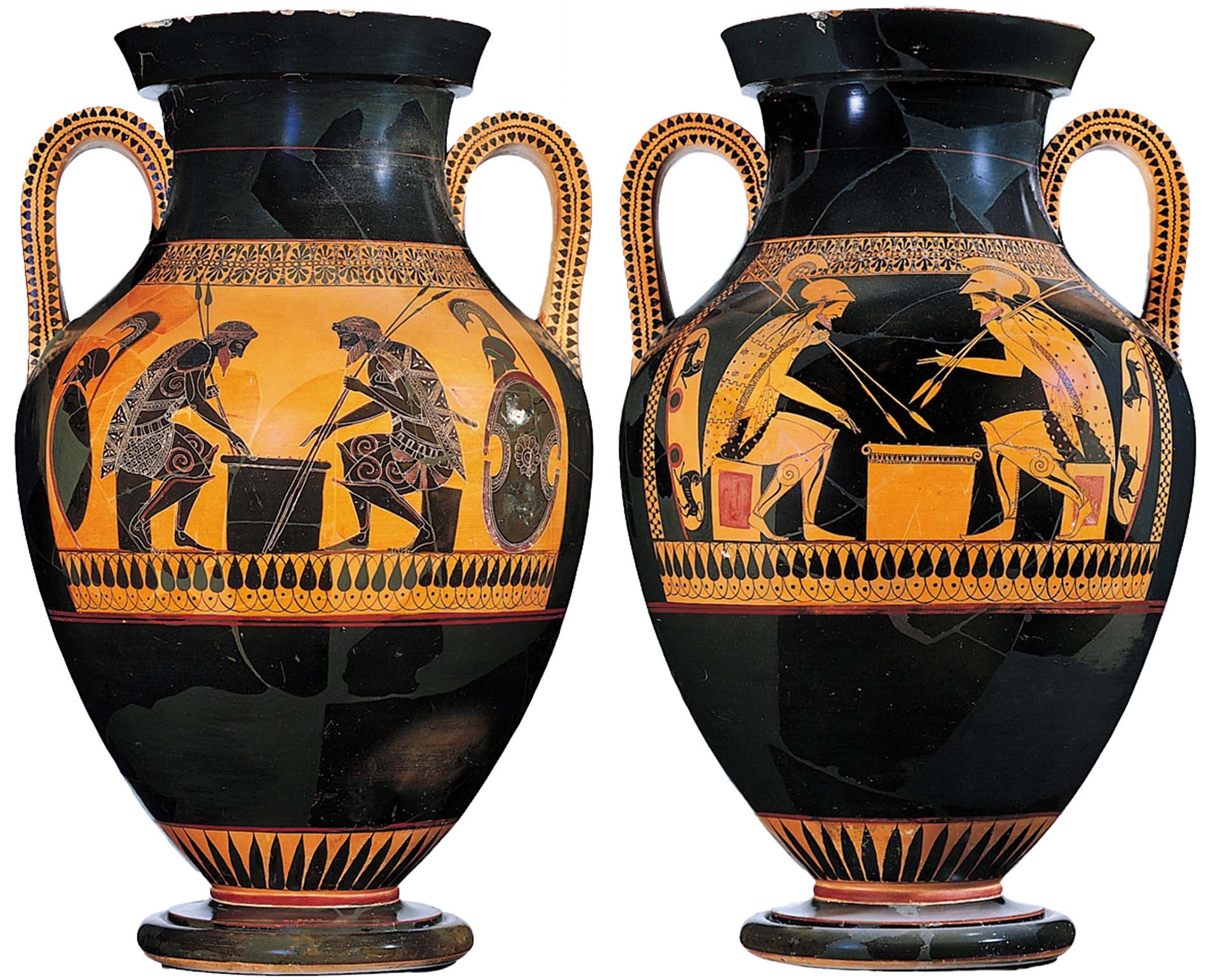
The Execution: The artist painted the figures as solid, flat silhouettes using the refined clay slip directly onto the pale orange clay body of the vase.
The Details: To add anatomy, eyes, or patterns on clothing, the artist used a sharp metal tool called a stylus to literally scratch away the black slip, incising fine lines that revealed the lighter clay beneath. White and purple-red clay pigments were occasionally added afterward to distinguish details like women's skin or fabric patterns.
The Aesthetic: Figures were inherently two-dimensional. Because it required scratching through dried slip, the lines were rigid, sharp, and geometric. Profiles were strict, and overlapping figures were difficult to depict clearly.
3. The Red-Figure Technique (c. 530 – 300 BC)
Invented in Athens around 530 BC—credited to the workshop of the potter Andokides—the Red-Figure technique flipped the entire process on its head.
The Execution: Instead of painting the figures, the artist painted the background with the black slip, leaving the figures themselves untouched as the raw, red-orange clay.
The Details: Instead of scraping away lines with a stylus, the artist drew internal anatomical details directly onto the red figures using a fine brush or a syringe-like tool filled with slip. These lines could be thick and raised (relief lines) or diluted to a light golden-brown (dilute slip) for subtle shading and musculature.
The Aesthetic: This single inversion revolutionized Greek art. Because drawing with a brush is infinitely more fluid than scratching with a metal tool, artists could suddenly paint foreshortening, three-quarter views, realistic fabric folds, and anatomical depth.
4. Technical Comparison
5. The "Bilingual" Transition Phase
The transition from Black-Figure to Red-Figure did not happen overnight. For a brief period in the late 6th century BC, Athenian workshops produced what modern archaeologists call Bilingual Vases.
The Hybrid Canvas: These rare vessels featured the exact same mythological scene painted on both sides of the same pot—one side executed in the traditional Black-Figure style, and the opposite side executed in the experimental Red-Figure style.
The Marketing Tool: Bilingual vases served as artistic showpieces. They allowed master potters to demonstrate their mastery of both styles simultaneously, easing conservative customers into accepting the radical new red-figure aesthetic that would soon dominate the Mediterranean market.
6. Legacy and Artistic Impact
The shift from Black-Figure to Red-Figure tracks perfectly with the broader cultural shift from the Archaic to the Classical period in Greece.
As Greek sculptors began understanding the organic weight-shift of the human body (contrapposto), vase painters used the red-figure technique to match that realism on clay. Master painters like Euphronios and Euthymides pushed the medium to its absolute limits, signing their work and actively boasting about their ability to render complex human movement. By freeing the brush from the restriction of the incised line, the red-figure breakthrough allowed pottery to step out of the realm of repetitive geometric craft and into the realm of high classical art.