In the 7th century BC, the Neo-Assyrian King Ashurbanipal established what is considered the world's first truly systematic library in his capital, Nineveh. While earlier rulers had kept archives, Ashurbanipal’s project was unique in its "Old Style" ambition: he sought to collect the entirety of human knowledge under one roof, organized and cataloged for the first time in history.
1. The Royal Mandate: "The King’s Search"
Ashurbanipal was a rare literate king in an age of warriors. He claimed to have mastered the art of writing (scribalism) and the complexities of mathematics.
The Collection Strategy: He didn't just wait for books to arrive; he sent agents across Mesopotamia with royal decrees. He commanded them to seize or copy every significant tablet from private collections and temple archives, particularly in Babylon.
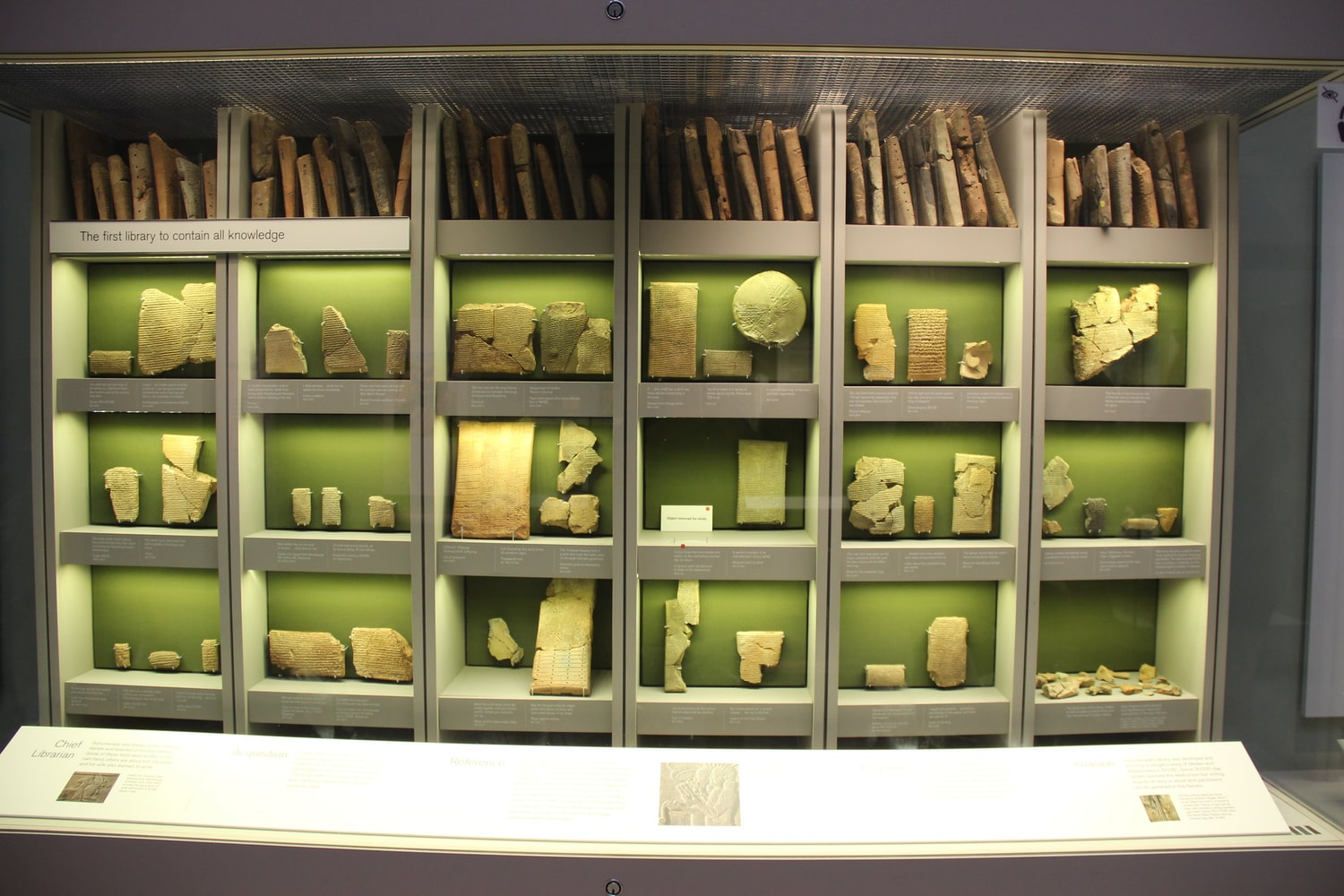
The Scope: Archaeologists have recovered roughly 30,000 cuneiform tablets and fragments. The library contained everything from state records and treaties to medical texts, incantations, and great works of literature.
2. The First Cataloging System
The Library of Ashurbanipal introduced the "Old Style" precursors to modern archival science.
Classification by Subject: Tablets were not thrown into piles but were organized by genre—astrology, omens, grammar, and history—and kept in dedicated rooms.
Colophons (The Ancient Metadata): At the bottom of most tablets, scribes added a colophon. This was a "label" that included the title of the work, the name of the scribe, the source from which it was copied, and a warning that the tablet was the personal property of the King’s palace.
Shelving and Tags: Clay tags were often attached to baskets or shelves, identifying the contents of the tablets within, allowing the King’s librarians to retrieve specific information quickly.
3. The Rediscovery of Epic Literature
The library is the primary reason we have access to the masterpieces of Mesopotamian culture today.
The Epic of Gilgamesh: The most complete version of this epic—the oldest known work of great literature—was found among the ruins of the library.
The Enuma Elish: The Babylonian creation myth was preserved here, detailing the "Old Style" cosmology of the gods and the rise of Marduk.
Bilingual Texts: The library contained many Sumerian-Akkadian dictionaries and grammars. Since Sumerian was a dead "prestige" language even then, these tablets were essential for scholars to translate ancient rituals.
4. Knowledge as Power: The Omen Texts
For Ashurbanipal, the library was a tool of statecraft. A large portion of the collection consisted of "Omen" texts.
Divination: By studying the movements of the stars (astrology) or the livers of sacrificed animals (extispicy), the King believed he could predict the future.
Information Supremacy: Having the most complete collection of these texts meant the King had the "Old Style" monopoly on divine communication, ensuring no rival could claim a better understanding of the gods' will.
5. The Architecture of Information
The tablets were housed in the North Palace and the Southwest Palace of Nineveh.
Durability: Unlike the Library of Alexandria, which was lost because papyrus burns, the Library of Ashurbanipal was "saved" by fire. When Nineveh was sacked by the Medes and Babylonians in 612 BC, the fire that destroyed the buildings baked the clay tablets, making them harder and preserving them for millennia beneath the rubble.
6. The Legacy of the "King of the World"
When Sir Austen Henry Layard and Hormuzd Rassam excavated the site in the mid-19th century, the discovery changed our understanding of history. It proved that the "Old Style" of intellectual organization we often attribute to the Greeks actually had roots thousands of years earlier in the Fertile Crescent.