Introduction: The Uncrackable Script of the Aegean
When the British archaeologist Sir Arthur Evans unearthed the ruins of Knossos on Crete in 1900, he did not just discover a palace; he discovered a forgotten civilization. Among the artifacts were thousands of baked clay tablets covered in a sophisticated, linear script that Evans named Linear B. For over half a century, these tablets remained a profound historical dead end. Scholars worldwide tried and failed to read them, stymied by Evans’s dogmatic belief that the script recorded a non-Greek, indigenous Minoan language.
The breakthrough did not come from an established professor of classics, but from Michael Ventris, an English architect and wartime codebreaker. Approaching the tablets as a pure cryptographic cipher rather than a linguistic relic, Ventris pulled off what has been called the philological triumph of the 20th century. By systematically mapping the internal mechanics of the symbols, he proved that Linear B was actually an incredibly ancient, Bronze Age dialect of Greek—rewriting the history of the Aegean and pushing back the dawn of Western literacy by half a millennium.
1. The Linguistic Enigma of Crete
When Sir Arthur Evans excavated the Palace of Knossos in 1900, he discovered thousands of clay tablets covered in two distinct, unknown scripts. He labeled them Linear A and Linear B.
The Stagnation: Evans fiercely maintained that Linear B represented a distinct, non-Greek Minoan language. Because of his immense authority in the archaeological world, he restricted access to the tablets for decades. This gatekeeping severely hindered progress, leaving Linear B an unsolved riddle for over half a century.
The Three Assumptions: To decipher an unknown script, cryptanalysts generally need to know the language it represents, the script's mechanics, or a bilingual monument (like the Rosetta Stone). Linear B had none of these. Investigators had to deduce the internal logic of the language entirely from the clay fragments themselves.
2. Alice Kober’s Grid
Before the script could be decoded, an American classicist named Alice Kober laid the critical mathematical foundation. She realized that without knowing how a single sign sounded, she could still prove the grammatical structure of the language.
Inflection and Triplets: Kober noticed that certain words shared the same initial symbols but changed their ending symbols depending on the context. She isolated these "triplets" and deduced that Linear B belonged to an inflected language, meaning word endings changed to alter meaning (similar to Latin or Greek).
The Consonant-Vowel Junction: By mapping how these endings swapped out, Kober began building a grid that linked signs sharing the same consonant or vowel. While she passed away in 1950 before completing the work, her structural grid provided the exact blueprint needed for the final breakthrough.
3. Michael Ventris’s Cryptanalytic Approach
Michael Ventris was not an academic classicist; he was an architect who had served as a codebreaker during World War II. He approached Linear B not as a literary puzzle, but as a pure cryptographic cipher.
[ UNKNOWN SYMBOLS ] ──► [ Map Structural Alterations ] ──► [ Inject Geographic Hypotheses ] ──► [ Pylos / Knossos Match ] ──► [ GREEK ]
The Syllabary Deduction: Ventris counted approximately 87 distinct signs in the script. Because this number was too large for an alphabet (which typically has 20–30 signs) and too small for a logographic system like Chinese (which has thousands), he deduced that Linear B was a syllabary, where each sign represents a consonant-vowel pair (e.g., da, me, ko).
The Architectural Grid: Expanding on Kober’s work, Ventris built a massive punch-card grid system, systematically linking signs into phonetic relationships based on their frequency and positioning within words.
4. The Geographic Breakthrough
In 1952, Ventris decided to test a radical hypothesis: that certain repeating words on the tablets were actually the names of specific Cretan towns.
Targeting the Towns: He isolated a specific triplet of words found frequently on tablets from Knossos. He guessed that these represented the towns of Knossos, Amnisos (its harbor town), and Tylissos.
Unlocking the Phonetics: By forcing the known consonant-vowel patterns of these city names into his grid, the symbols began to click into place. Suddenly, the word endings associated with these places started spelling out archaic grammatical suffixes.
5. The "Aha" Moment: It is Greek
Ventris had long believed, like Evans, that Linear B was an indigenous Minoan tongue. However, as the phonetic values from the town names spread across the rest of his grid, recognizable words began to emerge.
The Unexpected Discovery: The signs did not form a mysterious, exotic language. They spelled out words like po-me (ποιμήν - shepherd), ka-ko (χαλκός - bronze), and do-e-ro (δοῦλος - slave).
The Oldest Greek: Linear B was actually an incredibly archaic, Bronze Age dialect of Greek, pushing back the written history of the Greek language by more than 500 years. It was the language of Homer's heroes, written seven centuries before the rise of Classical Athens.
6. The Ultimate Verification: The Tripod Tablet
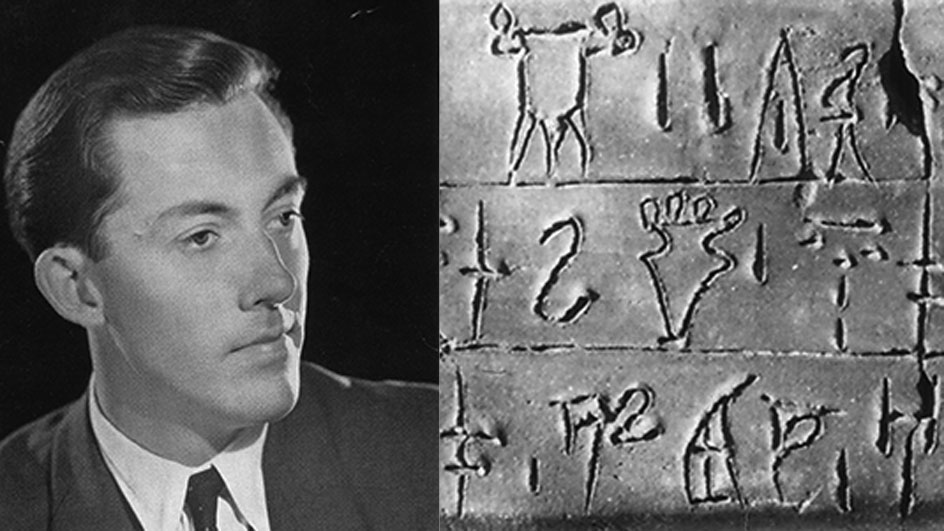
In 1953, archaeologist Carl Blegen discovered a brand new Linear B tablet at Pylos on the Greek mainland, cataloged as Ta 641. Ventris’s grid was applied to this unseen artifact to test its validity.
The Perfect Match: The tablet featured drawings of vessels next to Linear B text. Using Ventris's system, the text next to a three-legged pot spelled out ti-ri-po-de (tripodes—three-legged pots). The text next to a pot with four handles spelled out qe-to-ro-we (four-eared), and the pot with three handles read ti-ri-o-we (three-eared).
The Verdict: The decipherment was a resounding success. The Tripod Tablet provided undeniable, visual proof that Ventris's architectural approach had cracked the code, transforming our entire understanding of the prehistoric Aegean world.