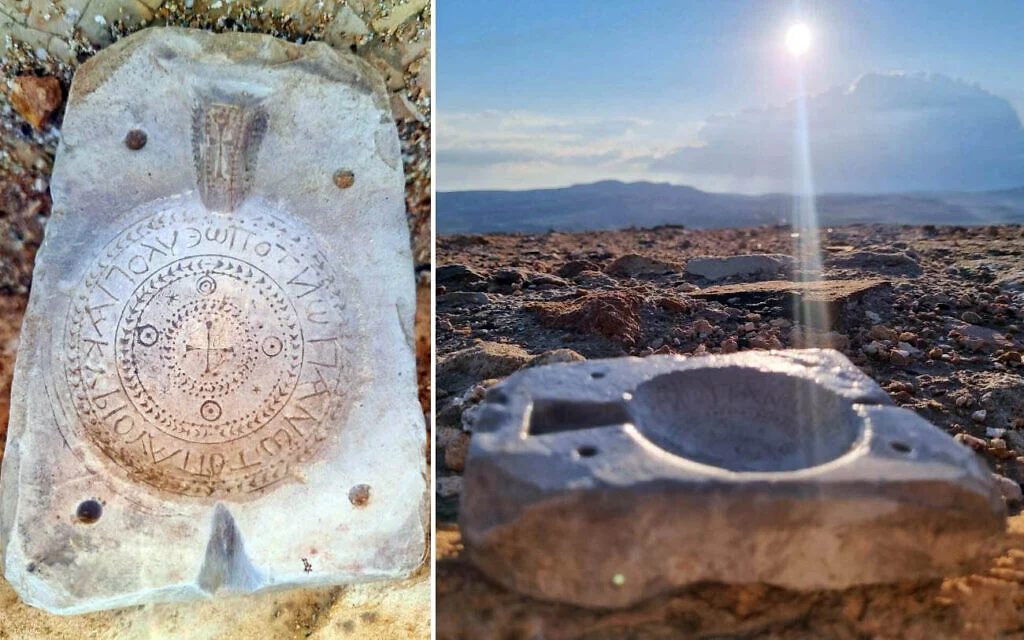
Archaeologists working at the isolated site of Hyrcania in the Judean Desert have discovered an unusual limestone mold once used to make small pilgrimage flasks over 1,400 years ago. The find offers new insight into the scale and meaning of Christian pilgrimage during the Byzantine era. Reported by scholars from the Hebrew University of Jerusalem and first noted by The Times of Israel, the discovery suggests the presence of a local workshop that produced religious souvenirs for pilgrims visiting the Holy Land.
The object is a two-part mold designed to cast small containers known as ampullae. It features a decorative cross and a Greek inscription reading “Lord’s blessing from the holy places.” These vessels were probably filled with oil, water, or soil linked to sacred locations and taken home by pilgrims as physical tokens of their spiritual journey.
Researchers date the mold to the 6th–7th centuries CE, a time when Christian settlements and monasteries were expanding throughout the Judean Desert. Comparable flasks have been found in distant regions such as Northern Italy, indicating wide-ranging networks of pilgrimage, trade, and religious exchange within the Byzantine world.
Insight into Hyrcania’s complex history
Hyrcania is located east of Jerusalem, overlooking the rugged valleys and plateaus of the Judean Desert—a severe yet historically significant region that marked the boundary between inhabited land and wilderness. The site began as a Hasmonean fortress in the late 2nd to early 1st centuries BCE and was later reconstructed by Herod the Great. After being abandoned, it was reoccupied in the 5th century CE as a Christian monastery associated with Saint Sabas, a prominent monastic figure.
The desert environment strongly shaped monastic life at Hyrcania. The Judean Desert hosted many monastic communities that valued isolation for spiritual purposes. Its steep cliffs, caves, and seasonal streams provided solitude and protection, while its closeness to Jerusalem and the Dead Sea maintained links to pilgrimage paths and trade routes.
The mold was uncovered alongside other notable finds, including gold coins, a gold ring, fragments of inscriptions, and the lid of a stone reliquary. Together, these artifacts help illustrate everyday life at the monastery and reveal how pilgrims engaged with the religious communities they visited.
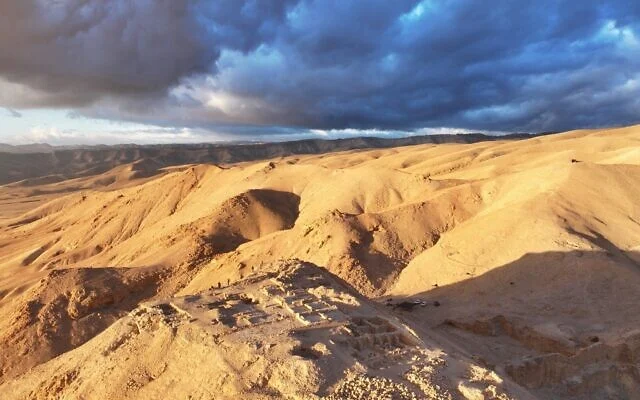
Hyrcania, located in the Judean Desert in the West Bank, as seen at the conclusion of the second excavation season in February 2025.
Evidence of a pilgrimage economy
Lead excavators Dr. Oren Gutfeld and Michal Haber describe the flask mold as direct evidence of a “flourishing Christian pilgrimage industry” operating in the region during the Byzantine era. Rather than being simple trinkets, the ampullae were devotional objects — portable blessings that travelers carried back to their hometowns.
The Judean Desert’s monasteries were not only spiritual centers but also nodes in a broader economic landscape. Pilgrims purchased food, lodging, manuscripts, and keepsakes as they moved between Jerusalem, Bethlehem, and desert monasteries such as Mar Saba and Hyrcania. The production of souvenir flasks suggests that craft workshops may have operated alongside the monastic community, either run by resident artisans or by visiting tradespeople.
The discovery also helps explain why similar flasks have been unearthed in Europe and the Near East. As pilgrims traveled home, they spread artistic motifs, inscriptions, and devotional practices that reflected the Holy Land’s sacred geography.
Protecting a vulnerable heritage site
Excavations at Hyrcania are part of an ongoing effort to rescue and research the site after decades of looting and erosion. The project, carried out in cooperation with the Civil Administration’s Archaeology Unit, combines salvage archaeology with academic study to document fragile remains before they are lost.
Researchers emphasize that the finds are still undergoing conservation and analysis, but early results underscore the site’s importance for understanding both the Second Temple period and the Byzantine monastic world.