In recent years, just off the shore of Lake İznik in northwestern Turkey, archaeologists have uncovered the remains of a 4th-century basilica dedicated to St. Neophytos, hidden beneath the water for more than seven centuries. The structure, which clearly was not originally built underwater, is believed to have been destroyed by an earthquake in 1065, after which rising lake waters gradually submerged the ruins.
Archaeologists who examined the site describe it as a classic basilican layout, featuring three naves, an eastern apse, a narthex, and what appears to be a baptistery area. Images of the ruins first emerged in 2014, prompting research teams to begin underwater studies of the site.
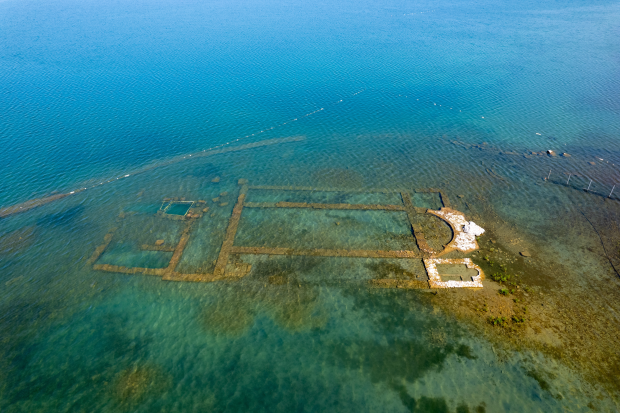
Now, time and nature have combined to reveal the ruins once hidden beneath Lake İznik. What was previously five to seven feet underwater, about 100 feet offshore, is now exposed as water levels drop — a striking moment of history resurfacing. Research also shows that beneath the current basilica, an earlier structure dating to around 325 once stood.
Who is St. Neophytos?
St. Neophytos of İznik was a young Christian martyr of the early 4th century, traditionally believed to have been executed during the Diocletian persecutions for refusing to participate in pagan sacrifices. His story reflects the experiences of many early Christians who faced imprisonment or death for their faith.
Communities quickly honored such martyrs, and studies suggest that a wooden structure was built within years of Neophytos’s death, though it was destroyed by an earthquake in 358. The basilica that has now resurfaced likely began around 380 on the same site, continuing to honor Neophytos and other martyrs who were buried there.
This St. Neophytos is distinct from Neophytos of Cyprus, a 12th-century monk and writer who lived in the Troodos Mountains, founded the Engleistra hermitage, and left detailed spiritual writings. Though they share a name, they belong to different eras, regions, and forms of Christian witness.
Discovery and the Role of Nature
Archaeologists first spotted the structure via aerial photography in 2014 and identified it as a classic basilica, featuring three naves, an eastern apse, a narthex, and what appears to be a baptistery. Excavations over subsequent seasons revealed graves surrounding the basilica, including some beneath a probable predecessor structure.
The emergence of the church after centuries underwater provided scholars and believers alike with a tangible connection to early Christian history. The site has become key for understanding how devotion to St. Neophytos of İznik — and early Christian worship in the region — developed.
Evidence of the earlier, smaller church beneath the basilica suggests that the location was venerated long before the larger building was constructed. This continuity indicates that Christians gathered, prayed, buried their dead, and honored martyrs here from the earliest days of Nicaea’s Christian community.
As of 2025, the ruins are no longer submerged. Lower water levels, caused by prolonged drought and increased regional water use, have left the basilica on dry ground. This has allowed archaeologists to document, preserve, and plan public access more effectively, including the creation of a small on-site museum.
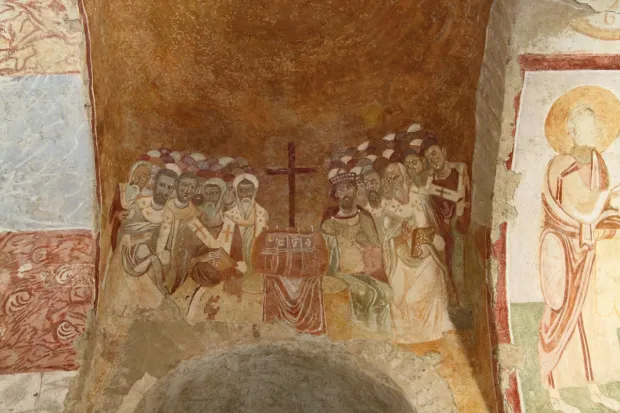
Detail of a fresco of the first council of Nicaea. From the church of St Nicholas, Demre, Southern turkey
Ella Doroshchenko
Surviving Remains and Modern Recognition
What remains of the basilica today are its foundation walls, floors, and graves, as the upper structure collapsed long ago. Even in ruin, the layout reveals a building far larger than many contemporary local churches, capable of hosting sizable gatherings.
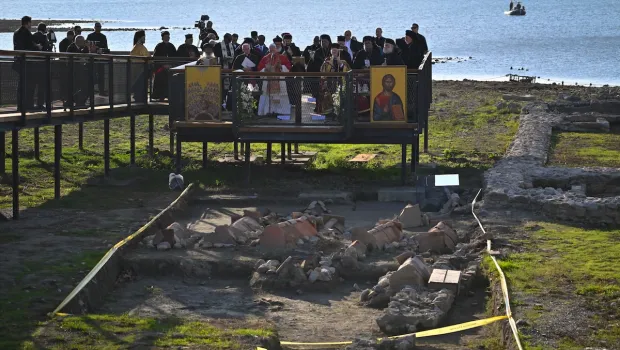
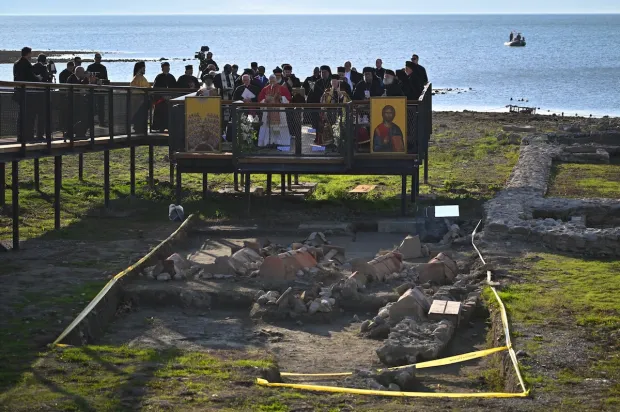
On November 28, 2025, the site gained renewed attention when Pope Leo XIV visited İznik and prayed over the newly exposed ruins, highlighting both its spiritual significance and the fragile environmental factors that allowed its re-emergence.
For modern visitors, the basilica provides a rare opportunity to experience early Christian architecture and history firsthand. Amid the trenches and exposed foundations, one can sense the life of the ancient Christian community and the extraordinary journey of a church that sank beneath a lake only to resurface centuries later.