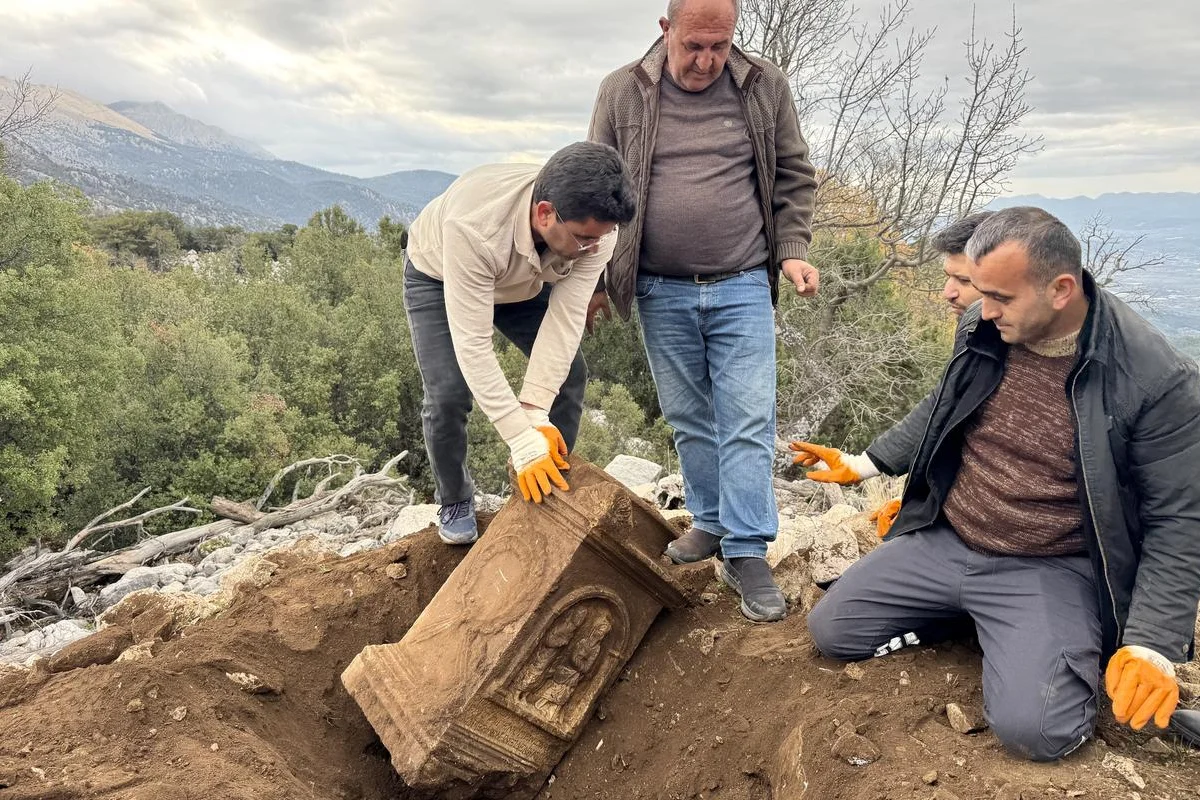
An ornately carved stele was discovered by a goat herder while tending his animals on a remote forested mountain near Kayaçık, Turkey. Upon notifying the Fethiye Museum Directorate, archaeologists conducted an initial inspection. Given the site’s extreme remoteness in the rugged highlands of Muğla’s Seydikemer district, the team temporarily reburied the stele and secured the area to protect it from potential looting.
Recovering the stele was a demanding operation. Archaeologists and support personnel hiked roughly 45 minutes from the nearest road, re-excavated the stele, and carefully wrapped the fragile stone for transport. They spent nearly seven hours carrying it by hand over steep, rocky terrain, navigating narrow paths and unstable slopes to bring it safely down to the valley.
Experts date the stele to the 1st to 3rd centuries BC, a period when altar-shaped grave monuments were common across Roman Anatolia. Archaeologist Ahmet Meke noted that this example stands out for its elaborate relief carvings and clear inscription, giving it exceptional epigraphic value.
The front of the stele depicts a man and woman, likely a family portrait commemorating the deceased. Their clothing and hairstyles provide rare insights into everyday Roman-period life in the region. An inscription beneath the figures offers further information about the individual buried there. One of the side panels features a carved wreath, suggesting that the person memorialized held a respected place within the local community.
With the stele now secured in the museum, specialists will begin cleaning and conservation work before formally adding it to the collection.