A new genomic study suggests that the first humans reached the landmass now known as Australia about 60,000 years ago and that they arrived by two different routes.
Exactly when people first set foot on the continent has long been debated. Some earlier genetic research pointed to an arrival between 45,000 and 50,000 years ago, while other evidence has hinted that humans may have been present as early as 65,000 years ago. The latest findings, based on nearly 2,500 mitochondrial DNA samples from Indigenous groups across Australia, New Guinea, Oceania, and Southeast Asia, lend stronger support to the earlier date and show that migration into the region was not the result of one single journey.
During the Pleistocene, Australia, Tasmania, and New Guinea formed a single connected landmass known as Sahul. These areas remained joined until sea levels rose about 9,000 years ago at the end of the last ice age.
Archaeogeneticist Martin Richards and his team at the University of Huddersfield studied DNA mutation rates and genetic links between modern and ancient populations to map out these early movements. They also compared their genetic findings with archaeological discoveries and climate records.
Their work indicates that people reached Sahul by following two major routes from the ancient Southeast Asian landmass called Sunda. One path led travellers through Malaysia, Java, and Timor, bringing them into Sahul west of where the city of Darwin is today. These are described as the “southern route lineages.”
A second stream of migration the “northern route lineages” can be traced through the islands stretching from the Philippines and Sulawesi to Papua New Guinea, eventually entering Sahul through the northern tip of what is now Queensland.
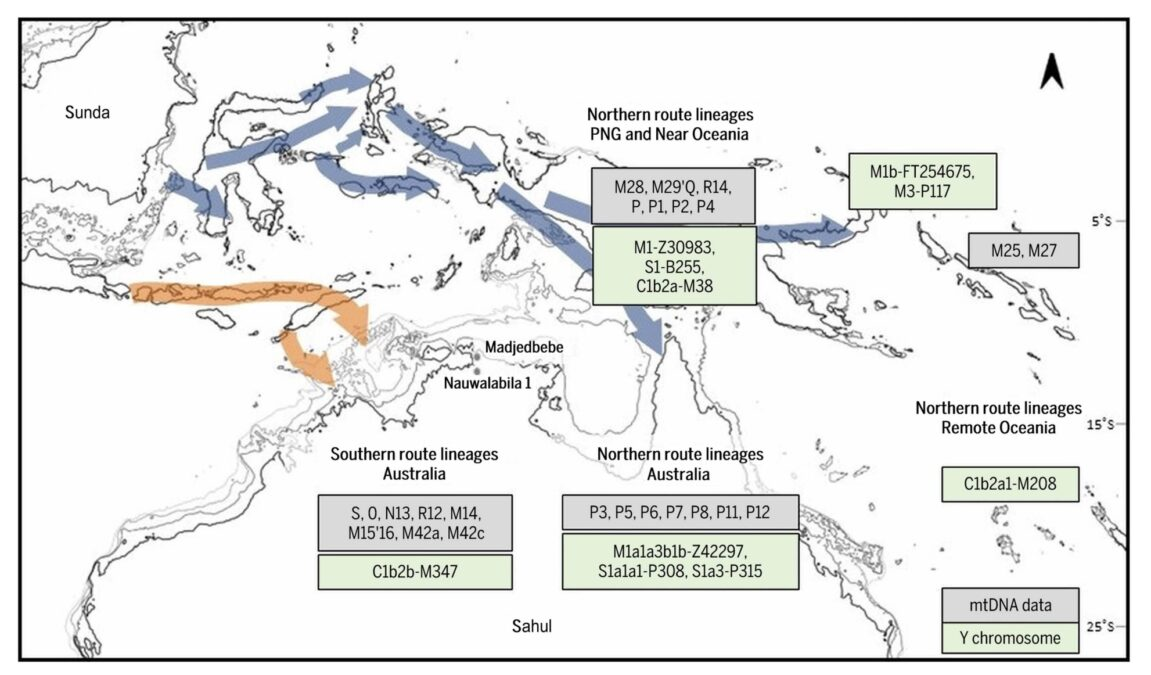
Map showing the continental shelves of Sunda, Sahul, and the Western Pacific. Orange arrows represent southern route lineages; blue arrows represent northern route lineages.
Richards told New Scientist journalist James Woodford that both migration waves appear to have occurred at roughly the same time about 60,000 years ago. This finding, he said, supports the “long chronology” for the settlement of Australia, rather than the “short chronology,” which places human arrival between 45,000 and 50,000 years ago.
According to the team’s estimates, around 36% of the earliest genetic lineages come from people who entered Australia through the northern route, while about 64% can be traced to those who followed the southern route.
The study also indicates that some of the first groups moving along the northern route did not stay in Sahul. Instead, they continued on to the Bismarck Archipelago and the Solomon Islands shortly after arriving.
Because of this extended movement, the authors explain that most surviving genetic lineages in ancient Sahul and the broader region of Near Oceania descend from ancestors who traveled through the northern portion of the now-submerged Sunda continent and northern Wallacea roughly 60,000 years ago.
However, a smaller share of overall lineages — but nearly two-thirds of those found specifically in Australia — originated from people who arrived via the southern route, moving through southern Sunda.
The researchers add that ancient DNA from southern Asia and Sahul remains scarce, and obtaining more samples would help clarify the timing and details of these early migrations.