Researchers say processing plant foods was key to human spread across globe

Archaeologists argue that the belief our early ancestors lived solely on meat and that modern “carnivore” diets reflect ancient eating habits is incorrect.
Evidence now shows that humans have been preparing and consuming plant-based foods far earlier than once believed, gaining significant nutritional advantages along the way.
The latest findings challenge the idea of strictly “palaeolithic meat-eaters,” revealing that early humans used a wide variety of plant resources. They gathered, stored, and ate ground nuts, as well as cooked starchy roots and tubers.
By examining multiple studies on ancient plant use, researchers found that sophisticated plant processing played a major role in the global expansion of early human populations.
Plant-based diets were not a late development tied to farming. Archaeological discoveries from many regions indicate that our ancestors were grinding wild seeds, preparing tubers, and removing toxins from bitter nuts thousands of years before agriculture emerged.
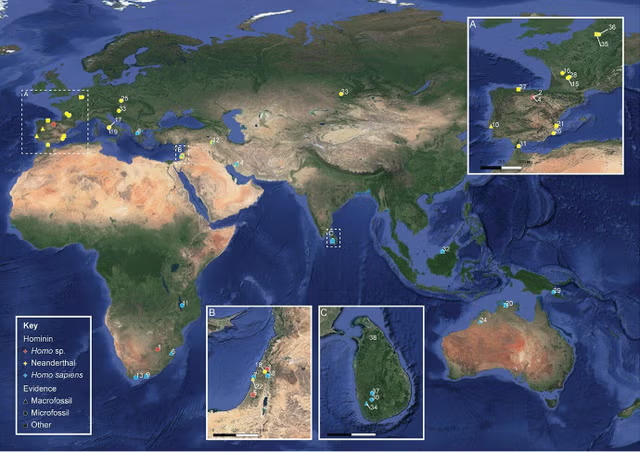
Archaeological sites that show direct evidence of early processed plant food use.
Researchers explain that the human body is not built to rely heavily on protein for energy. The liver can only regulate a small amount of amino acids the components of protein in the bloodstream. Because of this, eating too much meat can lead to “protein poisoning.”
They note that this biological limit creates an upper “protein ceiling” of roughly 250–300 grams per day. Plant-based foods, therefore, are not just sources of key nutrients and easily absorbed carbohydrates; they also provide the extra calories humans need beyond protein alone.
The research team examined fossils containing unusually large amounts of charred grass grains, including wild cereals and various small-seeded grasses. They also uncovered evidence of early food-processing methods such as cooking, pounding, and grinding.
These techniques made plant foods easier to digest and more flavorful, while also helping release more nutrients and energy from them.
Further findings came from the shores of the Sea of Galilee, at the 23,000-year-old site of Ohalo II, where over 150,000 plant fossils were preserved. These remains show that early humans were collecting and processing plant foods long before the rise of agriculture.
According to the researchers, the ability to prepare plant foods allowed early humans to tap into essential calories and nutrients and thrive in diverse environments around the world. It highlights that our species developed as resourceful, tool-using foragers who could turn a wide range of plants into nourishing meals.