An archaeologist has suggested that a large earth mound in west Cumbria may be the final resting place of the legendary Viking leader Ivarr the Boneless.
Ivarr, also known as The Legless or The Dragon, established a powerful Viking dynasty in Dublin and commanded forces that devastated much of England in the 9th century. Despite his historical significance, his burial site has never been identified.
Steve Dickinson, an archaeologist, believes that Ivarr was laid to rest inside his ship beneath a hill known in medieval sources as The King’s Mound. He described the possibility as “exciting,” noting that it could indicate the presence of a hidden Viking burial complex, or necropolis, along the Cumbrian coast.
If Dickinson’s interpretation proves accurate, The King’s Mound would represent one of just 16 known monumental ship burials in north-west Europe—and the first of its kind ever discovered in the UK.
Ship burials were practiced by certain ancient cultures as a mark of honor and status. Britain’s most famous example is the Anglo-Saxon ship burial uncovered at Sutton Hoo in Suffolk.
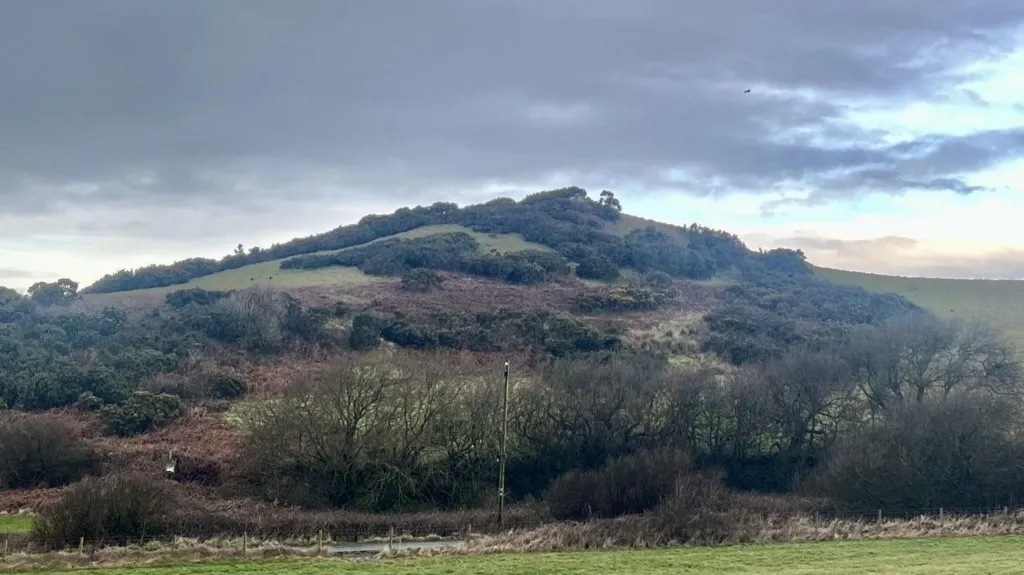
The top of the hill could contain a Viking ship and the remains of Ivarr the Boneless, according to archaeologist Steve Dickinson
Dickinson, a member of the European Association of Archaeologists, explained that this burial practice reflects a belief system very different from those held today. According to him, an important ruler—such as a king or queen—would be placed inside a ship and buried beneath a mound of earth.
The vessel would be filled with items symbolising the community’s honour and respect for the deceased, including jewellery, royal insignia, weapons, food offerings, and even sacrificed animals, sometimes household pets.
People at the time believed the ship would serve as a vessel to carry the ruler into the afterlife.
Steve Dickinson used medieval manuscripts to find what he believes is a Viking grave
Ivarr—sometimes spelled Ivar—was the son of the legendary king Ragnar Lothbrok and is also known to modern audiences as a character in the Amazon TV series Vikings.
There have been previous attempts to locate Ivarr’s burial place, and at one point it was thought he may have been buried at Repton in Derbyshire. However, while studying an Icelandic saga, Dickinson repeatedly encountered references to a site known as Coningeshou, meaning “The King’s Mound”. This prompted him to consider it as a possible location for Ivarr’s burial.
Dickinson also noted that even if a grave were uncovered, there would be no definitive physical evidence to confirm the identity of the individual buried there.
To protect the site, the exact location of the mound has not been disclosed. What is known is that it measures roughly 60 metres (197 feet) across, stands about 6 metres (20 feet) high, and lies close to the coastline.
Later this year, Dickinson plans to conduct ground scans to assess whether the mound is indeed a burial site. He added that archaeological finds in the surrounding area support his hypothesis.