• MAIN PAGE
  • LATEST NEWS
    • Lost Cities
    • Archaeology's Greatest Finds
    • Underwater Discoveries
    • Greatest Inventions
    • Studies
    • Blog
  • PHILOSOPHY
  • HISTORY
  • RELIGIONS
    • Africa
    • Anatolia
    • Arabian Peninsula
    • Balkan Region
    • China - East Asia
    • Europe
    • Eurasian Steppe
    • Levant
    • Mesopotamia
    • Oceania - SE Asia
    • Pre-Columbian Civilizations of America
    • Iranian Plateau - Central Asia
    • Indus Valley - South Asia
    • Japan
    • The Archaeologist Editor Group
    • Scientific Studies
    • Aegean Prehistory
    • Historical Period
    • Byzantine Middle Ages
    • Predynastic Period
    • Dynastic Period
    • Greco-Roman Egypt
  • Rome
  • PALEONTOLOGY
  • About us
Menu

The Archaeologist

  • MAIN PAGE
  • LATEST NEWS
  • DISCOVERIES
    • Lost Cities
    • Archaeology's Greatest Finds
    • Underwater Discoveries
    • Greatest Inventions
    • Studies
    • Blog
  • PHILOSOPHY
  • HISTORY
  • RELIGIONS
  • World Civilizations
    • Africa
    • Anatolia
    • Arabian Peninsula
    • Balkan Region
    • China - East Asia
    • Europe
    • Eurasian Steppe
    • Levant
    • Mesopotamia
    • Oceania - SE Asia
    • Pre-Columbian Civilizations of America
    • Iranian Plateau - Central Asia
    • Indus Valley - South Asia
    • Japan
    • The Archaeologist Editor Group
    • Scientific Studies
  • GREECE
    • Aegean Prehistory
    • Historical Period
    • Byzantine Middle Ages
  • Egypt
    • Predynastic Period
    • Dynastic Period
    • Greco-Roman Egypt
  • Rome
  • PALEONTOLOGY
  • About us

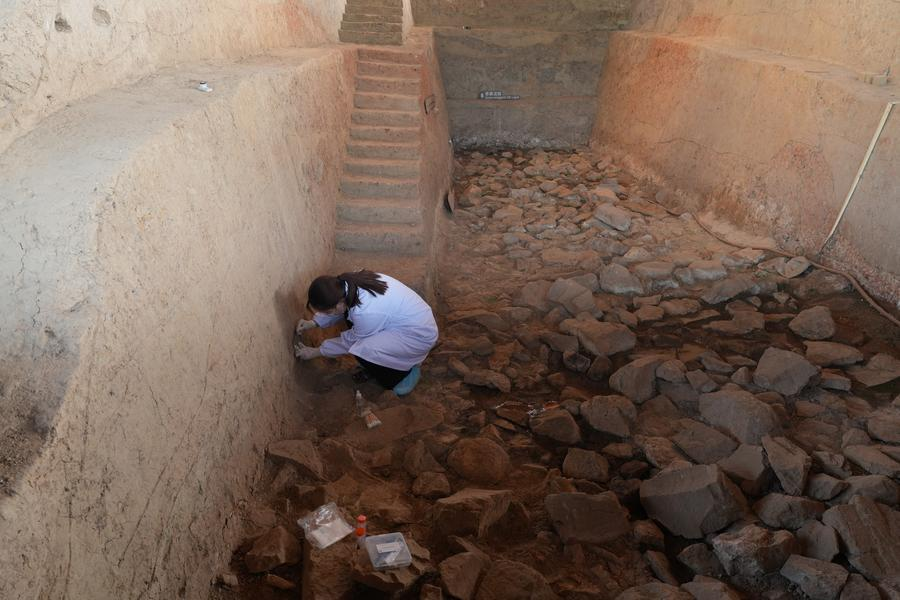
A researcher takes soil samples from the southern city wall of the Archaeological Ruins of Liangzhu City in Hangzhou, east China's Zhejiang Province

Xinhua Headlines: How archaeology reveals roots of China's uninterrupted civilization

February 1, 2026

How Archaeology Reveals China’s Unbroken Civilizational Roots

On a crisp winter morning in early 2026, hundreds of runners gathered at the Liangzhu Archaeological Ruins in Hangzhou, Zhejiang Province, a UNESCO World Heritage Site over 5,300 years old. At the starting signal, participants ran along paths once marked by ancient city walls and waterways, turning a modern New Year’s ritual into an encounter with deep history.

For many, the run was less about competition and more about experiencing firsthand one of East Asia’s earliest urban civilizations. This reflects a broader trend in China, where the past is increasingly explored not only in classrooms but as part of everyday life. With roughly 1.5 billion museum visits annually, the public’s interest in understanding the uninterrupted story of Chinese civilization is evident.

This enthusiasm parallels a national push for archaeological research. From 2021 to 2025, more than 7,700 projects across China uncovered over 130,000 cultural relics, offering fresh insights into the country’s roots and contributing to global discussions on human civilization’s continuity, diversity, and evolution.

Enriching the Global Understanding of Human History

Recent Chinese archaeological discoveries also carry international significance. They have provided new evidence on early human migration, long-term tool-making practices, and adaptation to extreme environments.

At the Salawusu site in Inner Mongolia, one of China’s earliest Paleolithic sites, researchers have found fossils, stone tools, and signs of fire use dating back at least 50,000 years. Chen Fuyou of the Chinese Academy of Sciences notes that the finely crafted tools reflect a consistent technological tradition in northern China, offering strong evidence for the continuous evolution of early human populations in East Asia.

Further southwest, discoveries on the eastern Qinghai-Tibet Plateau have challenged assumptions about human resilience. Paleolithic sites at approximately 4,300 meters elevation demonstrate that prehistoric groups adapted to low oxygen levels and harsh climates much earlier than previously believed.

Taken together, these sites and artifacts create a broader mosaic, gradually reconstructing a multidimensional picture of China’s long and continuous civilizational history.
← Saint Mary's College of California Student Christopher Baker Conducts Global Archaeological Research On Bronze Age ShipwreckArchaeologists Unearth unprecedented 16th-Century River Pier on the Banks of Russia’s Volkhov River →
Featured
image_2026-02-01_111347876.png
Feb 1, 2026
Saint Mary's College of California Student Christopher Baker Conducts Global Archaeological Research On Bronze Age Shipwreck
Feb 1, 2026
Read More →
Feb 1, 2026
image_2026-02-01_110858691.png
Feb 1, 2026
Xinhua Headlines: How archaeology reveals roots of China's uninterrupted civilization
Feb 1, 2026
Read More →
Feb 1, 2026
image_2026-02-01_103524729.png
Feb 1, 2026
Archaeologists Unearth unprecedented 16th-Century River Pier on the Banks of Russia’s Volkhov River
Feb 1, 2026
Read More →
Feb 1, 2026
image_2026-02-01_102604498.png
Feb 1, 2026
Israel closes Hebron's center to secure settlers' storming of archaeological site
Feb 1, 2026
Read More →
Feb 1, 2026
image_2026-02-01_101121414.png
Feb 1, 2026
Archaeologists toil to preserve Roman villa site next to roadworks
Feb 1, 2026
Read More →
Feb 1, 2026
image_2026-02-01_095849679.png
Feb 1, 2026
Archaeologists Rediscover Alexandria on the Tigris, a Lost City Founded by Alexander the Great
Feb 1, 2026
Read More →
Feb 1, 2026
read more

Powered by The archaeologist