The phrase Baghdad Battery may sound unfamiliar or even meaningless at first, but it refers to an archaeological mystery that has intrigued scholars for almost a century.
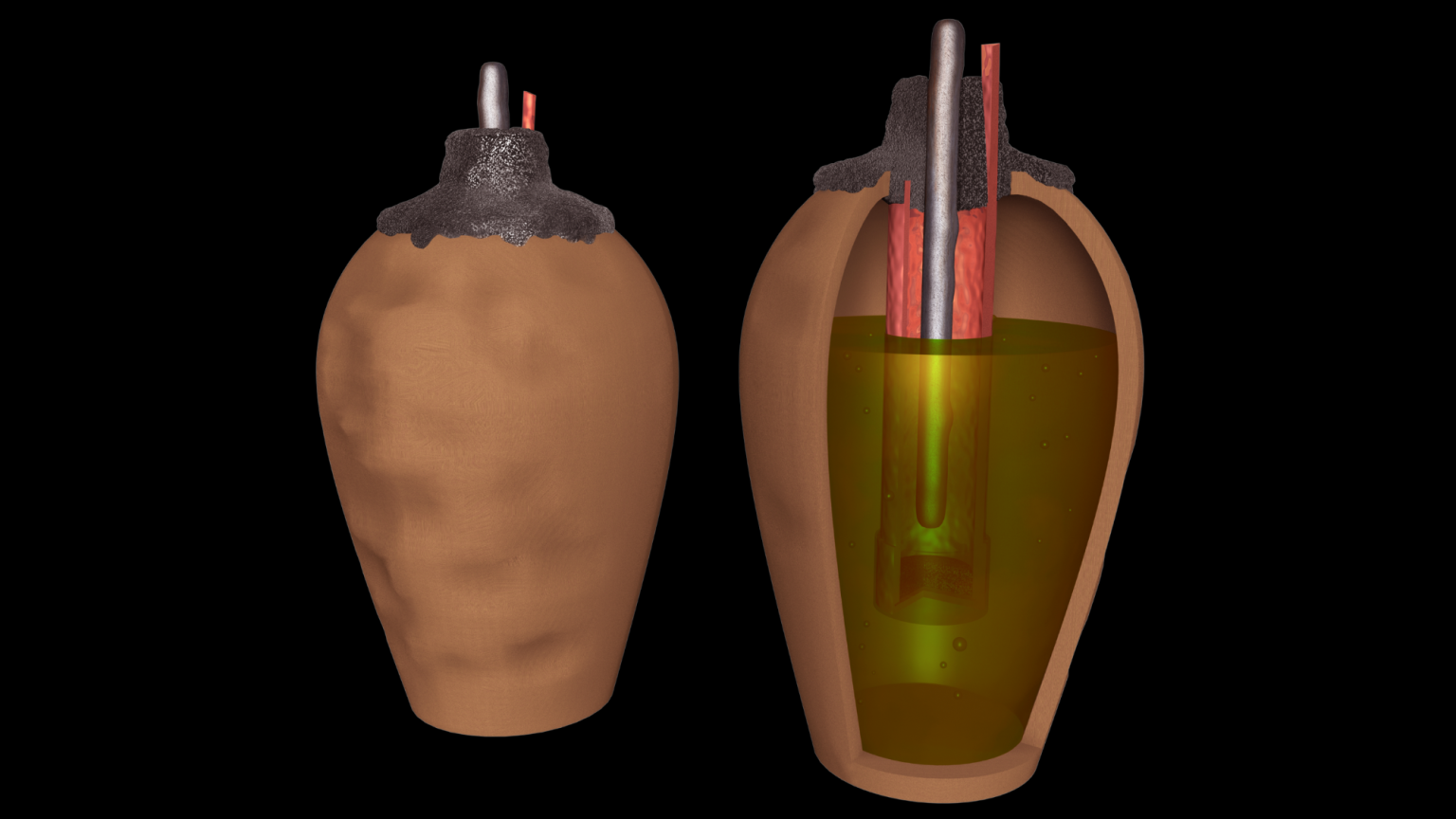
Discovered in Iraq in the 1930s, the object was a broken clay jar whose purpose has long been debated. Some believe it was simply a ritual container with no technological importance, while others argue it may have functioned as an ancient battery—potential evidence of early electrical knowledge. Sadly, the artifact can no longer be examined directly, as it was lost during the 2003 invasion of Iraq. Even so, enough documentation remains to keep the debate alive.
The jar contained a copper cylinder and an iron rod, a configuration strikingly similar to a galvanic cell, the basic mechanism behind modern batteries. This resemblance sparked the provocative idea that people living 2,000 years ago may have unknowingly discovered principles of electricity.
A recent study from the University of Pennsylvania, reported by Chemistry World, has reignited discussion. Independent researcher Alexander Bazes recreated the artifact and concluded that it could have generated up to 1.4 volts—comparable to the output of a modern AA battery. His reconstruction suggests that the jar’s porous clay may have acted as a separator, enabling an electrolyte such as lye to interact with the metals and produce an electrical charge.
However, Bazes stops short of claiming the device was used for advanced technology. He dismisses the popular theory that it served to electroplate jewellery and instead proposes a ritual-based explanation. In his view, the electrical reaction may have been used to visibly corrode inscribed prayers, giving worshippers tangible evidence that a supernatural force had acknowledged their offering.
On the opposing side, University of Pennsylvania archaeologist William Hafford argues that the object more closely resembles known sacred prayer jars rather than any form of battery. Archaeologists have uncovered similar vessels in Iraq containing multiple copper items—far too many to function electrically. Hafford suggests that the iron rod may not have been an electrode at all, but simply a nail used in a ritual sealing process before the jar was buried as an offering to underworld deities.
Whether technological device or ritual object, the Baghdad Battery remains a fascinating artifact. The question of its true purpose is still unresolved and is likely to remain a topic of debate for many years to come.