Around 3.4 million years ago, in today’s Afar region of Ethiopia, at least two distinct types of early human relatives shared the same landscape.
A recent study published in Nature examines fossils from Woranso-Mille, a mid-Pliocene site already known for Australopithecus afarensis—the species of the famous “Lucy”—and a more recently identified species, Australopithecus deyiremeda. When A. deyiremeda was first described, scientists also had a partial foot from a nearby site called Burtele but couldn’t confidently assign it to any species.
Linking the Foot to a Jaw
The new research presents additional jaws and teeth from the same rock layers, showing that these “missing pieces” now firmly connect the Burtele foot to A. deyiremeda.
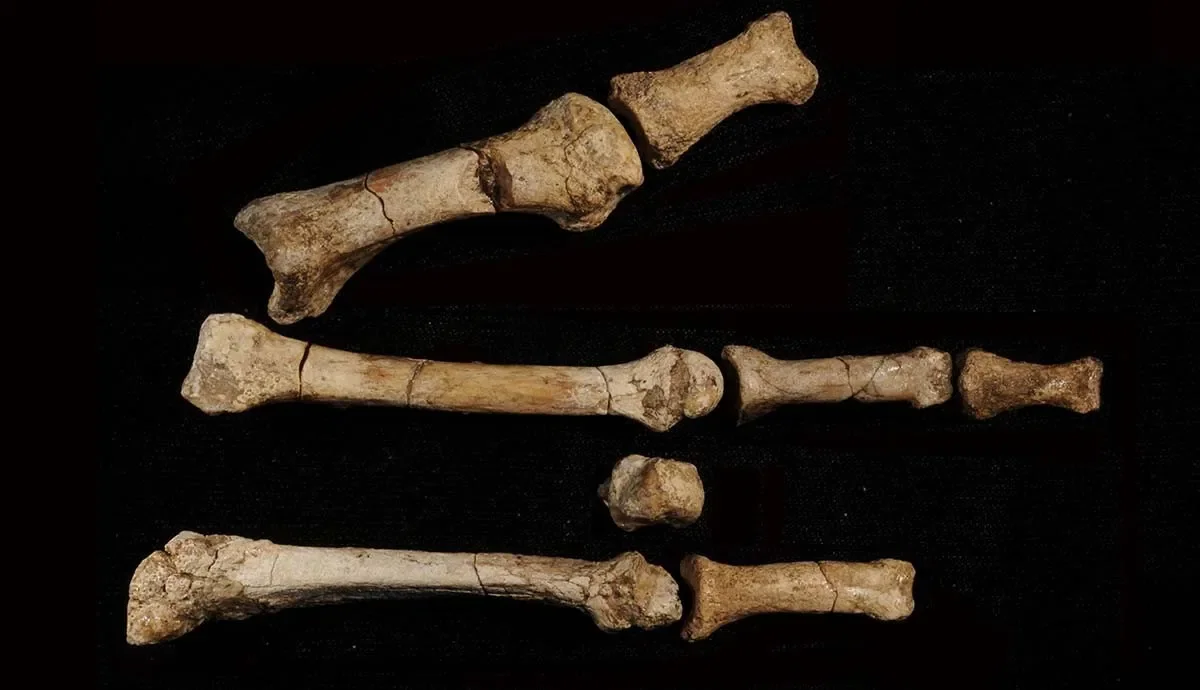
In 2009, paleoanthropologist Yohannes Haile-Selassie and his team discovered eight bones from a human ancestor’s foot in 3.4-million-year-old sediments. This specimen, called the “Burtele Foot,” was announced in 2012. At the same time, teeth had already been found in the area, but scientists were unsure whether they came from the same sedimentary layer. In 2015, those teeth led to the identification of A. deyiremeda, though the connection to the foot remained uncertain. Paleontologists generally name new species only based on bones from the head and jaw, so the foot remained unassigned.
After years of returning to the site and uncovering more fossils, researchers now confirm that the Burtele foot and the dental remains belong to A. deyiremeda.
https://www.youtube.com/watch?v=WsG7t1vQ9yo
What We Know About A. deyiremeda
The fossils themselves are modest: a juvenile lower jaw with baby and emerging adult teeth, isolated premolars and molars, fragments of adult mandibles, and a juvenile hip bone. Their context, however, is remarkable. Radiometric dating of volcanic ash and magnetic measurements place the fossils between 3.47 and 3.33 million years ago, overlapping with A. afarensis sites. This means two separate hominin species lived side by side, rather than one gradually evolving into the other.
Species identification relied on teeth and jaws, which carry strong taxonomic signals. A. deyiremeda is characterized by relatively small, narrow first molars, reduced canines without pronounced inner ridges, and premolars resembling earlier species rather than A. afarensis. The newly found juvenile jaw lacks A. afarensis traits, reinforcing that these bones belonged to a distinct species.
The Burtele Foot and Bipedality
Evidence suggests the foot and teeth belong to the same individual. The Burtele foot indicates a form of bipedalism that was different from A. afarensis. Its long, curved toes suggest adaptation for climbing, while the big toe shows a shift toward a more forward-facing, human-like orientation. The midfoot remains flexible, allowing life both in the trees and on the ground. Statistical analyses place the Burtele foot as intermediate: more human-like than Ardipithecus but less specialized for long-distance walking than Lucy’s species.
Linking Diet to Locomotion
Chemical analysis of tooth enamel reveals the diet of A. deyiremeda. Carbon isotopes indicate a reliance on woodland resources like tree leaves, contrasting with A. afarensis, which consumed more grasses from open plains. Combined with the partly grasping foot, this suggests A. deyiremeda relied on trees for both food and safety.
A Complex Picture of Human Evolution
These findings emphasize that early human evolution was not a straight line from ape-like ancestors to fully human australopiths. Instead, multiple evolutionary “experiments” coexisted. A. deyiremeda exhibits a mosaic of traits linking it closer to later species such as Australopithecus africanus and even the lineages leading to Paranthropus and Homo, demonstrating that Lucy’s species was not the only hominin thriving at the time.
“All our research into ecosystems from millions of years ago isn’t just about curiosity or understanding our origins,” Haile-Selassie explains. “It also helps us learn about the present and the future.”