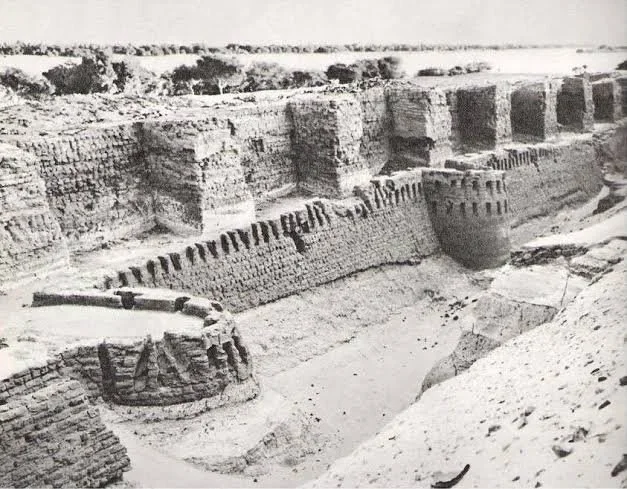
The Indus Valley Civilisation (IVC), also called the Sindhu-Saraswati civilisation, flourished between 5,000 and 3,500 years ago in what is now northwest India and Pakistan.

The Indus River was the lifeblood of the civilisation.
Why the Indus Valley Civilisation Disappeared: Insights from IIT Scientists
The Indus Valley Civilisation (IVC), also known as the Sindhu-Saraswati civilisation, thrived between 5,000 and 3,500 years ago across what is now northwest India and Pakistan. Famous for its advanced cities like Harappa, Mohenjo-Daro, Rakhigarhi, and Lothal, the IVC featured sophisticated urban planning, drainage systems, and remarkable craftsmanship, including iconic artifacts like the “Dancing Girl.”
Despite its achievements, the civilisation eventually declined, and the reasons for its disappearance have long puzzled historians and archaeologists. Recent research from IIT Gandhinagar offers a compelling explanation: prolonged droughts over centuries forced urban populations to abandon their cities.
Climate Change and Water Scarcity
The Indus River was essential for the civilisation, supporting agriculture, trade, and daily life. Paleo-climate records and climate simulations reveal significant variability in rainfall, driven by shifts in both the Indian summer and winter monsoons. Using high-resolution climate models and geological proxies, such as stalactites and lake sediments, researchers reconstructed rainfall and river flow patterns over thousands of years.
Findings indicate a persistent drying trend, with average annual rainfall dropping by 10–20% and temperatures rising by roughly 0.5°C during the civilisation’s existence. Four major droughts, each lasting more than 85 years, occurred between 4,450 and 3,400 years ago, with the longest spanning 164 years and affecting over 90% of the region. These were part of a broader pattern of declining water availability rather than isolated events.
Impact on Settlements and Agriculture
Initially, IVC communities were concentrated in areas with reliable rainfall. As droughts intensified, people moved closer to the Indus River in search of water. Hydrological simulations show that even riverbanks experienced reduced flows during these droughts, creating widespread water scarcity. Archaeobotanical evidence indicates that farmers attempted to adapt by shifting from wheat and barley to drought-tolerant millets, but these efforts could not fully mitigate the impact of prolonged aridity.
Lake level records and cave data support these findings, showing declines in water bodies and rainfall during key drought periods. The final century-long drought, between 3,531 and 3,418 years ago, coincides with archaeological evidence of large-scale urban abandonment and population dispersal into smaller rural communities.
The Role of Global Climate Drivers
The study also highlights the influence of global climate phenomena on the IVC’s decline. Events like El Niño and North Atlantic cooling weakened the Indian monsoon. Higher Pacific and Indian Ocean temperatures reduced the land-sea temperature gradient, suppressing monsoon rainfall, while changes in atmospheric circulation further limited moisture transport into South Asia.
A Gradual Decline, Not an Abrupt Collapse
Rather than collapsing suddenly, the IVC underwent a slow, complex decline shaped by climate, social, and economic pressures. While severe droughts were a major factor, communities adapted through migration, crop diversification, and trade. The civilisation fragmented into smaller units, representing a transformation rather than a complete disappearance.
Lessons for Today
The story of the Indus Valley Civilisation serves as a warning about the vulnerability of complex societies to environmental stress. It underscores the importance of effective water management and climate adaptation—lessons that remain highly relevant today as modern societies confront increasing risks from climate change and water scarcity. Encouragingly, paleo-climate researchers note that global warming may lead to increased rainfall in the Indian monsoon, offering some hope for the region.