• MAIN PAGE
  • LATEST NEWS
    • Lost Cities
    • Archaeology's Greatest Finds
    • Underwater Discoveries
    • Greatest Inventions
    • Studies
    • Blog
  • PHILOSOPHY
  • HISTORY
  • RELIGIONS
    • Africa
    • Anatolia
    • Arabian Peninsula
    • Balkan Region
    • China - East Asia
    • Europe
    • Eurasian Steppe
    • Levant
    • Mesopotamia
    • Oceania - SE Asia
    • Pre-Columbian Civilizations of America
    • Iranian Plateau - Central Asia
    • Indus Valley - South Asia
    • Japan
    • The Archaeologist Editor Group
    • Scientific Studies
    • Aegean Prehistory
    • Historical Period
    • Byzantine Middle Ages
    • Predynastic Period
    • Dynastic Period
    • Greco-Roman Egypt
  • Rome
  • PALEONTOLOGY
  • About us
Menu

The Archaeologist

  • MAIN PAGE
  • LATEST NEWS
  • DISCOVERIES
    • Lost Cities
    • Archaeology's Greatest Finds
    • Underwater Discoveries
    • Greatest Inventions
    • Studies
    • Blog
  • PHILOSOPHY
  • HISTORY
  • RELIGIONS
  • World Civilizations
    • Africa
    • Anatolia
    • Arabian Peninsula
    • Balkan Region
    • China - East Asia
    • Europe
    • Eurasian Steppe
    • Levant
    • Mesopotamia
    • Oceania - SE Asia
    • Pre-Columbian Civilizations of America
    • Iranian Plateau - Central Asia
    • Indus Valley - South Asia
    • Japan
    • The Archaeologist Editor Group
    • Scientific Studies
  • GREECE
    • Aegean Prehistory
    • Historical Period
    • Byzantine Middle Ages
  • Egypt
    • Predynastic Period
    • Dynastic Period
    • Greco-Roman Egypt
  • Rome
  • PALEONTOLOGY
  • About us
No results found

Madjedbebe: World's Oldest Ochre Processing Site

June 24, 2026

Madjedbebe, a sandstone rock shelter situated at the base of the Arnhem Land escarpment in northern Australia, holds the undisputed mantle as the oldest confirmed human occupation site on the continent, radically pushing back the timeline for the human diaspora out of Africa and the colonization of Sahul. Intensive excavations leveraging state-of-the-art single-grain optically stimulated luminescence dating protocols established that modern humans were actively living at the site by 65,000 years ago.

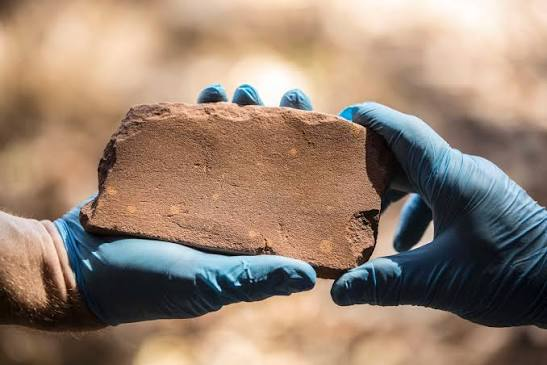
The site's lowest human occupational horizon yielded a spectacular behavioral archive, including the world's oldest and most advanced ochre processing infrastructure. Archaeologists uncovered massive quantities of high-grade red and yellow ochre, found alongside specialized grinding stones, stone axes with shaped edges, and reflective mica sheets, indicating a highly organized domestic space.

The presence of sophisticated paint-grinding technology at 65,000 years ago demonstrates that the first humans to walk on Australian soil possessed a fully developed, complex cognitive framework. They utilized artistic pigments and heavy-duty edge-ground axes to mark territory, express identity, and fundamentally alter their new environment from the moment of arrival, forever changing the global timeline of modern human behavioral complexity.

← Wyrie Swamp: Australia's 20,000-Year BoomerangsNauwalabila: Australia's 50,000-Year Stone Tools →
Featured
image_2026-06-22_223748063.png
June 24, 2026
Lake Mungo: Australia's 42,000-Year Cremation Rites
June 24, 2026
Read more →
June 24, 2026
image_2026-06-22_223711115.png
June 24, 2026
Wyrie Swamp: Australia's 20,000-Year Boomerangs
June 24, 2026
Read more →
June 24, 2026
image_2026-06-22_223638840.png
June 24, 2026
Madjedbebe: World's Oldest Ochre Processing Site
June 24, 2026
Read more →
June 24, 2026
image_2026-06-22_223602824.png
June 24, 2026
Nauwalabila: Australia's 50,000-Year Stone Tools
June 24, 2026
Read more →
June 24, 2026
image_2026-06-22_223518130.png
June 24, 2026
Devil's Lair: Australia's 48,000-Year Ochre Use
June 24, 2026
Read more →
June 24, 2026
image_2026-06-22_223408714.png
June 24, 2026
Laili Cave: East Timor's 44,000-Year Colonizers
June 24, 2026
Read more →
June 24, 2026
read more

Powered by The archaeologist