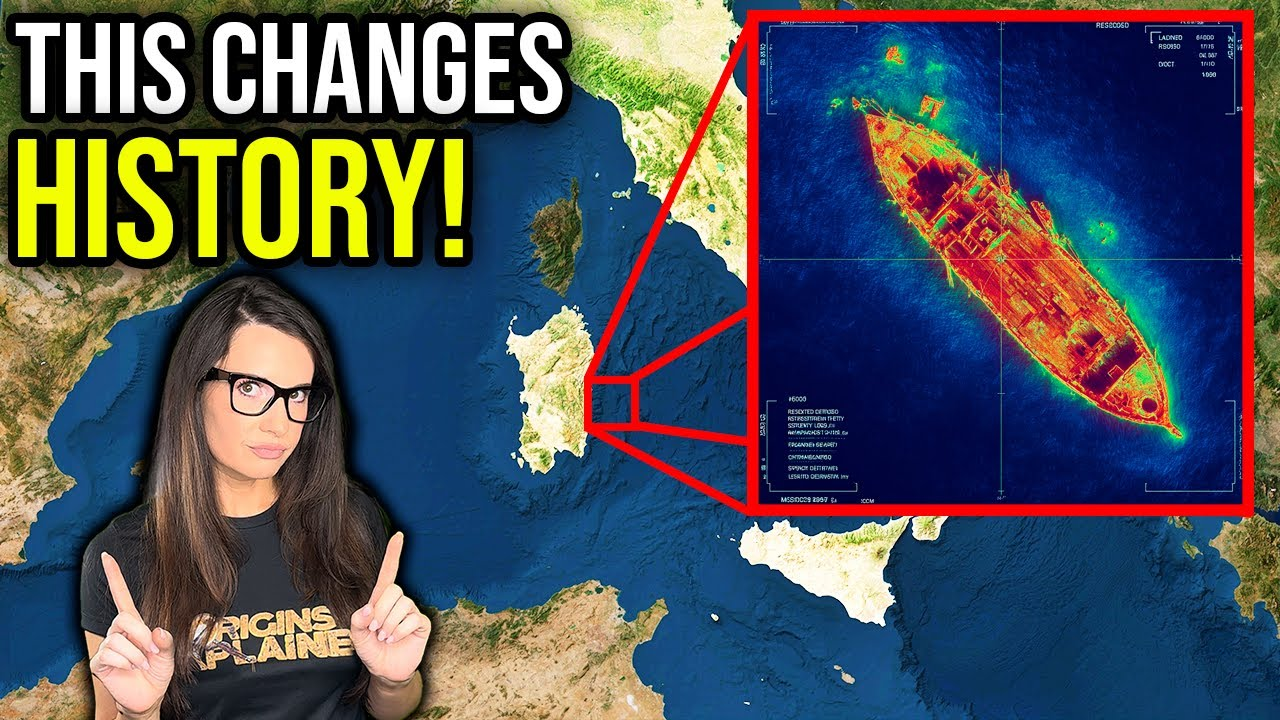
Two thousand years ago, a Roman merchant ship sank off the coast of Sardinia.
There was nothing glamorous in its hull. No gold. No statues. No treasure fit for legend. Just heavy, unremarkable lead ingots — raw material destined for construction somewhere in the vast machinery of the Roman world.
And yet, that forgotten cargo would become something far more extraordinary than anyone aboard could have imagined.
Because the sea kept it hidden.
Buried beneath saltwater and sediment for centuries, the lead was shielded from a quiet but relentless force that constantly washes over our planet: cosmic radiation. Invisible particles from space bombard Earth every second, subtly contaminating almost everything around us at the atomic level.
But at the bottom of the Mediterranean, that ancient Roman lead rested in darkness, protected.
And two millennia later, modern physicists realized it was something priceless.
Ancient Metal, Modern Science
To detect neutrinos — the elusive “ghost particles” that pass through us by the trillions every second — scientists must build incredibly sensitive detectors. The problem? These detectors are so delicate that even the faintest radioactive contamination can overwhelm the signal.
Modern lead, exposed to centuries of cosmic radiation, contains trace isotopes that create background noise.
But Roman lead, sealed away before the industrial age and shielded beneath the sea, is astonishingly “clean.”
It became the perfect shielding material for cutting-edge physics experiments designed to observe neutrinos — particles born in supernovae, nuclear reactions, and some of the most violent events in the universe.
Think about that for a second.
A cargo of construction metal from the Roman Empire now helps scientists listen to the cosmos.
When History Reaches Forward
What makes this story so powerful is how it flips our expectations.
We usually think of archaeology as a way to look backward — to reconstruct lives, trade routes, and empires long gone. But here, the ancient world isn’t just informing us about the past. It’s actively helping us understand the deepest mechanics of reality itself.
A shipwreck off Sardinia becomes part of experiments that probe stellar explosions and cosmic mysteries.
A mundane shipment of lead becomes a shield against the noise of the universe.
It’s a reminder that history and science aren’t separate lanes. Sometimes they intersect in ways that feel almost poetic.
And That’s Just the Beginning…
This compilation doesn’t stop there. From ancient shipwrecks unlocking particle physics to harrowing tales of survival and mystery across the seas, each story reveals how the past still shapes our understanding of the world — and beyond.
Chapters:
0:00 Intro
0:43 The Shipwreck Unlocking the Universe
9:05 Madness and Murder on the Batavia
17:37 Shocking Reason for Shackleton’s Doomed Expedition
22:56 The Mystery of the Lost Pirate Shipwrecks
🎥 Watch the video below to discover how a forgotten Roman shipwreck helped unlock the secrets of the universe — along with four more incredible maritime mysteries: