Learn more about the Vikings, their lifestyle, and where the stereotypical horned helmet originated from.
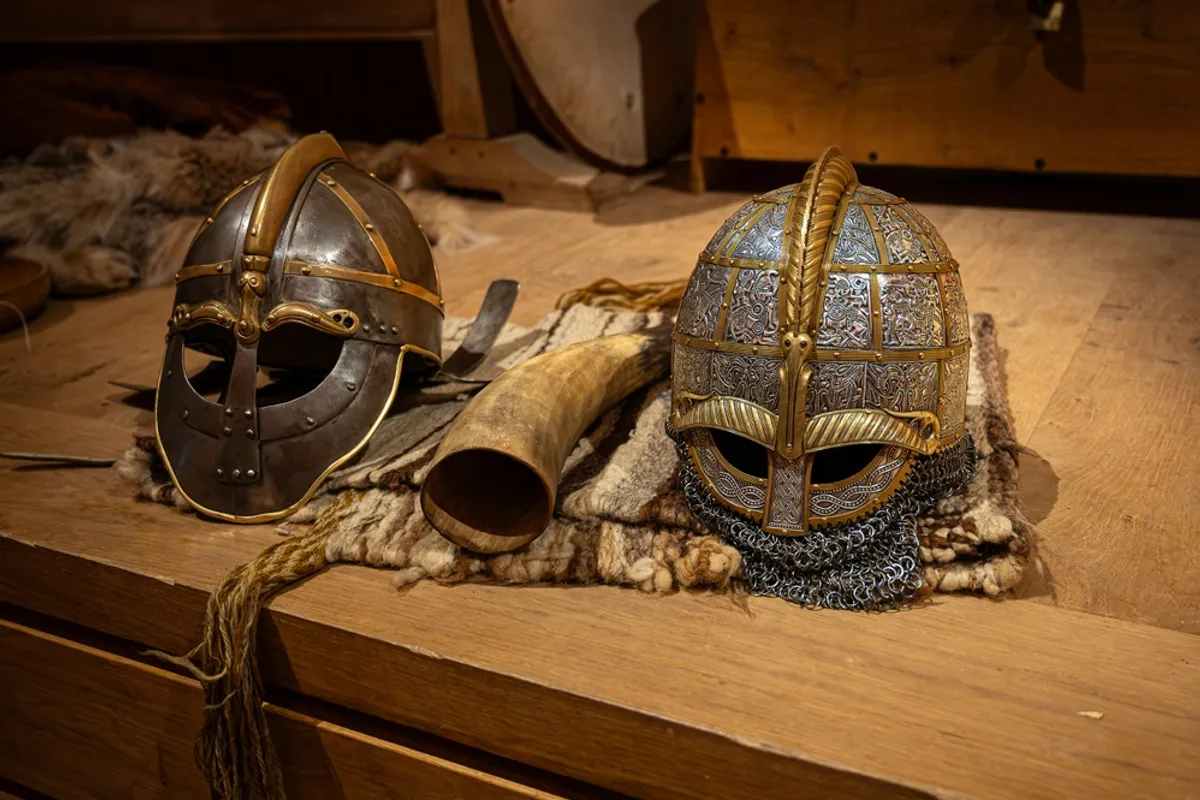
Representations of Viking helmets
Over the past century, Vikings have often been portrayed in highly inaccurate ways. They are frequently described as male-dominated, excessively violent, culturally uniform, and famously depicted wearing horned helmets. In reality, their society was far more complex, and while horned helmets may have existed, there is no evidence they were worn by Vikings themselves.
The Vikings were seafaring Norse peoples who, during the early Middle Ages, traveled, raided, traded with, and settled among other societies across Europe and the North Atlantic, including Iceland, Greenland, and even Newfoundland, according to research from Smith College. Importantly, they were not a single, uniform group but rather a combination of various North Germanic tribes.
As Colin Connors, a postdoctoral fellow at the University of Oslo’s Institute for Archaeology, Conservation, and History, explains, the term “Viking” referred to an activity rather than a shared ethnic identity. People living in Scandinavia at the time did not identify themselves as Vikings; instead, the term was used to describe individuals who took part in raiding and piracy.
“It was essentially a job title,” Connors notes.
Myths about Viking violence
Although the Norse gained a reputation for brutality, they were not significantly more violent than other societies of the same era. Warfare and bloodshed were common throughout medieval Europe, not unique to the Viking world.
“It’s misleading to claim that the Norse were exceptionally violent,” Connors says.
Likewise, the idea that Vikings were unmatched warriors is exaggerated. While they achieved victories, they also suffered severe defeats and violent deaths. Their reputation for extreme cruelty largely stems from historical records written by Christian monks who were frequent targets of Viking raids.
When monks were killed by pagan raiders, they were often regarded as martyrs, which elevated the significance of their deaths and sometimes led to sainthood. If they were killed by fellow Christians, however, the act was simply considered murder. As a result, attacks carried out by Vikings were more likely to be documented in detail.
“For Christian writers, recording pagan attacks was advantageous,” Connors explains, noting that such accounts reinforced religious narratives and moral contrasts.
For a long time, popular culture has portrayed Vikings in ways that are largely inaccurate. They are often shown as uniformly violent, male-dominated, and culturally identical warriors, almost always wearing horned helmets. In reality, Viking society was far more complex and less exaggerated than these stereotypes suggest—and horned helmets were not actually part of their everyday gear.
The Vikings were seafaring Norse people who, during the early Middle Ages, traveled widely to explore, raid, trade, and settle across Europe and the North Atlantic. Their journeys took them to places such as Iceland, Greenland, and even Newfoundland. However, they were not a single, uniform group. Instead, Viking society was made up of various North Germanic tribes, each with its own local identities and customs.
Importantly, the term “Viking” did not refer to an ethnic group. According to Colin Connors, a postdoctoral researcher at the University of Oslo, the word described an activity rather than a people.