• MAIN PAGE
  • LATEST NEWS
    • Lost Cities
    • Archaeology's Greatest Finds
    • Underwater Discoveries
    • Greatest Inventions
    • Studies
    • Blog
  • PHILOSOPHY
  • HISTORY
  • RELIGIONS
    • Africa
    • Anatolia
    • Arabian Peninsula
    • Balkan Region
    • China - East Asia
    • Europe
    • Eurasian Steppe
    • Levant
    • Mesopotamia
    • Oceania - SE Asia
    • Pre-Columbian Civilizations of America
    • Iranian Plateau - Central Asia
    • Indus Valley - South Asia
    • Japan
    • The Archaeologist Editor Group
    • Scientific Studies
    • Aegean Prehistory
    • Historical Period
    • Byzantine Middle Ages
    • Predynastic Period
    • Dynastic Period
    • Greco-Roman Egypt
  • Rome
  • PALEONTOLOGY
  • About us
Menu

The Archaeologist

  • MAIN PAGE
  • LATEST NEWS
  • DISCOVERIES
    • Lost Cities
    • Archaeology's Greatest Finds
    • Underwater Discoveries
    • Greatest Inventions
    • Studies
    • Blog
  • PHILOSOPHY
  • HISTORY
  • RELIGIONS
  • World Civilizations
    • Africa
    • Anatolia
    • Arabian Peninsula
    • Balkan Region
    • China - East Asia
    • Europe
    • Eurasian Steppe
    • Levant
    • Mesopotamia
    • Oceania - SE Asia
    • Pre-Columbian Civilizations of America
    • Iranian Plateau - Central Asia
    • Indus Valley - South Asia
    • Japan
    • The Archaeologist Editor Group
    • Scientific Studies
  • GREECE
    • Aegean Prehistory
    • Historical Period
    • Byzantine Middle Ages
  • Egypt
    • Predynastic Period
    • Dynastic Period
    • Greco-Roman Egypt
  • Rome
  • PALEONTOLOGY
  • About us

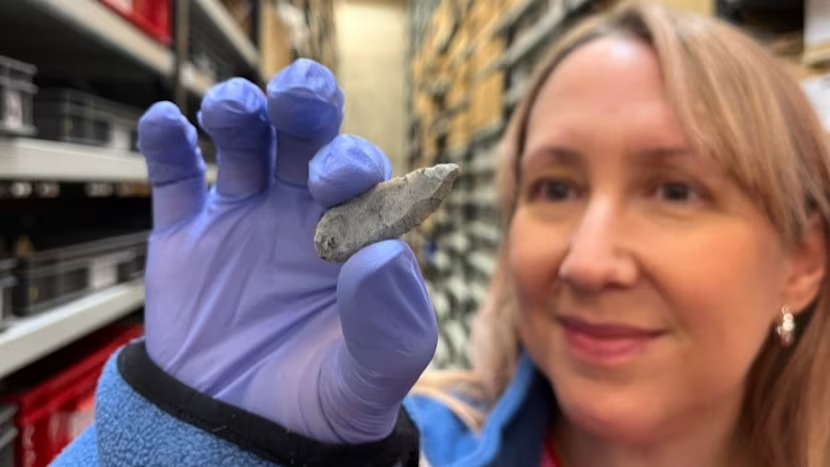
Kat Baxter, Leeds Museums and Galleries’ curator, with a 6,000-year-old arrowhead.

Prehistoric arrow and Roman artefacts among items found during East Leeds Orbital project

January 13, 2026

A prehistoric arrowhead is set to be exhibited after being uncovered among a collection of historic artefacts during the construction of a dual carriageway in Leeds.

The 6,000-year-old flint spearhead was discovered while work was underway on the East Leeds Orbital Route, which opened in 2022.

According to the council, the leaf-shaped tool is exceptionally well preserved, with the fine marks left by ancient stone-sharpening techniques still clearly visible.

The artefact will be displayed alongside numerous other finds from the excavation that together span thousands of years of human activity.

These include a Bronze Age axe head dating back 4,000 years, a Roman-era bead, 18th-century nutcrackers, and an early Victorian clay pipe bowl decorated with a carved image of Britannia.

Also uncovered were pottery fragments from the Norman period, a post-medieval buckle, and remains linked to a former medieval village known as Morwick.
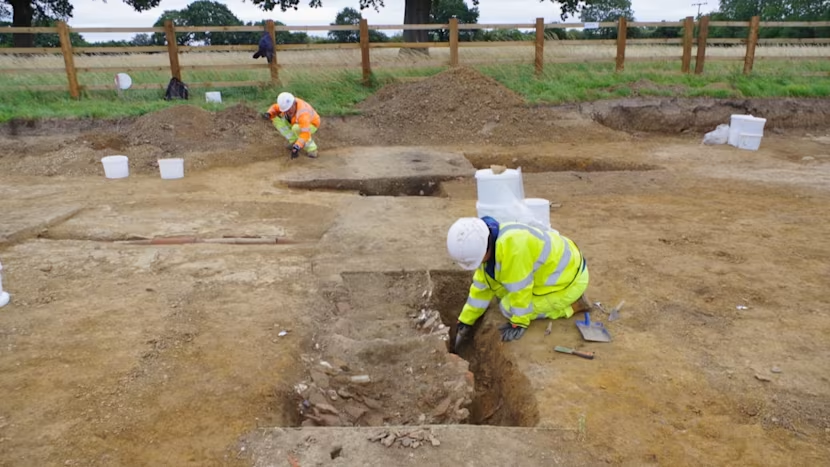
Archaeologists were taken on to excavate the site on the outskirts of Leeds during the construction of a major dual carriageway project

A museum curator has described the discoveries as a revealing glimpse into thousands of years of the city’s past and the landscape it occupies.

Leeds Museums and Galleries curator Kat Baxter said the collection stands out because of its remarkable breadth and depth.

“What makes this such a compelling archive is its sheer range and scale,” she explained.

“It offers a snapshot of the many different people and communities who have lived in this part of Leeds over millennia.

“From the Stone Age through to the medieval period, archaeology allows us to picture the lives of those who came before us. It also highlights how vital it is to protect archaeological archives, so future generations can understand the city’s heritage and the history beneath our feet.”

The excavations were carried out by a team of archaeologists commissioned during the four-year construction of a new bypass on the edge of the city.

The findings follow a separate discovery in 2022, when archaeologists uncovered the remains of more than 60 men, women and children from the Roman era near Garforth, also on the outskirts of Leeds.

According to the council, the latest collection of artefacts will be put on public display this spring at the Leeds Discovery Centre.

Leeds City Council’s Cllr Salma Arif said each object contributes a small but important piece to the wider story of east Leeds.

“When viewed together, they truly reflect just how rich and fascinating that story is,” she said.

“Gathering and preserving finds like these is a crucial part of what museums do, making sure our local heritage is safeguarded for future generations and that these objects are not lost to history.”
← Northumberland Stonehenge: Snow-covered Duddo Five StonesChewing gum has no nutrition, but scientists say it does something unexpected to your brain →
Featured
image_2026-01-13_145551915.png
Jan 13, 2026
Archaeologists Say They’ve Unearthed a Massive Medieval Cargo Ship That’s the Largest Vessel of Its Kind Ever Found
Jan 13, 2026
Read More →
Jan 13, 2026
image_2026-01-13_142940648.png
Jan 13, 2026
600-year-old Viking shipwreck is the largest of its kind
Jan 13, 2026
Read More →
Jan 13, 2026
image_2026-01-13_141554876.png
Jan 13, 2026
The wild reason ancient statues always have tiny p*nises, because I bet you’ve wondered
Jan 13, 2026
Read More →
Jan 13, 2026
image_2026-01-13_135852029.png
Jan 13, 2026
Carnoustie Stone Age hall challenges view of Scotland’s early people
Jan 13, 2026
Read More →
Jan 13, 2026
image_2026-01-13_135115162.png
Jan 13, 2026
Archaeologists Found an Entirely New Language Among the Ruins of an Ancient Empire
Jan 13, 2026
Read More →
Jan 13, 2026
image_2026-01-13_134311101.png
Jan 13, 2026
Poison Detected on 60,000-Year-Old Arrowheads
Jan 13, 2026
Read More →
Jan 13, 2026
read more

Powered by The archaeologist