Introduction
The deep limestone karst chambers of southwestern Sulawesi, Indonesia, host visual records that have fundamentally redefined global art history. At the site of Leang Bulu’ Sipong 4, hidden within the Maros-Pangkep tower karst network, geochronologists and archaeologists uncovered a monumental cave art panel that stands as the world's oldest confirmed narrative scene of a prehistoric hunt.
Dating back at least 43,900 years according to high-precision uranium-series analysis, this ancient red-ochre painting depicts a group of abstract, supernatural figures actively tracking and confronting endemic large mammals. The scene provides definitive proof that the human capacity for complex mythological thought and creative visual storytelling originated deep within the tropical landscapes of Wallacea.
Visual Composition and the Rise of Shamanic Mythology
The hunting tableau at Leang Bulu’ Sipong 4 spans a large limestone wall and is rendered entirely in a fluid, iron-oxide red pigment. The central focus of the composition features detailed figurative portraits of large endemic animals: two Sulawesi warty pigs and four dwarf buffaloes (anoa), which are depicted with realistic body profiles and sharp, sweep-back horns.
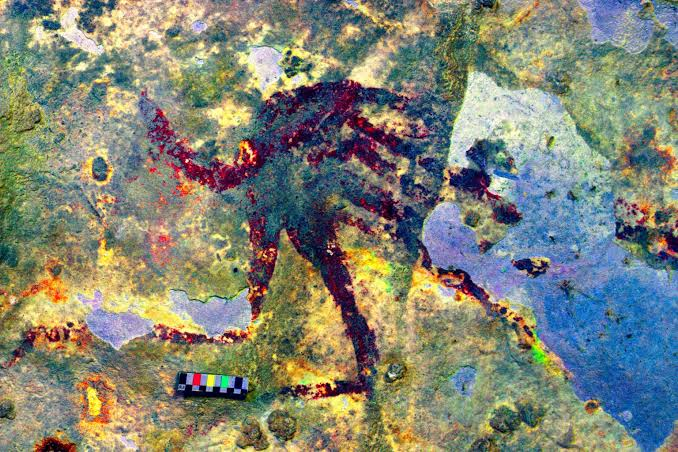
The extraordinary element of the panel is the group of eight tiny figures that surround the anoa. Rather than simple stick-figure humans, these hunters are rendered as therianthropes—abstract beings possessing human bodies integrated with distinct animal traits, such as elongated snouts, feline tails, and bird-like beaks.
The therianthropes are depicted holding long, thin lines that extend directly toward the muzzles and flanks of the anoa, which researchers interpret as spears, lassos, or spiritual energy lines used in a ritualized hunt. Because these figures represent creatures that do not exist in the natural world, their presence confirms that the artists were not merely documenting a mundane daily event. Instead, they were externalizing an advanced, complex religious mythology or shamanic belief system, using visual art to transmit deep concepts of the spirit world and the sacred bonds of the hunt across generations. Conclusion The deep-time hunting panel at Leang Bulu’ Sipong 4 stands as an irreplaceable treasure of human cognitive evolution. It challenges traditional theories that complex narrative art and religious storytelling suddenly exploded in western Europe, proving instead that these advanced mental capabilities were globally widespread. By anchoring the origins of figurative composition firmly in the Pleistocene archipelagos of Indonesia, this ancient rock art panel confirms that our early ancestors were already visual storytellers, painting their complex spiritual world onto the stone long before the dawn of agriculture.