Introduction
The Holocene archaeology of Wallacian hunter-gatherers is punctuated by the sudden appearance of a highly distinctive, sophisticated stone tool tradition known as the Toalean culture. Flourishing in the southwestern peninsula of Sulawesi between approximately 8,000 and 1,500 years ago, this localized maritime and forest-adapted technology diverged sharply from the simple flake toolkits that had dominated the region for millennia. Characterized by exquisitely crafted, serrated stone arrowheads and complex microliths, the Toalean complex represents a highly creative phase of technological specialization, showcasing a deep human adaptation to the dense tropical rainforests and limestone karst eco-zones of Sulawesi.
Knapping Specialization and the Toalean Toolkit
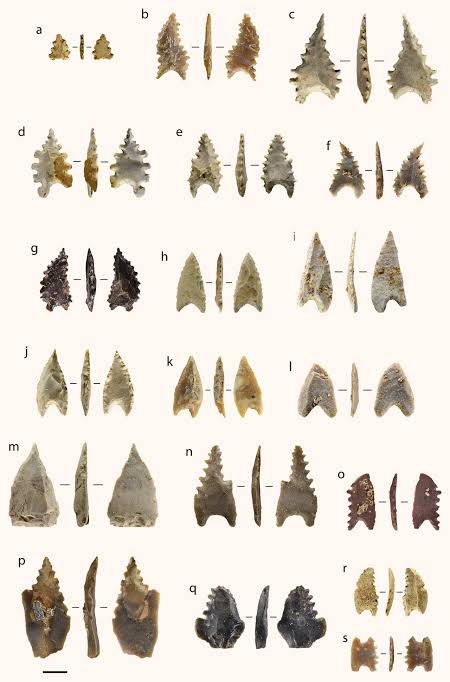
The defining diagnostic artifact of this culture is the Maros point—a small, hollow-based stone arrowhead engineered with remarkable precision. Toalean artisans utilized delicate pressure-flaking techniques, pressing bones or wooden points against the edges of high-quality chert and chalcedony blanks to snap off micro-flakes.
This process created a deeply concave base designed for secure hafting onto wooden arrow shafts, paired with aggressively serrated, saw-like outer margins. Alongside these arrowheads, the Toalean toolkit included Mallinrung points (pointed flakes with serrated edges but flat bases) and tiny, geometric back-microliths used as barbs for compound hunting weapons.
This specialized weaponry allowed Toalean communities to become elite apex predators within the dense inland forest canopies. Faunal remains excavated from key Toalean sites—such as Leang Sarru and Leang Panninge—reveal a diet focused on fast-moving arboreal game, specifically the endemic Sulawesi warty pig and various species of cuscus (marsupial possums).
Furthermore, recent genetic studies on the remains of a young Toalean woman buried at Leang Panninge have revealed a unique genetic profile: a distinct, deep-time human lineage that shares mixed ancestry with both Indigenous Australians/Papuans and a mysterious, previously unknown Asian hominin branch, confirming that the Toalean culture was as demographically unique as it was technologically innovative.
Conclusion
The Toalean culture stands as a brilliant example of localized technological innovation during the mid-to-late Holocene. The emergence of the Maros point and associated microliths demonstrates that prehistoric hunter-gatherers did not require continental influences to develop complex, highly efficient projectile technologies. Instead, the pressure-flaked arrowheads of southwestern Sulawesi reflect an independent, creative solution to the challenges of forest hunting, highlighting the rich cultural variety hidden within the prehistoric island archipelagos of Wallacea.