A 400-foot-long granite structure off the coast of Brittany suggests late hunter-gatherers were already beginning to settle down.
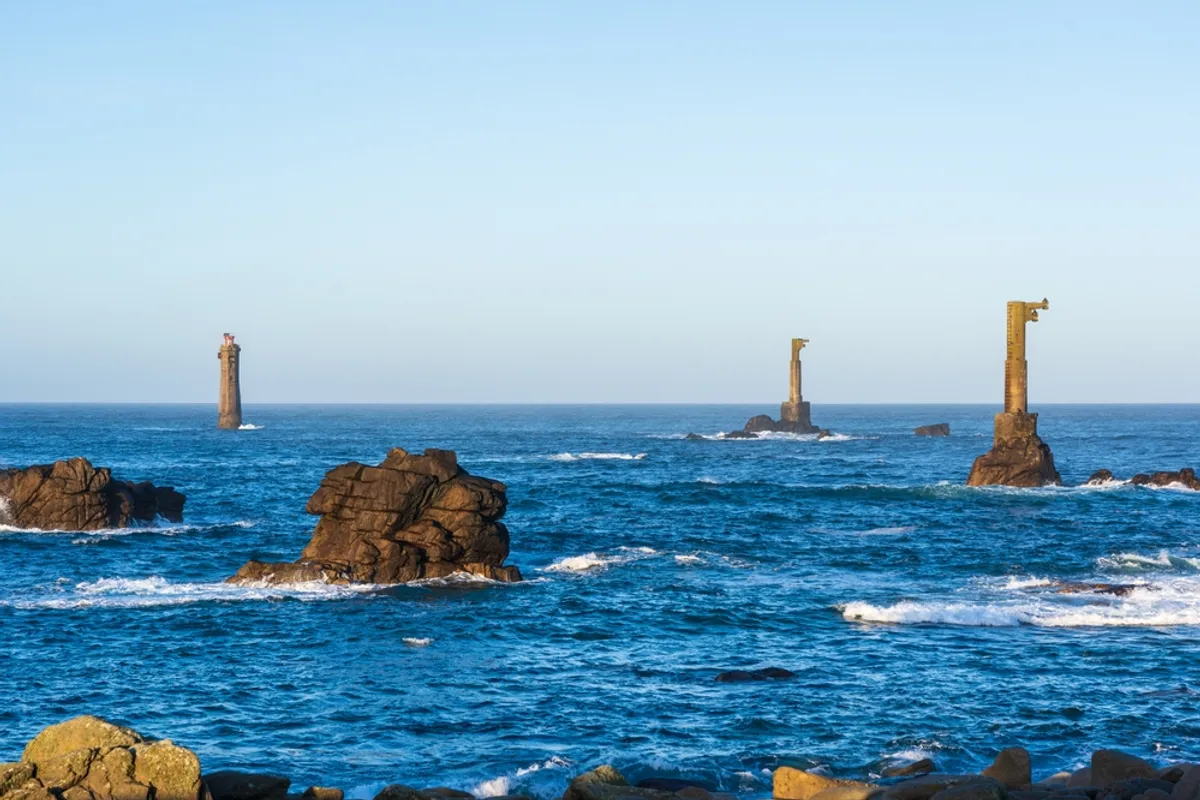
Phare de Nividic Lighthouses in Brittany, France.
After surveying Brittany’s coastline with laser-based mapping technology, a French geologist noticed an unusual feature about 30 feet below the Atlantic’s surface.
A follow-up dive revealed a roughly 400-foot-long granite wall built by humans around 7,000 years ago. According to research published in the International Journal of Nautical Archaeology, the structure is made of deliberately arranged stone slabs and monoliths. Its form and location suggest it may have been used either as an early fish trap or as a barrier to protect coastal communities from the sea.
Either explanation highlights an unexpected level of technical knowledge during a key phase of prehistory, when Mesolithic hunter-gatherers were beginning to settle permanently and transition toward Neolithic farming.
A Human Structure Beneath the Sea
The discovery traces back to 2017, when retired geologist Yves Fouquet examined LiDAR seabed data near Sein Island off western France. The scans revealed 11 submerged features at depths deeper than researchers anticipated in such rough waters.
Between 2022 and 2024, underwater investigations confirmed the presence of several granite constructions, including a wall nearly 400 feet long. Today the remains sit about 30 feet underwater, but they date to roughly 5,800–5,300 BCE, when sea levels were lower and the shoreline lay several miles farther out. What is now seabed was once dry land.
Research in the area has long been difficult due to strong tides, heavy waves, and thick seaweed. Because of this, archaeologists were surprised to find the stonework so well preserved, with upright slabs and monoliths still clearly defined in a now-hostile marine environment.
Since no organic material survived on the stones, direct radiocarbon dating was not possible. Instead, researchers estimated the age by reconstructing ancient sea levels and matching them with known periods of human settlement along the former coast.
Fish Weirs or Coastal Defenses
Along the coasts of Brittany and Normandy, many prehistoric fish weirs have already been identified through aerial and satellite imagery. Some of the newly found structures resemble these traps, but others are far larger than typical examples.
Fish weirs were usually placed in tidal zones to guide fish as the water receded. However, the size of several submerged walls suggests they may also have functioned as protective barriers, guarding settlements against storm surges or advancing seas during a time of environmental change.
Whatever their purpose, the walls demonstrate organized labor and advanced construction skills, including the ability to gather and position massive stones. Notably, this knowledge appears to predate the region’s earliest ceremonial megaliths by about five centuries.
Insight into a Time of Change
These underwater remains provide rare evidence of coastal Mesolithic societies on the verge of the Neolithic. The study notes that fish weirs were a vital food source for hunter-gatherers and required coordinated effort and ongoing upkeep—clear indicators of increasingly settled lifestyles.
The Mesolithic-to-Neolithic transition in Brittany, dated to around 5500–5000 BCE, occurred as post-Ice Age sea-level rise began to slow. The submerged walls suggest that coastal groups were already modifying their surroundings and managing resources well before agriculture became fully established.