The House of the Vettii in Pompeii is one of the most famous examples of a Roman domus, providing a rare and vivid glimpse into the domestic life of the 1st century AD. It is particularly significant because it was owned by two brothers, Aulus Vettius Conviva and Aulus Vettius Restitutus, who were freedmen (formerly enslaved people) who rose to great wealth, likely as wine merchants. Their home is a masterpiece of "nouveau riche" self-presentation, where architecture and art were used to assert social status and cultural literacy.
1. Architectural Layout: A "Performance" Space
Unlike more traditional aristocratic homes, the House of the Vettii was explicitly designed for hosting and impressing visitors.
The Entrance & Atrium: Visitors entered through the fauces (vestibule) into a large, impressive atrium. In a display of calculated status, the brothers placed two iron-bound strongboxes (arcae) in plain view here—a direct, visual signal of their liquid wealth to any client or guest who entered.
The Absence of a Tablinum: Traditionally, a tablinum (a formal office) sat between the atrium and the private areas. The House of the Vettii famously lacks this, choosing instead to open the space directly onto the garden, creating a continuous, airy vista that emphasized the scale of their property.
The Peristyle: The heart of the house is the large, colonnaded courtyard garden (peristyle). It was lavishly decorated with marble fountains, bronze statuary (including cherubs and cupids), and manicured plantings. This was the stage for the brothers' social entertainment and dinner parties.
Service vs. Private Zones: The house is divided into two distinct parts. The "public" areas (atrium, peristyle, reception rooms) were for prestige. A separate service area—centered around a smaller, secondary atrium—housed the kitchen, latrines, and the quarters for their staff, ensuring that the labor required to maintain such an opulent lifestyle remained out of sight.
2. Art as Social Climbing
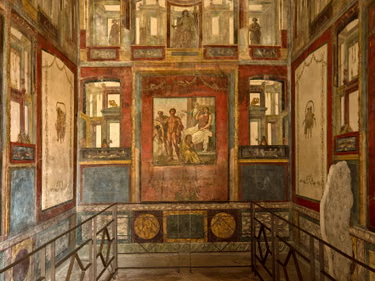
The house is a premier example of the Fourth Style of Pompeian wall painting, characterized by elaborate architectural perspectives, illusionistic scenes, and decorative flair.
Mythological "Galleries": The walls are covered in complex mythological scenes—such as the punishment of Ixion, the death of Pentheus, and the strangling of the serpents by infant Hercules. These were essentially "picture galleries" (pinacothecae) intended to show that the brothers were cultured, educated, and well-versed in high Greek mythology.
Apotropaic Symbolism: Near the entrance, a famous fresco of the god Priapus (a fertility deity) weighing his own phallus against a bag of gold served both as a symbol of prosperity and an apotropaic charm—meant to ward off the "Evil Eye" of envy from visitors who might resent the brothers' sudden climb in status.
The Room of the Cupids: One of the most famous spaces, the triclinium (dining room), features a vibrant frieze of cupids performing "human" tasks—selling wine, acting as goldsmiths, and charioteering. This playful imagery suggests a high degree of artistic sophistication and a desire to delight and entertain guests during banquets.
3. The Social Context
The layout of the House of the Vettii illustrates how Roman society managed social hierarchy. The brothers used their home as a tool to bridge the gap between their past (as enslaved people) and their present (as prominent, wealthy citizens). By mimicking the architectural and artistic language of the traditional elite, they effectively curated their own identity, turning their home into a museum of their own success.
The house reminds us that in Roman culture, the home was never truly "private." It was a stage for the patron-client system, where the design of a space was just as important as the wealth displayed within it.