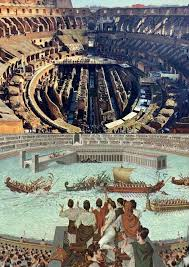
The naumachia—or mock naval battle—held inside the Flavian Amphitheatre (the Colosseum) remains one of the most debated and technically fascinating spectacles of Roman engineering. While ancient authors like Martial and Cassius Dio described elaborate naval battles taking place within the arena, modern archaeologists have long puzzled over the logistics, as the arena floor is honeycombed with the hypogeum, a complex subterranean network of tunnels, elevators, and animal cages.
1. The Hydraulic Challenge
To flood the arena, the Romans had to overcome the massive structural obstacle of the hypogeum. If the arena floor were simply filled with water, the wooden structures and mechanisms beneath it would have been destroyed, and the structural integrity of the Colosseum’s foundation would have been compromised by the immense weight of the water.
The Evidence for Flooding: Archaeologists have found large, lead-lined stone channels beneath the arena floor. These channels were connected to the massive Aqua Claudia and Anio Novus aqueducts that fed Rome. The logistical theory suggests that these channels functioned as a sophisticated drainage and filling system, allowing water to be pumped into the arena through high-pressure conduits.
2. The Timeline of the Naumachia
It is widely believed by modern scholars that the naumachia occurred primarily during the early phase of the Colosseum’s existence, specifically under the Emperor Titus in 80 AD.
Pre-Hypogeum Era: During the inauguration games in 80 AD, the hypogeum had not yet been fully constructed (or was at least not yet the permanent multi-story complex it would later become under Domitian). Before these subterranean levels were walled in with permanent masonry, the arena floor was likely a removable wooden platform.
The Logistical Process:
Removal of the Floor: The wooden arena floor was dismantled, exposing the deeper pit beneath.
Sealing the Drain: The main drainage channels (the cloaca) were plugged.
Controlled Inundation: Water from the city’s primary aqueducts was diverted into the arena, filling the basin to a depth sufficient to float specialized, low-draft vessels.
3. The Structural Constraint: Water Weight and Displacement
Water is exceptionally heavy—approximately 1,000 kilograms per cubic meter. Filling the entire arena bowl of the Colosseum would have created an immense pressure load on the exterior walls and the foundation.
Limited Depth: The naumachia were likely not "deep water" battles. Instead, they utilized shallow-draft boats or flat-bottomed barges. This limited the volume of water required, reducing the hydrostatic pressure on the arena walls while still providing enough buoyancy for the ships to maneuver.
Rapid Drainage: The Romans were masters of civil engineering. Once the spectacle was finished, they utilized the gravity-fed sewer system (the Cloaca Maxima) to drain the arena rapidly, allowing the area to be reset for standard gladiatorial combat in a relatively short timeframe.
4. Why the Practice Ended
The "flooding" era of the Colosseum was short-lived. Following the reign of Titus, Emperor Domitian completed the permanent, multi-story hypogeum. This massive brick-and-stone subterranean complex essentially turned the area beneath the arena into a "backstage" factory for gladiatorial games, complete with lifts and pulley systems to bring lions and warriors up into the arena. Once this permanent structure was installed, flooding the arena became physically impossible without destroying the complex machinery that made the daily games possible.
The naumachia effectively moved from the Colosseum to purpose-built, dedicated basins elsewhere in Rome—such as the Naumachia Augusti—which were designed specifically for naval combat and did not have the complex sub-floor machinery of the Colosseum.
While the naumachia in the Colosseum represent a pinnacle of Roman showmanship, they were a fleeting technological experiment. The permanent installation of the hypogeum reflects the Roman shift toward the "industrialized" entertainment of the later Empire, where efficiency and complexity were prioritized over the short-term spectacle of flooding the arena.