The Crucible of Northern Trade: Birka
Founded in the mid-8th century on the island of Björkö in Lake Mälaren, Birka was arguably the most important trading center in Viking Age Sweden. While many Viking settlements were agrarian, Birka was a dedicated urban hub—a "proto-city"—specifically engineered to facilitate the flow of goods between the Baltic Sea, the interior of Scandinavia, and the vast markets of the Abbasid Caliphate and the Byzantine Empire.
1. The Geometry of a Trading Hub
Birka was not a sprawling metropolis; it was a tightly organized, highly defensible center of commerce. Its layout was designed to maximize efficiency for traders who arrived by boat and stayed for months to conduct business.
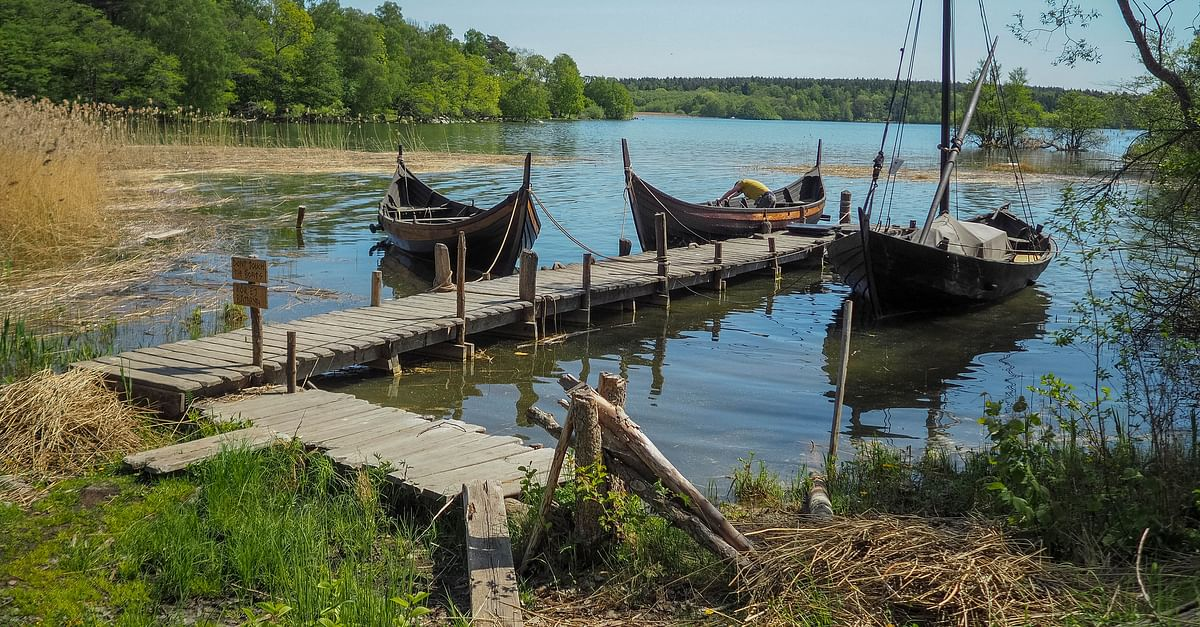
The Harbor and Waterfront: The town was built directly on the water, with rows of wooden piers and jetties extending into the lake. This allowed for the rapid unloading of heavy goods like furs, slaves, and walrus ivory, and the loading of luxury imports like silk, glass, and spices.
The Defensive Rampart: A massive semicircular earthen wall—the Kvarnbacken rampart—was built to enclose the town on the landward side. It served not only to protect the town’s residents but also to strictly control the flow of people and goods in and out, ensuring that traders paid their "market taxes" to the local chieftain.
2. The Eastern Connection: The "Silk Road" of the North
Birka’s importance rested entirely on its role as the western terminus of the Volga and Dnieper trade routes. Norse merchants, known in the East as the Rus, traveled deep into Russia, navigating rivers as far as the Caspian Sea and the Black Sea.
The Luxury Import Economy: Archaeologists have unearthed incredible quantities of non-Scandinavian goods at Birka:
Silk: Fragments of high-quality Chinese and Persian silk, often used as trim for everyday Viking clothing.
Dirhams: Thousands of silver dirhams—Arab coins minted in places like Baghdad and Samarkand—have been found in Birka’s graves and house floors. These were not just currency; they were the primary commodity the Norse brought back to be melted down into jewelry or used as status symbols.
Glass and Beads: Colored glass vessels and beads from the Rhineland and the Byzantine Empire provided the status-defining "bling" that allowed the Birka elite to distinguish themselves.
3. Social and Religious Pluralism
Because it was a commercial hub, Birka was far more cosmopolitan than the typical rural Norse settlement. It acted as a "melting pot" where the rigid social norms of the rural interior were often bypassed in favor of commerce.
The First Christian Mission: It was here, in the 830s, that the monk Ansgar made his first attempt to convert the Swedish Vikings to Christianity. The fact that he was allowed to establish a mission at all—despite the local pagan elite's resistance—shows that Birka was a site of religious negotiation and tolerance, largely driven by the practical need to accommodate foreign traders.
The "Black Earth": The town was built on a thick layer of dark, organic-rich soil known as the Svartjorden (Black Earth). This soil is packed with the refuse of centuries—broken pottery, animal bones, spindle whorls, and thousands of tiny metal scraps. It acts as an "archaeological time capsule," allowing modern researchers to reconstruct the daily lives of the craftspeople who lived in the town’s cramped, wooden row houses.
Birka was the physical embodiment of the Viking Age's transition from raiding to long-distance commerce. By 975 AD, Birka was abandoned—likely due to a combination of land elevation (the harbor became too shallow for larger ships) and the rise of a new, more strategically located town nearby: Sigtuna. However, for two centuries, it remained the essential gateway that tied the Scandinavian world to the economic engines of the Orient.