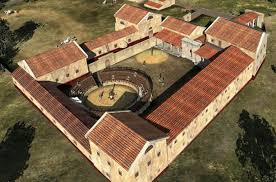
ust across the street from the Colosseum lies the Ludus Magnus, the "Great School." It was the most prestigious gladiator training facility in the Roman Empire, a specialized barracks and arena designed to keep Rome’s most valuable performers in peak physical condition and ready for the games.
1. The Proximity to the "Big Stage"
The location of the Ludus Magnus was a matter of logistics. Because gladiators were both high-value assets and potential security risks, the Roman authorities wanted them close to the Colosseum but contained.
The Tunnel: Excavations revealed a brick-lined underground tunnel that connected the Ludus Magnus directly to the subterranean levels of the Colosseum. This allowed gladiators to move from their barracks to the arena floor without ever stepping foot in the public streets.
The Imperial Command: Unlike smaller, privately-owned schools, the Ludus Magnus was under the direct control of the Emperor, managed by a high-ranking official called the Procurator Ludi Magni.
2. Architecture: A Mini-Colosseum
Archaeologists have uncovered about half of the original structure. It was essentially a miniature version of the Colosseum itself.
The Training Arena: At the center of the rectangular courtyard sat an elliptical arena. It was surrounded by a small cavea (seating area) that could hold about 3,000 spectators. This allowed the public to watch "practice" sessions, almost like modern open-practice days for professional sports teams.
The Living Quarters: Surrounding the arena were 14 cells on each floor. These were Spartan and cramped, designed to house up to 2,000 gladiators at the school’s peak.
3. The Daily Grind: Training and Diet
Excavations and skeletal analysis from gladiator cemeteries nearby provide a vivid picture of the life of a "student" at the Ludus.
The "Barley Men": Despite their muscular depictions, gladiators were known as hordearii (barley-eaters). Their diet was heavy in carbohydrates (barley and beans) to create a layer of subcutaneous fat. This fat served as a "biological shield," allowing for superficial cuts that looked dramatic for the crowd but didn't reach vital organs or muscles.
The Palus: Training began with the palus, a wooden post set in the ground. Novices practiced their strikes against the post using heavy wooden swords (rudis) that were significantly heavier than real weapons, building immense strength and endurance.
4. The Infrastructure of Care
Because a trained gladiator was a massive financial investment, the Ludus Magnus featured amenities that even some Roman citizens lacked:
Medical Care: The school had its own infirmary and some of the best surgeons in the empire. Galen, the most famous doctor of antiquity, began his career treating gladiators, gaining his knowledge of human anatomy from their wounds.
The Bath Complex: A private bathhouse ensured the fighters could recover from their grueling sessions, maintaining their hygiene and muscle health.
5. The End of the Games
The Ludus Magnus remained active until the early 5th century. As Christianity became the state religion and the empire faced financial strain, the bloody spectacles of the arena were eventually banned. The school fell into disrepair, was used as a burial ground, and was eventually partially built over by the modern city of Rome.