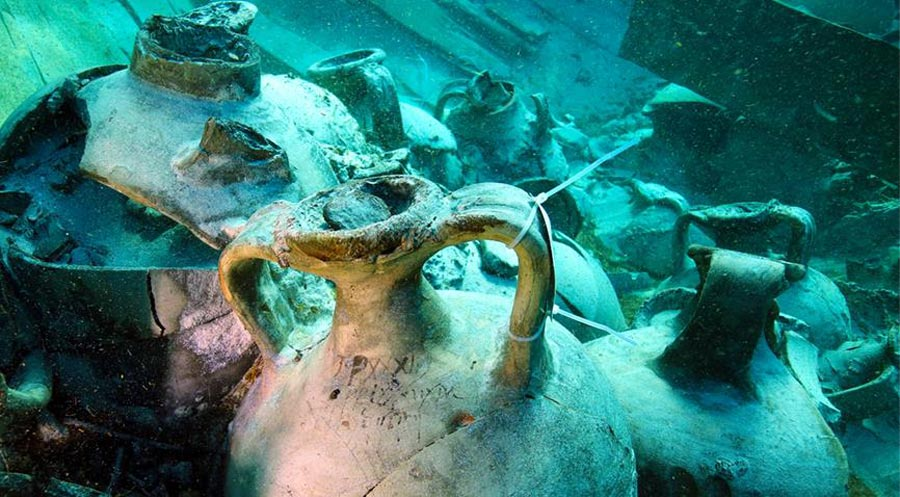
The shipwreck of the Grand Congloué, located off the coast of Marseille, France, is one of the most significant underwater archaeological discoveries in history. It didn't just reveal a sunken vessel; it provided a "receipt" for the massive scale of the Roman wine trade and pioneered the field of modern maritime archaeology.
1. The Discovery and Cousteau
In 1952, the legendary Jacques Cousteau and his team on the Calypso began excavating a mound of amphorae (clay jars) at the base of the Grand Congloué rock. This was the first time a shipwreck was excavated using scuba gear and a systematic archaeological approach.
For decades, the site confused divers because it seemed to contain two different types of cargo from two different eras. Eventually, it was determined that two separate ships—Grand Congloué 1 and Grand Congloué 2—had actually sunk on top of each other, roughly 100 years apart.
2. The Cargo: A Floating Vineyard
The older ship, dating to roughly 200–180 BC, was a massive merchant vessel for its time. It was carrying a staggering amount of cargo destined for the markets of Gaul (modern-day France).
The Amphorae: The ship held approximately 400 to 1,200 amphorae. Most were "Dressel 1" style jars, specifically designed with long, pointed bottoms to be stacked in layers in the ship's hold.
The Wine: Residue analysis showed that these jars carried Italian wine, likely from the vineyards of Campania or Latium. During this period, Roman wine was a luxury status symbol for the Celtic chieftains of Gaul.
Fine Tableware: In addition to the wine, the ship carried over 7,000 pieces of "Campanian" pottery—glossy, black-slipped plates and bowls that were the "fine china" of the Roman Republic.
3. The "Sestius" Connection: An Ancient Brand
One of the most remarkable finds at Grand Congloué was the presence of stamps on the handles of the amphorae. Many bore the mark SES, identifying them as the property of Marcus Sestius, a powerful Roman businessman based in Delos, Greece.
This discovery allowed historians to map out an incredible trade route: Sestius produced or bought wine in Italy, bottled it in jars stamped with his "brand," and shipped it across the Mediterranean to the frontier markets of the West. It proved that the Roman economy was far more "globalized" and brand-conscious than previously thought.
4. Shipbuilding Technology
The Grand Congloué ships were built using the "shell-first" method, a technique characteristic of the Greco-Roman world.
Mortise and Tenon Joints: Instead of building a frame first, shipwrights joined the outer planks together using thousands of tiny wooden joints called mortise and tenons, held in place by wooden pegs. This created an incredibly strong, rigid hull.
Lead Sheathing: To protect the wood from "shipworms" (wood-boring mollusks), the hull was covered in thin sheets of lead, which were secured with copper nails. This was a costly but effective way to extend the life of a merchant vessel on long-haul routes.
5. The Scale of the Trade
The Grand Congloué was just one ship in a massive fleet. It is estimated that during the peak of the Roman wine trade, tens of millions of liters of wine were shipped into Gaul every year.
The trade was so lopsided that the Roman writer Diodorus Siculus claimed a Gaulish chieftain would trade a slave for a single jar of Italian wine. The shipwrecks at Grand Congloué represent the physical evidence of this economic powerhouse, where wine was used as a tool for both profit and cultural Romanization.
6. Legacy of the Site
The Grand Congloué excavation changed archaeology forever by moving it from the land to the seafloor. It proved that shipwrecks are "time capsules"—unlike cities, which are lived in and changed over centuries, a shipwreck represents a single, frozen moment in time. The artifacts recovered are now housed in the Museum of Roman Docks in Marseille, where the "Sestius" amphorae still stand as symbols of the world's first great maritime commercial empire.