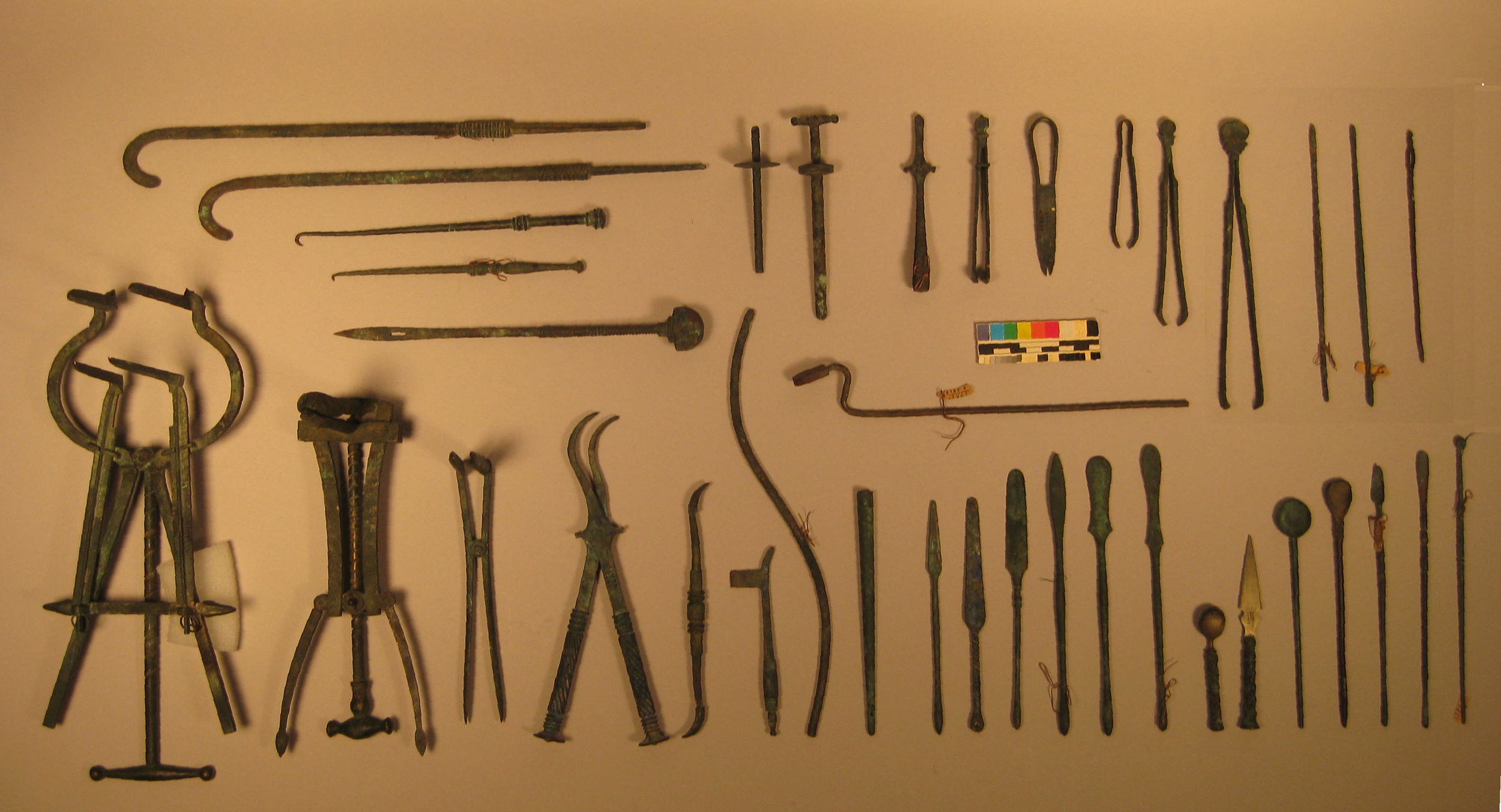
The discovery of the House of the Surgeon in Pompeii provides the most comprehensive look at the "Old Style" of Roman medical practice. While Roman medicine was heavily influenced by Greek pioneers like Hippocrates and Galen, it was the Roman military's need for battlefield surgery that pushed their medical technology to a level of precision not seen again until the 18th century.
1. The Scalpel: The Primary Cutting Tool
The Roman scalpel (scalpellum) was a dual-purpose instrument. It typically featured a high-carbon steel blade attached to a bronze handle.
The Blade: Used for making precise incisions in soft tissue. Because iron rusts, most archaeological finds only preserve the bronze handle, but the slots for the iron blades show they were often replaceable or double-sided.
The Handle: The blunt, leaf-shaped end of the bronze handle served as a "dissector," allowing the surgeon to gently separate layers of tissue without cutting them.
2. Bone Levers and Drills
Roman surgeons were surprisingly adept at treating traumatic bone injuries, particularly those sustained in gladiatorial combat or war.
Bone Levers: These were used to pry fractured bone fragments back into their proper alignment. They were stout, bronze tools designed to withstand significant pressure.
Trepanation Drills: In cases of head trauma, surgeons used bow drills to remove circular sections of the skull to relieve pressure on the brain. The "House of the Surgeon" contained several drill bits designed specifically for this delicate procedure.
3. Forceps and Extractors
The surgical kit included a wide variety of forceps (vulsella), each designed for a specific task.
Tissue Forceps: Used to grasp and hold skin or vessels during suturing.
Epilation Forceps: While used for grooming, these were also essential for removing debris, splinters, or clothing fibers from deep wounds to prevent infection.
Arrow Extractors: A specialized Roman invention, these tools featured long, thin arms that could reach into a wound, clasp the barbs of an arrow head, and pull it out with minimal additional tearing of the flesh.
4. The Speculum: Diagnostic Innovation
One of the most complex items found in Pompeii was the vaginal speculum. This device demonstrated a high level of mechanical engineering, featuring a central screw mechanism that, when turned, expanded three or four metal blades. This allowed Roman doctors to perform internal examinations and even basic gynecological surgeries, showing that their medical care extended far beyond just treating traumatic injuries.
5. Cautery Irons and Styptics
In a world without modern anesthesia or blood transfusions, controlling hemorrhage was the surgeon's greatest challenge.
Cauterization: Roman kits contained various "cautery irons"—metal rods with different shaped tips that were heated to "cherry red" and used to sear shut open blood vessels.
Styptics: Surgeons also used chemical "plugs" made of alum, copper sulfate, or vinegar-soaked sponges to encourage clotting, often applied with specialized bronze spatulas found in the kit.
6. Hooks and Probes
Finally, the kit was filled with an array of "minor" instruments that were essential for everyday procedures.
Sharp Hooks: Used to snag and lift small sections of skin or blood vessels during surgery.
Blunt Probes (Spathomele): These long, thin rods had a small bulbous end. They were used to "sound" a wound—exploring its depth and direction—or to apply medicinal salves deep within a cut. The bulbous end ensured the doctor didn't accidentally puncture an organ or artery while investigating the injury.