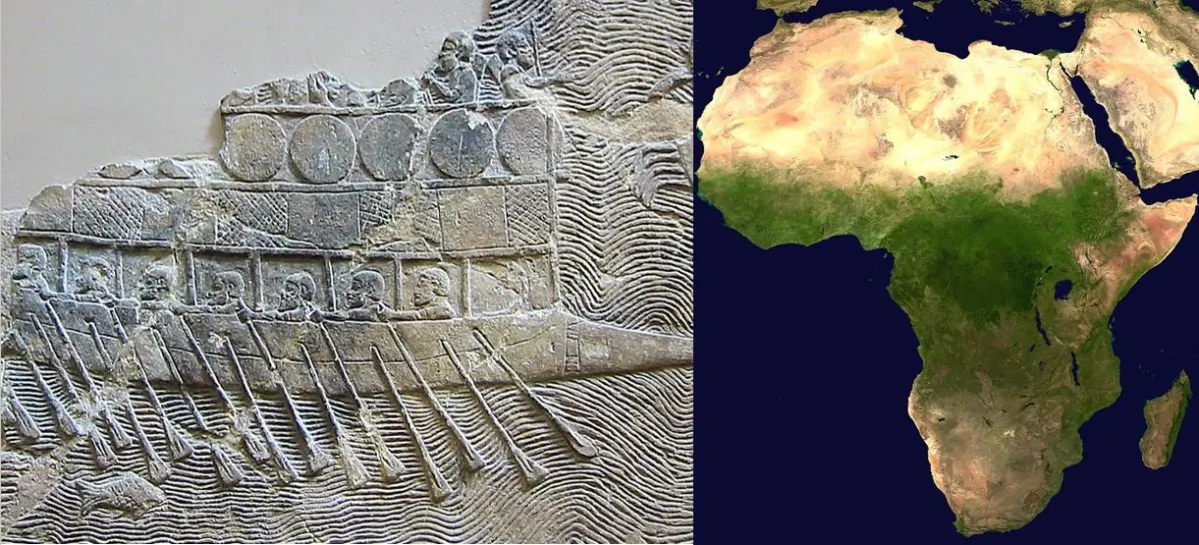
The Phoenicians were the preeminent mariners of the ancient world, dominating Mediterranean trade from their city-states in modern-day Lebanon. While they were famous for establishing Carthage and mining tin in Britain, the most debated feat in their history is the alleged circumnavigation of Africa—nearly 2,000 years before Vasco da Gama.
1. The Primary Source: Herodotus
The only historical account of this voyage comes from the Greek historian Herodotus in his work The Histories (written c. 440 BC).
According to Herodotus, the Egyptian Pharaoh Necho II (reigned 610–595 BC) commissioned a crew of Phoenician sailors to find a passage from the Red Sea around the southern tip of Africa (then called Libya) and back through the Pillars of Hercules (the Strait of Gibraltar).
2. The Narrative of the Voyage
Herodotus describes a journey that took three years to complete. The Phoenicians used a "stop-and-start" strategy:
Seasonal Farming: Every autumn, the sailors would land, sow a crop of wheat, and wait for it to ripen. After harvesting the grain, they would continue their journey.
The Route: They started in the Red Sea, sailed south along the eastern coast of Africa, rounded the southern tip, and traveled north along the Atlantic coast until they reached the Mediterranean.
3. The "Impossible" Detail that Proves the Fact
Herodotus himself was skeptical of the story, specifically citing a detail he found unbelievable:
"And they said—which I for my part do not believe, but others may—that in sailing round Libya they had the sun on their right hand."
To a Greek living in the Northern Hemisphere, the sun is always in the southern sky. However, for anyone sailing west around the southern tip of Africa (the Cape of Good Hope), the sun would indeed appear to the north—meaning it would be on their right-hand side.
This "error" by Herodotus is seen by modern historians as the strongest evidence that the voyage actually took place. The Phoenicians couldn't have known about this celestial shift unless they had actually crossed the equator and reached the southern reaches of the continent.
4. Phoenician Ship Technology
The Phoenicians were capable of such a journey because of their advanced shipbuilding. Unlike the lighter Greek galleys, Phoenician merchant ships (gauloi) were deep-hulled and powered by both oars and large rectangular sails.
The "Hippoi": Their ships often featured horse-head carvings on the prow.
Navigation: They were the first to use the "Phoenician Star" (the Pole Star/Ursa Minor) for navigation at night, allowing them to travel far from the sight of land.
Keel Construction: They utilized the "mortise and tenon" joint, which created incredibly strong, watertight hulls capable of surviving the rougher Atlantic swells and the "Cape of Storms."
5. Challenges to the Theory
Despite the compelling "sun on the right" evidence, some archaeologists remain skeptical for several reasons:
Lack of Archaeological Evidence: No Phoenician shipwrecks or artifacts have been found on the southern or western coasts of Africa.
The Benguela Current: Sailing north along the west coast of Africa requires fighting the powerful Benguela Current and prevailing winds, which would have been extremely difficult for ancient square-rigged vessels.
Purpose: There is no record of the Egyptians or Phoenicians attempting the trip again, leading some to wonder why such a monumental discovery was never exploited for trade.
6. The Verdict
Most modern scholars believe the voyage was historically plausible. The detail regarding the sun's position is far too specific to be a lucky guess. While it may not have resulted in a permanent trade route due to the sheer danger and distance, the Phoenician circumnavigation remains the most impressive maritime achievement of antiquity—a 13,000-mile journey completed in wooden ships using only the stars and seasonal winds.