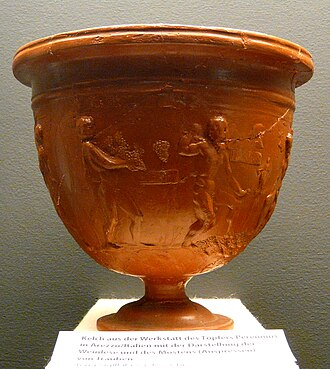
In the "Old Style" of Roman commerce, Terra Sigillata ("sealed earth") represented the world's first truly globalized consumer product. This distinctive, bright-red, glossy pottery was not a luxury item for the ultra-wealthy, but a standardized, mass-produced tableware used by soldiers in Britain, merchants in North Africa, and citizens in Rome alike. Its production was an industrial marvel that combined artistic flair with a proto-factory system.
1. The Hallmark of Quality: Slip and Gloss
The defining feature of Terra Sigillata was its deep coral-red color and its smooth, lustrous surface.
The Sintered Slip: The "Old Style" gloss was not a glaze in the modern sense. Instead, it was a fine "slip"—a mixture of water and highly refined clay particles (illite). When fired at specific temperatures ($1000^{\circ}C$ to $1050^{\circ}C$), these particles fused into a glass-like finish that was both waterproof and exceptionally durable.
Oxygen Control: The red color was achieved through an oxidizing atmosphere in the kiln. If the potter accidentally cut off the oxygen, the iron in the clay would turn black, resulting in the rarer "black-gloss" variety.
2. The Mould-Based Industrial Revolution
Unlike traditional hand-thrown pottery, the mass production of decorated Terra Sigillata relied on the use of stamps and moulds.
The Master Punches: Artisans created individual stamps (poinçons) out of fired clay or bronze, depicting gods, gladiators, animals, or floral scrolls.
The Mould: These stamps were pressed into the interior of a wet clay bowl (the mould). Once the mould was fired, it could be used to produce hundreds of identical bowls.
Production Speed: A potter simply had to press fresh clay into the rotating mould. As the clay dried, it shrunk slightly, popping out of the mould with the intricate relief patterns perfectly intact.
3. The Arretine and Samian Centers
Production moved through several "Old Style" industrial hubs as the Empire expanded.
Arezzo (Arretium): The original center in Italy (1st century BC). Arretine ware was known for its delicate, high-relief scenes influenced by silver plate designs.
La Graufesenque (Gaul): By the 1st century AD, massive production centers in modern-day France took over the market. These sites were true factories; excavations at La Graufesenque revealed kilns capable of firing 40,000 vessels at a single time.
Distribution: Because the pottery was standardized and stacked easily, it was used as "space-filler" on ships carrying grain or wine, allowing it to reach the furthest corners of the Roman world at a low cost.
4. Epigraphy: The "Sigillum" (The Seal)
The name Terra Sigillata comes from the sigillum (seal or stamp) found on the base of most pieces.
The Potter’s Signature: Potters would stamp their name or the name of their workshop into the bottom of the vessel (e.g., OF VITALIS—"From the workshop of Vitalis").
Archaeological Chronology: These stamps are a goldmine for archaeologists. Because we know exactly when certain workshops operated, finding a piece of signed Terra Sigillata allows us to date an entire archaeological layer to within a decade.
5. Standardized Forms: The Dragendorff System
To facilitate mass production and shipping, shapes were strictly standardized. In the late 19th century, Hans Dragendorff categorized these into "Forms" which are still used by researchers today.
Form 27: A small, double-curved cup.
Form 37: A large, deep decorated bowl.
Form 18/31: A flat plate or shallow dish.
This standardization meant that a consumer in Londinium could buy a replacement for a broken dish and know it would match the "Old Style" set they already owned.
6. The Decline and the "African Red Slip"
By the 3rd century AD, the great Gallic factories began to decline due to economic instability and shifting trade routes. The market was eventually captured by African Red Slip (ARS) ware from modern-day Tunisia. While ARS was also mass-produced and red-slipped, it moved away from complex moulded reliefs in favor of simpler, stamped floral and Christian motifs, reflecting the changing tastes of the Late Empire.