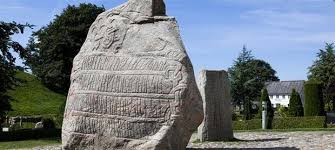
King Gorm the Old is a foundational figure in Scandinavian history, representing the transition from the fragmented Viking Age to the unified "Old Style" Kingdom of Denmark. Ruling from Jelling in Jutland during the mid-10th century, Gorm is considered the first historically recognized King of all Denmark, and his legacy is physically immortalized in the Jelling Stones—monuments often called "Denmark's Birth Certificate."
1. The Small Jelling Stone: A Tribute to Thyra
Before the great unification, Gorm raised the smaller of the two Jelling stones. It is a deeply personal monument that also carries significant political weight.
The Inscription: The runic text reads: "King Gorm made this monument in memory of Thyra, his wife, Denmark's adornment."
The "Denmark" Mention: This is the first time the word "Tanmaurk" (Denmark) appears within the country's borders. By calling his wife the "adornment of Denmark," Gorm was asserting his claim over a unified territory, rather than just a local chiefdom.
2. The Great Jelling Stone: Harald Bluetooth’s Manifesto
While Gorm began the work, his son, Harald Bluetooth, completed the transformation of Danish identity. He raised a massive three-sided stone next to his father’s, which served as a monumental "Old Style" press release for the new era.
The Three Pillars of the Inscription: The stone famously claims that Harald:
Won for himself all of Denmark.
Won Norway.
Made the Danes Christian.
The Transition of Art: The stone features a unique blend of Viking "Mammen" style intertwining patterns with the earliest Scandinavian depiction of Christ. It marks the shift from the pagan "Old Style" of the Viking North to the Christianized European mainstream.
3. The Jelling Mounds: A Statement in the Landscape
Gorm’s power was expressed through massive earthworks that dominated the flat Jutland horizon.
The North Mound: This is believed to be Gorm’s original burial place. Excavations revealed a wooden burial chamber, though it was found empty—likely because his son later moved Gorm’s remains to the newly built church nearby to signify the family's conversion.
The South Mound: Larger than the North Mound, this massive structure contains no burial chamber. It was likely built as a ceremonial platform or a monumental landmark to showcase the "Old Style" scale of Harald’s royal power.
4. The Trelleborg Fortresses: Defending the New Identity
To maintain his father’s unified kingdom, Harald Bluetooth constructed a series of highly standardized "Old Style" ring fortresses known as Trelleborgs.
Perfect Geometry: These forts were perfectly circular, divided into four quadrants by gates and roads. The precision of their construction suggests a centralized government with advanced engineering capabilities and a standing military force.
Control Points: Strategically placed across the Danish landscape, these forts allowed the king to collect taxes, suppress local rebellions, and defend against the Holy Roman Empire to the south.
5. From Pagan Chief to Christian King
Gorm the Old’s reign was the twilight of the pagan "Old Style" Viking world. While Gorm himself likely died a worshipper of Odin, his unification of the Danish tribes provided the political structure that allowed his son to bring Denmark into the Christian fold.
The Jelling Church: Built between the two mounds, this simple wooden (and later stone) church represented the "New Style" of leadership. By burying his father under the floor of the church, Harald symbolically "baptized" the lineage of Danish kings.
6. The Longest Lineage in Europe
The Jelling Stones and the reign of Gorm the Old established a royal line that continues to this day. The current Danish Monarchy traces its roots directly back to Gorm, making it one of the oldest continuous monarchies in the world. Jelling is no longer just a Viking site; it is a sacred space where the "Old Style" Viking spirit was forged into a modern national identity.