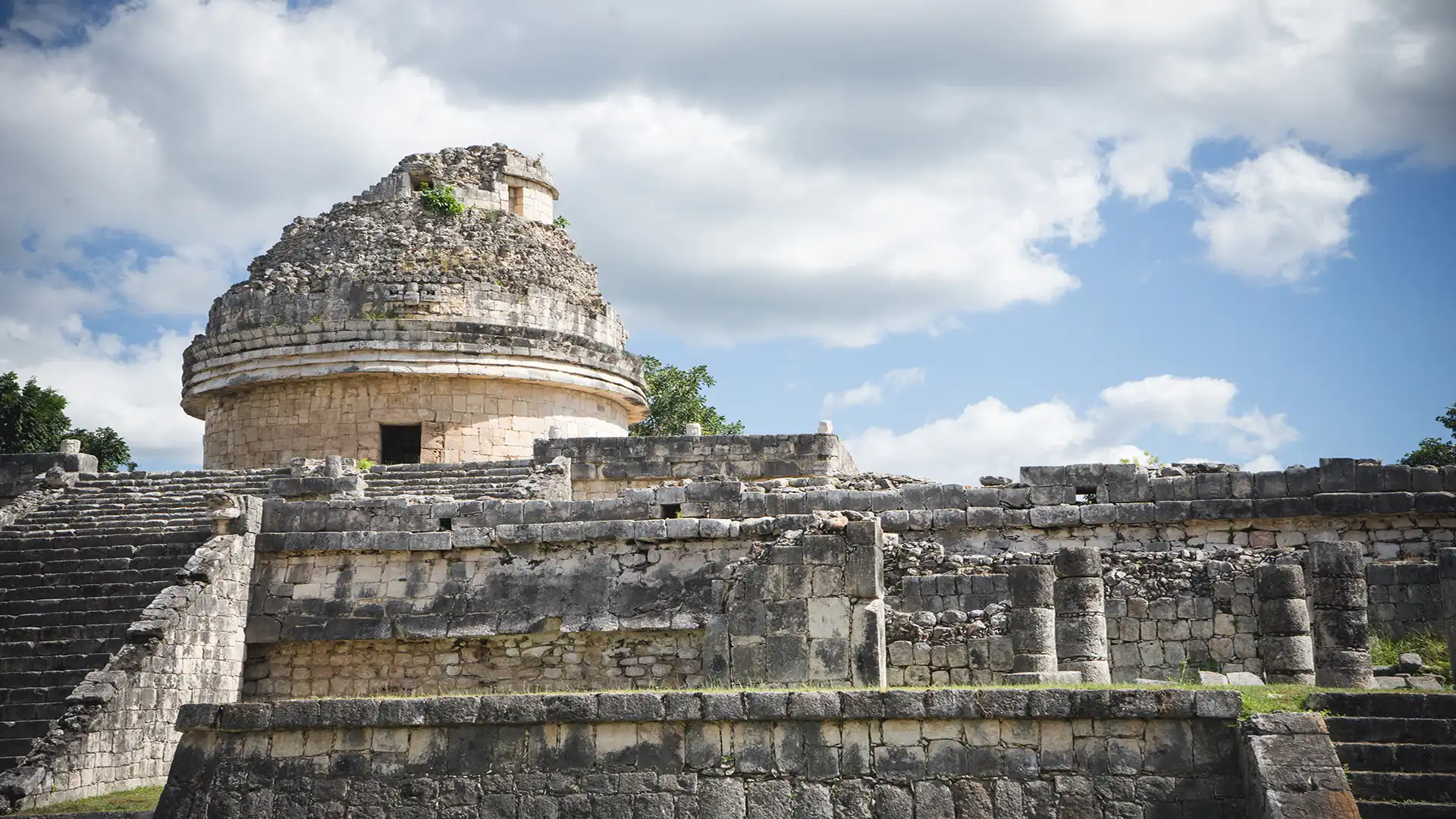
The Maya were masters of celestial mechanics, and nowhere is this more evident than in the Caracol at Chichen Itza. Built around 906 AD, this unique "Old Style" circular structure served as a sophisticated astronomical observatory, allowing Maya priests and astronomers to track the movements of the heavens with startling precision.
Its name, which means "snail" in Spanish, refers to the interior stone spiral staircase that winds up to the observation chamber, mimicking the shape of a conch shell.
1. The Geometry of the Heavens
Unlike the square or rectangular structures common in Maya architecture, the Caracol is a cylindrical tower set upon two massive rectangular platforms.
The Circular Design: The round shape was a functional choice. It provided a $360^{\circ}$ field of view, essential for tracking objects as they rose and set along the horizon.
The Orientation: The primary platform is not aligned with the other buildings in Chichen Itza. Instead, it is skewed to point toward the northernmost and southernmost positions of Venus on the horizon.
2. The Focus on Venus (The Morning Star)
To the Maya, Venus was not just a planet; it was Kukulkan (the Feathered Serpent), a deity of war and rebirth. The Caracol was specifically engineered to track the 584-day Venus cycle.
Venus Extremes: The diagonal sightings through the building's windows align perfectly with the "Venus station" points—the furthest north and south points the planet reaches over an 8-year period.
The Dresden Codex: The data gathered at sites like the Caracol allowed the Maya to create the Venus Table in the Dresden Codex, which predicted the planet's position with an error of only two hours over 500 years.
3. The Observation Windows
The upper chamber of the Caracol originally had several narrow, tunnel-like windows. While many have collapsed, the remaining three provide a "gun-sight" view of specific celestial events:
Window 1: Aligns with the setting sun at the Vernal Equinox.
Window 2: Points toward the northernmost setting point of the moon.
Window 3: Aligns with the setting sun at the Summer Solstice.
By looking through these narrow apertures, astronomers could eliminate ambient light and focus on the exact moment a celestial body touched the horizon.
4. The Ritual and Agricultural Calendar
Astronomy was never just a hobby for the Maya; it was a mechanical necessity for their "Old Style" survival.
The Haab' and Tzolk'in: By tracking the sun and stars, the Maya synchronized their 365-day solar calendar with their 260-day sacred calendar.
Predicting the Rains: Observations at the Caracol told the priests exactly when the rainy season would begin, signaling when the jungle should be cleared and the maize planted. A mistake in these calculations could lead to widespread famine.
5. Architectural Engineering
The Caracol demonstrates a deep understanding of structural stability and "Old Style" visual perspective.
The Platforms: The tower sits on a double-tiered platform that elevated the observers above the surrounding forest canopy, providing an unobstructed view of the horizon.
The Core: The central pillar of the spiral staircase acted as a structural anchor, allowing the heavy stone roof to stay intact despite the hollow observation shafts carved into the walls.
6. The Zenith Passage
Twice a year, the sun passes directly overhead in the tropics, casting no shadow. The Caracol, along with other Maya structures, was used to mark these "Zenith Passages." For the Maya, this was a sacred moment when the sun was believed to be in direct contact with the earth, charging the world with divine energy.
The Caracol remains one of the most significant "Old Style" scientific monuments of the pre-Columbian world, proving that the Maya were not just observers of the stars, but mathematicians who could translate the chaotic movements of the sky into a rigid, predictable architectural reality.