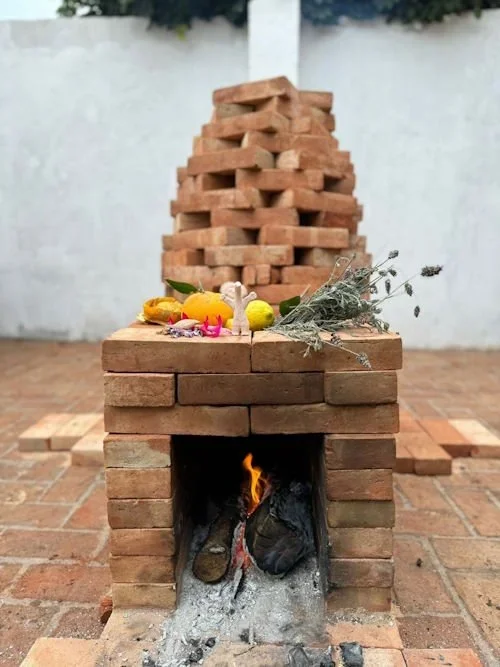
Brick production was essential to the development of durable architecture in many ancient societies. Fired bricks could be used to construct walls, floors, drains, ovens, storage facilities, and other structures, while ceramic production supplied households with vessels for cooking, storage, and transport. Although large workshops and organized production centers have received considerable archaeological attention, smaller kilns located in rural hinterlands are equally important for understanding how communities manufactured building materials and everyday objects. These installations can reveal the relationship between household economies, local resources, agricultural cycles, and the movement of finished goods between settlements.
A kiln is a structure designed to control heat during the firing of clay or other materials. Its form depends on the products being manufactured, the fuel available, the desired temperature, and the technical traditions of the builders. Small-scale kilns may have consisted of simple pits, temporary firing structures, or more durable installations with chambers and flues. Some kilns were used repeatedly, while others may have been constructed for a limited production episode. Archaeologists must distinguish these possibilities by examining the surviving structure, the surrounding deposits, and evidence of repeated heating.
Identifying a kiln requires more than finding burned soil or a concentration of pottery. Hearths, cooking installations, metalworking furnaces, and accidental fires can also produce heat-altered deposits. A kiln interpretation becomes stronger when the feature contains evidence of controlled airflow, a firing chamber, a stokehole, vitrified surfaces, or discarded products showing signs of firing failure. The arrangement of the structure can reveal how fuel and pottery were positioned during production. Even so, the original design may be difficult to reconstruct when upper sections have collapsed or when later activity has disturbed the remains.
The materials used in brick and ceramic production were usually drawn from the local environment. Suitable clay deposits were essential, while sand, temper, or other additives could be incorporated to influence the properties of the finished product. Fuel might come from wood, brush, crop residues, or other combustible materials, depending on regional availability. The location of a kiln near clay sources and fuel supplies could reduce the effort required to transport heavy raw materials. However, proximity alone does not prove that the kiln supplied only the nearest settlement. Finished bricks and pottery could be moved to nearby villages, estates, markets, or construction sites.
Small-scale production may have been closely connected to household activities. A family could manufacture bricks for the construction or repair of its own dwelling, while a local craftsperson might produce vessels for neighboring households. Production could also occur seasonally, when agricultural demands were lower or when weather conditions were suitable for drying and firing clay. These arrangements would leave different archaeological signatures, although the distinctions are not always easy to establish. A small kiln could be operated by a household, a specialist artisan, or a group of workers, and the size of the installation alone cannot identify the social organization behind it.
The archaeological evidence for production often includes wasters, which are objects damaged during firing. Bricks may be warped, cracked, incompletely fired, or fused together, while pottery vessels may display uneven coloration or structural failure. Concentrations of such material near a kiln can indicate that production took place at the site. Researchers can compare wasters with finished objects found in nearby settlements to investigate whether the kiln supplied local consumers. Similarities in clay composition, temper, dimensions, and manufacturing marks can strengthen the connection, although finished objects may have circulated through several communities.
The distinction between brick production and pottery production is particularly important. Both require clay and controlled firing, but their technological demands may differ. Bricks are usually larger and may require different drying conditions and firing arrangements from small vessels. A kiln designed for pottery might not be suitable for efficiently producing large quantities of building bricks, and a brick kiln may have been used for other materials only under certain conditions. Archaeologists should therefore examine the dimensions of the firing chamber, the heat distribution, the types of wasters, and the products associated with the installation before determining its primary function.
Fuel consumption and environmental impact are important aspects of small-scale kiln production. Firing bricks and pottery requires substantial energy, and repeated production may have placed pressure on nearby woodlands or other fuel sources. Charcoal analysis can identify the kinds of wood used, although charcoal recovered from a kiln area may come from multiple activities. Pollen and other environmental indicators may help investigate changes in surrounding vegetation, while spatial analysis can show whether production installations were concentrated near fuel supplies or clay deposits. Nevertheless, a single kiln does not establish widespread deforestation or environmental degradation; such conclusions require evidence from a broader landscape and a suitable chronology.
Small kilns can also reveal patterns of exchange and economic specialization. If products from one kiln appear across several settlements, researchers may infer that the production site supplied a wider market. The distance and scale of distribution depend on the weight and fragility of the goods, the quality of transport routes, and the demand for standardized building materials. Bricks may be expensive to move over long distances, encouraging local production near construction sites. Pottery can sometimes travel farther, especially when vessels were used to transport commodities or when distinctive products were valued by consumers. These possibilities need to be tested through material analysis and distribution mapping.
Dating a kiln involves several potential challenges. Charcoal from a firing deposit may be suitable for radiocarbon dating, but old wood or reused fuel can produce dates older than the actual firing event. Pottery fragments within a kiln's construction fill may predate its use, while later objects can enter through disturbance. Archaeologists therefore distinguish construction, operation, repair, and abandonment phases. Multiple samples from secure contexts may provide a more reliable chronology than a single piece of charcoal or an isolated artifact.
The study of small-scale brick kilns in rural hinterlands provides insight into the organization of ancient production beyond major urban centers. These installations reveal how households and local craftspeople transformed earth, water, and fuel into durable materials for construction and everyday life. By combining architectural study, material analysis, environmental evidence, and distribution mapping, archaeologists can investigate whether production was domestic, specialized, seasonal, or connected to broader exchange networks. Small kilns may appear modest compared with large industrial installations, but they played an important role in sustaining settlements and adapting building technology to local resources and community needs.