Introduction
The Minoan civilization of Bronze Age Crete developed sophisticated craft industries supported by maritime exchange, agricultural production, and specialized labor.
Among the valuable materials produced in the ancient Mediterranean were colored textiles. Purple and reddish-purple dyes were especially significant because their production required specialized knowledge and large quantities of marine resources.
Certain mollusks, particularly species belonging to the family Muricidae, were used to produce highly valued purple dyes. Their processing could involve breaking shells, extracting glands, preparing dye mixtures, and treating fibers.
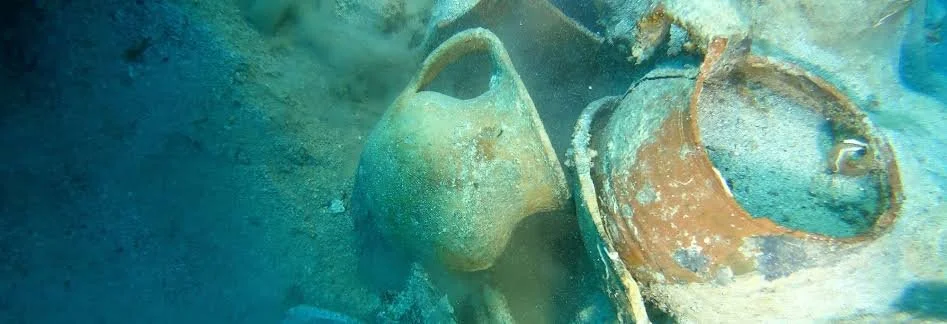
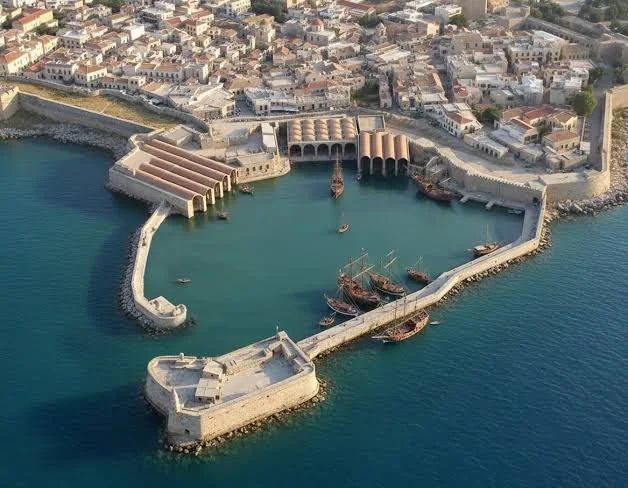
The possibility of submerged Minoan shell-dye vats in a harbor near Heraklion raises important questions about coastal craft production and maritime industry.
A specific underwater installation should not be considered a confirmed Minoan discovery without archaeological documentation. Nevertheless, the subject provides a useful framework for investigating ancient dye production and the relationship between Minoan settlements and coastal resources.
1. Minoan Crete and Maritime Industry
Minoan Crete developed extensive maritime connections during the Bronze Age.
Its settlements were connected through exchange networks involving the Aegean, eastern Mediterranean, and other regions.
Ships transported pottery, metals, agricultural products, textiles, and luxury goods.
Coastal settlements were particularly important because they provided access to maritime resources and transportation routes.
The relationship between craft production and coastal activity is therefore an important subject in the study of Minoan economic organization.
2. The Importance of Purple Dye
Purple dye was a valuable product in many ancient Mediterranean societies.
Its color could be associated with wealth, prestige, religious importance, and political authority.
Unlike many plant-based dyes, marine purple could be produced from certain sea snails.
The production process was labor-intensive, and the resulting dye could be expensive.
Its economic value depended on the quantity and quality of dye produced, the availability of mollusks, and access to skilled workers.
3. The Marine Mollusks Used in Dye Production
Ancient purple dye was commonly produced from marine gastropods belonging to the Muricidae family.
Different species were used in different regions, including members of the genera Hexaplex and Bolinus.
The dye-producing material came from a gland in the animal's body.
Processing required extracting the relevant substance and exposing it to conditions that allowed the color-producing compounds to develop.
The exact methods varied, and ancient recipes were not necessarily identical across different communities.
4. How Ancient Dye Production Worked
The production of marine purple dye involved several stages.
First, suitable mollusks were collected from coastal waters. Their shells were then opened to extract the dye-producing material.
The extracted substance could be processed in containers with other ingredients and exposed to air, sunlight, and controlled conditions.
Textile fibers were treated through repeated immersion or other procedures depending on the intended shade.
The process could generate strong odors and large quantities of shell waste.
These characteristics are important because they can help archaeologists identify possible dye-production areas.
5. Identifying Ancient Dye Vats
Dye vats were containers or installations used to process dye materials.
They might be made from ceramic, stone, or other heat-resistant and chemically suitable materials.
Archaeological indicators could include large vessels with unusual residues, shell concentrations, staining, and associated processing equipment.
A cluster of broken marine shells may suggest industrial activity, but it could also represent food consumption or natural accumulation.
The identification of a dye workshop requires evidence that the shells, vessels, and residues belong to a connected production process.
6. Why Harbor Installations Might Become Submerged
Coastal archaeological remains can become submerged through several geological and environmental processes.
Relative sea-level change, local land subsidence, tectonic movement, erosion, and sediment accumulation can alter the position of ancient shorelines.
An installation originally located near the water's edge might therefore be underwater today.
However, the modern coastline cannot automatically be used to reconstruct the Bronze Age harbor.
Researchers must investigate local geological conditions and reconstruct the historical shoreline using sediment cores, coastal deposits, and dated archaeological structures.
7. Shell Waste and Chemical Evidence
The discarded shells from dye production can provide important archaeological information.
Researchers identify mollusk species and examine breakage patterns that may indicate deliberate opening.
The presence of large concentrations of particular species may suggest organized collection and processing.
Chemical analysis of vessel residues may also identify compounds associated with marine dye production.
However, distinguishing dye-related residues from other organic deposits can be challenging, especially after thousands of years of burial and exposure to seawater.
8. The Organization of Minoan Dye Production
A specialized dye workshop may have required coordinated labor and access to marine resources.
Workers needed knowledge of mollusk collection, extraction techniques, processing conditions, and textile treatment.
The scale of production could range from household activity to larger specialized operations.
Evidence of storage facilities, processing vessels, shell deposits, and textile-related equipment can help establish the economic importance of a workshop.
The presence of a dye installation does not necessarily prove that production was controlled by a palace or centralized authority.
9. Underwater Archaeology and Conservation
Investigating suspected Minoan dye vats in a modern harbor would require careful underwater survey.
Divers could document structural remains, ceramic vessels, shell deposits, and associated artifacts.
Photogrammetry and three-dimensional mapping would preserve the layout of the installation.
Sediment sampling could establish the relationship between the structures and the ancient shoreline.
Marine archaeological materials require specialist conservation because saltwater exposure and changes in temperature can damage pottery, organic remains, and other artifacts after recovery.
Conclusion
Submerged shell-dye installations near Heraklion would provide valuable evidence of Minoan craft production and the economic importance of marine resources.
The production of purple dye required specialized knowledge, significant labor, and access to suitable mollusks. Its remains could reveal how coastal industries were organized and how valuable textiles entered wider exchange networks.
Although a specific group of submerged Minoan dye vats requires archaeological verification, the subject highlights the importance of investigating ancient shorelines and underwater industrial landscapes as part of Crete's Bronze Age history.